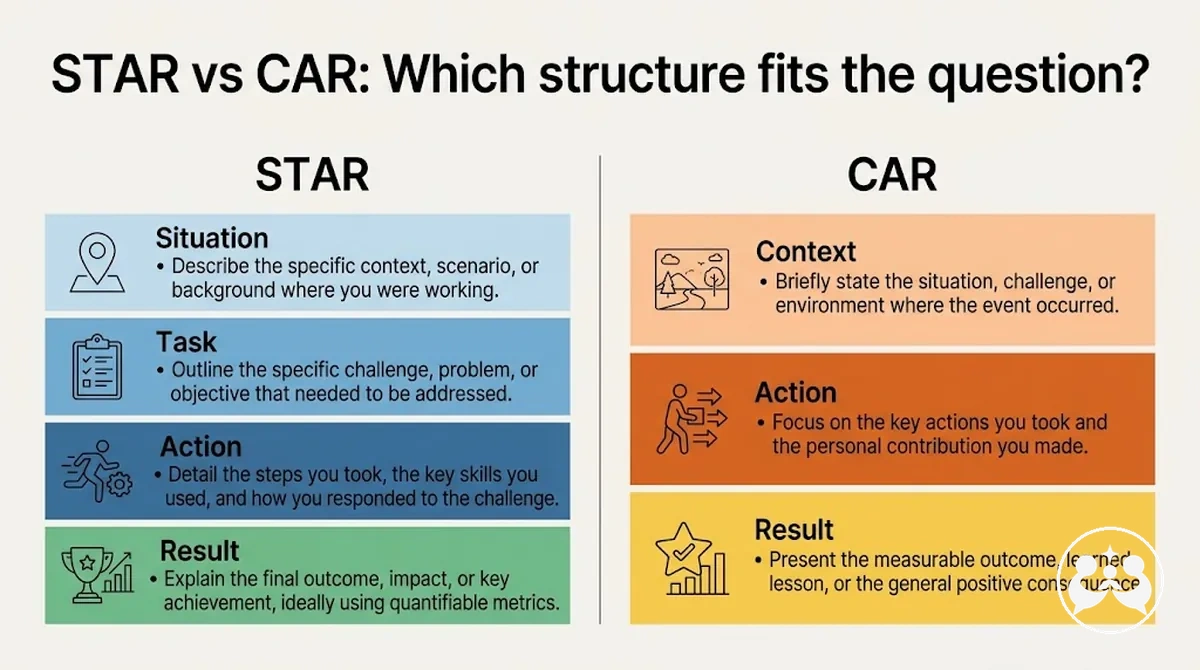
STAR vs CAR Interview Method: Choosing the Right Answer Structure
Use STAR when context and responsibility need to be separated clearly; use CAR when its Challenge (or Context) can carry the necessary setup without making the candidate's role ambiguous. Both methods keep Action and Result as the shared core, so the choice is about clarity and compression rather than one framework being universally better.
STAR or CAR decision guide
Choose the structure by what the interviewer must understand before your Action
Both frameworks can present the same evidence. The deciding question is whether separating the setup makes your responsibility, constraints, or contribution easier to interpret.
Choose STAR when…
Situation → Task → Action → Result
the Situation needs its own context before your responsibility is stated;
your responsibility could be unclear without a separate Task;
relevant constraints materially change how your Action should be understood.
Choose CAR when…
Challenge/Context → Action → Result
the Challenge or Context can carry the necessary setup in one concise opening;
your responsibility remains clear within the Challenge or Action;
extra setup would not change how your contribution or Result is interpreted.
Borderline case: mentally remove the separate Task stage. If responsibility, constraints, or the meaning of the Action becomes less clear, keep STAR; if clarity is unchanged, CAR can compress the setup.
The STAR method stands for Situation, Task, Action, and Result. The CAR method is expressed here as Challenge, Action, and Result; some sources use Context for the C.
Both organise an interview answer around setup, the candidate's Action, and the Result. The main structural distinction is that STAR gives responsibility its own Task stage, whereas CAR compresses more of the setup into its opening stage.
Table of Contents⌄
How STAR and CAR Structure Interview Answers Differ
STAR and CAR both organise an interview example around setup, Action, and Result, but they divide the setup differently.
STAR uses four stages—Situation, Task, Action, and Result—while CAR uses three stages—Challenge, Action, and Result and compresses the setup rather than isolating Task as a separate stage.
Structural function
STAR method
CAR method
Setup
Situation states the relevant context.
Challenge carries the relevant setup into one opening stage.
Responsibility or Task
Task explicitly identifies the candidate's responsibility or objective.
Responsibility can be included within Challenge or made clear as the answer moves into Action.
Action
Action states what the candidate did.
Action states what the candidate did.
Result
Result states the outcome.
Result states the outcome.
Typical level of detail
Situation and Task allow context and responsibility to be stated separately.
The three-stage structure combines more of the context and responsibility within the setup.
STAR's separate Task stage can make ownership more explicit when responsibility is not obvious from the Situation alone.
CAR can absorb that information into the Challenge or Action when the context already makes the candidate's role clear.
CAR is also expanded as Context, Action, Result in some sources, using Context rather than Challenge as the opening label.
This naming variation does not change the local comparison: STAR separates Situation and Task, while CAR uses a three-stage structure with a compressed setup.
STAR Separates Situation, Task, Action, and Result
The STAR method separates an interview answer into Situation, Task, Action, and Result.
Situation establishes the context, while Task identifies the candidate's responsibility or assigned objective before the candidate's Action and the outcome are described.
The four components separate context, responsibility, action, and outcome into distinct functions.
Situation: the circumstances, context, or relevant constraints surrounding the example.
Task: the responsibility or objective the candidate had within that situation.
Action: the candidate action taken to address the task or situation.
Result: the outcome or effect that followed the action.
Separating Situation from Task distinguishes what was happening from what the candidate personally had to do, which can make ownership easier to identify when those details are genuinely distinct.
Candidates who need the broader framework can learn the STAR method without treating this component distinction as a rigid rule for how much detail each part must receive.
CAR Combines the Context Into Challenge, Action, and Result
The CAR method structures an interview answer as Challenge, Action, and Result.
Its setup and responsibility are compressed rather than separated into a standalone Task stage, so responsibility may be carried within the Challenge or made explicit through the candidate's Action.
The three components show the relationship from setup to candidate action to outcome.
Challenge: establishes the relevant setup, including the problem or context needed to understand the candidate's responsibility.
Action: describes the candidate's personal contribution, decision, or response to the challenge.
Result: states the outcome or consequence that followed the action.
Some sources use Context rather than Challenge for the C in CAR; both terms serve a similar setup function before Action and Result.
The structure can remain concise when that compressed setup still provides enough context and responsibility for the Action and Result to make sense.
The Main Trade-Offs Between STAR and CAR
The main STAR and CAR trade-off is explicit setup versus compression, not quality versus weakness.
STAR can make context and responsibility more explicit, while CAR can support brevity and focus when a compressed setup still gives the interviewer enough information to understand the candidate's role, Action, and Result.
Each row compares the same structural attribute across both methods and shows how it can help or hinder clarity depending on what the interview question requires.
Trade-off dimension
STAR
CAR
Setup and context
Separates more of the setup, which can clarify relevant context and constraints when they affect how the example is understood.
Compresses the setup, which can improve focus when omitted detail does not change how the example is understood.
Responsibility
A separate Task stage makes responsibility and ownership explicit when the candidate's role could otherwise be unclear.
Responsibility can be carried within the setup or Action, which keeps the structure concise when ownership remains clear.
Brevity and focus
Additional structural separation can support clarity, but unnecessary setup can lead to over-explaining when the extra detail does not affect the story.
Compression can support brevity and focus, but excessive compression can lead to under-explaining when relevant context or responsibility is omitted.
Action visibility
Action remains a distinct stage and can be interpreted against separately stated context and responsibility.
Action remains a distinct stage and may also carry responsibility that was not separately stated in the setup.
Result visibility
Result remains a distinct ending stage for the outcome.
Result remains a distinct ending stage for the outcome.
The useful level of structure depends on what the interviewer needs to understand from the example.
More explicit context and responsibility can improve clarity when those details affect interpretation, while compression can improve focus when the same understanding is retained without separating them into additional stages.
STAR Provides More Context but Can Become Too Detailed
STAR detail is useful when the Situation and Task add context that changes how the candidate's responsibility, constraints, Action, or Result are understood.
When extra background no longer changes that interpretation, it lengthens the setup and may obscure the focus on what the candidate did and what followed.
Relevance test for STAR setup
Keep the detail
Retain context that explains a meaningful constraint, clarifies ownership, or changes how the Action or Result should be interpreted.
Compress the detail
Shorten background that extends the preamble but does not change the understanding of responsibility, constraints, Action, or Result.
There is no fixed amount of Situation or Task detail that marks the boundary; keep setup when it changes understanding and compress it when it does not.
CAR Keeps Answers Concise but Can Leave Out Useful Detail
CAR compression can keep an interview answer concise and focused on Action and Result when the Challenge still provides enough context to understand the candidate's responsibility and relevant constraints.
If that setup omits information that changes how the difficulty, ownership, or personal contribution is interpreted, the answer can become ambiguous rather than simply more focused.
How to Choose STAR or CAR for an Interview Question
Choose STAR when the question requires separate context and responsibility to make the answer clear, especially when a distinct Situation and Task help explain what the candidate was responsible for.
Choose CAR when the Challenge already provides enough setup to move clearly into Action and Result without a separate Task.
The main criteria are context complexity, responsibility ambiguity, relevant constraints, and setup burden.
Decision path
If the context is complex enough that the Action requires fuller setup, use STAR to separate Situation and Task.
If responsibility would be ambiguous without a separate Task, use STAR to make that responsibility explicit.
If constraints are necessary to interpret the Action, keep them explicit; use STAR when separating them from responsibility improves clarity.
If the Challenge can state the necessary context, responsibility, and constraints clearly without a separate Task, CAR can move directly from that compressed setup to Action and Result.
Borderline cases should be decided by whether compression changes how the candidate's responsibility, Action, or Result is understood, rather than by a rule for the question category.
To match methods to question types, treat question classification as a separate boundary; within this comparison, choose the structure that preserves clarity without unnecessary setup.
Use STAR When the Question Needs Clear Context and Responsibility
STAR is a stronger fit when the interviewer needs explicit context and a separate statement of responsibility before interpreting the candidate's Action.
Separating the Situation from the Task can clarify what was happening, what the candidate owned, and how their personal contribution relates to the outcome.
Separate context and responsibility carry information value when the setup would otherwise leave the candidate's role unclear.
Context complexity or multiple constraints can make fuller setup useful because those details affect how the Action is interpreted.
A distinct Task can make responsibility and ownership visible when combining them with the Situation would create role ambiguity.
STAR is therefore a fit when this separation improves clarity, not merely because a question is behavioural.
Complex context: fuller setup can clarify the Situation when several circumstances affect how the Action should be understood.
Distinct responsibility: a separate Task can clarify what the candidate personally owned when responsibility is not obvious from the context.
Multiple constraints: keeping relevant constraints explicit can show what shaped the candidate's choices without obscuring the Action.
Role ambiguity: separating Task from context may reduce ambiguity when the candidate's personal contribution would otherwise be difficult to identify.
Use CAR When a Shorter Challenge-to-Result Story Is Enough
CAR is a good fit when the Challenge can provide enough context for the candidate's responsibility to remain clear without a separate Task stage.
In that situation, the answer can move into Action and Result with a concise setup while preserving clarity about the candidate's contribution.
A separate Task stage adds little information when the context is self-explanatory, responsibility is already clear, and the problem leads straightforwardly into the candidate's Action.
CAR compresses that setup when doing so preserves the information needed to interpret the contribution and Result, which can support tighter focus.
If compression makes responsibility, relevant context, or the meaning of the Action ambiguous, more context should be restored.
Self-explanatory context: the Challenge can remain concise when it already provides the setup needed to understand the problem.
Clear responsibility: a separate Task adds little information when ownership is explicit in the Challenge or becomes clear through the Action.
Straightforward problem-to-action logic: compressed setup fits when the connection between the Challenge and personal contribution remains clear.
Tighter focus: CAR can keep attention on Action and Result when additional setup would not change how the candidate's responsibility or outcome is interpreted.
STAR and CAR Applied to the Same Behavioural Interview Question
Consider the behavioural interview question: “Tell me about a time you had to improve a process during an internship.”
Same evidence in both versions
An intern noticed repeated manual data entry in weekly reporting, was responsible for improving the process, created a reusable spreadsheet template, and reduced repeated entry while preserving the required report information. Only the answer structure changes.
STAR version
Situation
During an internship, the team prepared a weekly report by repeatedly entering the same categories of information into a spreadsheet.
Task
I was responsible for finding a practical way to reduce the repeated manual work without changing the information the team needed.
Action
I created a reusable spreadsheet template with the recurring fields and formulas already structured, then checked it against the existing reporting process before the team used it.
Result
The team completed the same weekly reporting task with less repeated manual entry while retaining the information required for the report.
CAR version
Challenge
During my internship, weekly reporting involved repeated manual data entry, and I was responsible for finding a practical way to reduce that work without changing the information the team needed.
Action
I created a reusable spreadsheet template with the recurring fields and formulas already structured, then checked it against the existing reporting process before the team used it.
Result
The team completed the same weekly reporting task with less repeated manual entry while retaining the information required for the report.
The STAR version separates context and responsibility into Situation and Task, while the CAR version compresses the same facts into the Challenge. In both versions, Action and Result remain substantively the same, so the comparison isolates structural packaging rather than different evidence.
Neither version is inherently better. STAR can be easier to follow when responsibility needs to be explicit before the Action is interpreted; CAR can be easier to follow when the combined Challenge already provides enough context. The more suitable structure depends on how much setup the interviewer needs to understand the candidate's Action and Result.