
How to Use the STAR Method in Internship Interviews
The STAR method organises a relevant past experience into Situation, Task, Action, and Result. In an internship interview, use it mainly for behavioural questions that ask what you did in a real situation: keep the context and responsibility concise, make your personal Action explicit, and finish with an accurate outcome or learning.
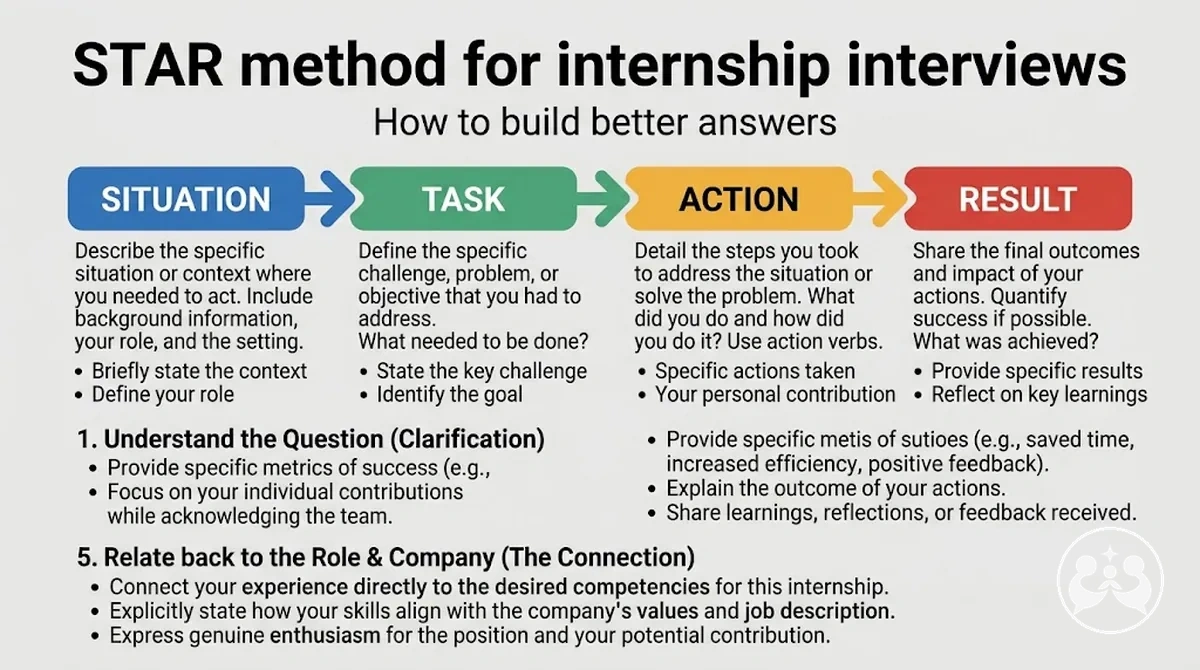
STAR answer blueprint
Build one connected example rather than four disconnected labels. Each stage should make the next stage easier to interpret.
-
Situation What relevant context does the interviewer need?
Give only the setting, timing, people, or constraint needed to understand the responsibility.
-
Task What were you responsible for?
Define your goal, problem, or remit and separate it from the wider team objective.
-
Action What did you personally do, decide, or change?
Use specific first-person evidence and explain reasoning when it clarifies an important choice.
-
Result What happened after your Action?
State an accurate measurable, qualitative, or learning outcome and keep the connection to your contribution clear.
- Use STAR when
- the prompt asks for a specific past example or demonstrated behaviour.
- Evidence can come from
- work, study, projects, volunteering, or extracurricular activities.
- Give most detail to
- Action and Result, after Situation and Task are clear enough to understand the example.
- Final check
- the same skill runs through the example, your ownership is clear, and the Result follows logically from the Action.
Table of Contents
How the STAR Method Structures an Interview Answer
The STAR method structure assigns a different informational function to Situation, Task, Action, and Result, while keeping all four stages connected as one evidence sequence.
Situation establishes the relevant context, Task identifies the candidate's responsibility, Action explains the candidate's behaviour or contribution, and Result states the outcome.
This response structure turns a past experience into a progression from background to responsibility, personal action, and evidence of what followed.
The STAR sequence organises the evidence chain in a four-stage order so each stage answers a different informational need: context, responsibility, action, or outcome.
The sequence moves from the circumstances of the experience to what the candidate needed to do, what the candidate did, and what happened as a result.
- Situation: Establish the relevant context or background so the interviewer can understand the circumstances that matter; this provides the setting for the Task.
- Task: Define your responsibility, goal, or relevant constraint within that Situation; this establishes what you needed to address before describing your Action.
- Action: Explain the decisions, behaviour, or personal contribution you made in response to the Task; this supplies the evidence that connects your conduct with the Result.
- Result: State the outcome that followed from the Action and, where relevant, what you learned from the experience; this completes the sequence by showing what happened after your contribution.
The four stages should describe the same experience rather than operate as isolated labels.
Context establishes why the responsibility mattered, the responsibility gives the action a purpose, and the action gives the outcome an identifiable connection to what the candidate did.
This continuity makes the evidence easier to follow from the beginning of the example to its result.
STAR is a specific framework for organising example-based evidence, while broader guidance on how to understand strong answer structure can apply beyond this four-part sequence.
Within a STAR answer, causal and narrative coherence matters: the Result should follow logically from the Action described rather than appear as an unsupported ending.
The accompanying illustration focuses on how responsibility and personal contribution connect within the STAR sequence, complementing the ordered stages by showing how the candidate's role carries through the response.

Situation: Set the Relevant Context
The Situation is the minimum relevant context the interviewer needs to understand where, when, and under what circumstances the example occurred.
It establishes the setting without turning the response into a detailed account of what happened beforehand.
A relevant detail belongs in the Situation when it helps explain the responsibility, constraint, or problem state that made the example meaningful.
Include the setting and timing, the people involved when their roles affect the Situation, and any constraint or problem state the interviewer needs to interpret the example.
Necessary context might be that you were completing a university group project with a deadline and a specific responsibility; excess background would be unrelated course history or chronology that does not change the meaning of that responsibility.
The accompanying illustration highlights essential context and visually de-emphasises excess background so the relevance boundary is easier to recognise.
Keeping the background limited to details that affect the responsibility makes the task easier for the interviewer to understand.

Task: Define Your Responsibility or Goal
The Task identifies the candidate's specific responsibility, objective, or problem to solve within the example.
It defines the role the candidate was responsible for carrying out and the goal that responsibility was meant to address.
The Task should make the candidate's own remit clear rather than leaving responsibility at the level of the wider team.
A team objective might be to complete a group project by its deadline, while the candidate's own Task could be to coordinate one assigned part of that project.
A constraint belongs in the Task when it shaped the responsibility or limited what the candidate was expected to accomplish, such as a fixed deadline or defined scope.
The accompanying illustration distinguishes the wider team goal from the candidate's personal role and relevant constraint, making the responsibility boundary easier to see.
Fix the candidate's responsibility and expected objective clearly before describing how it was addressed.

Action: Explain What You Did
The Action should explain what the candidate personally did and why those choices mattered within the example.
This is where specific first-person evidence makes the candidate's contribution distinct from the team's wider activity.
A clear Action connects the candidate's behaviour and skill to a decision, response, or intervention rather than simply naming a skill.
Describe the steps taken with specific verbs, then connect each important decision to the reasoning behind it.
Explain why you chose one approach, how you prioritised what to do, or how you adapted when circumstances changed, but only where that reasoning clarifies your contribution.
Keep ownership accurate when other people were involved: identify your own behaviour without claiming responsibility for work completed by the whole team.
The accompanying illustration organises representative candidate-owned actions with brief reasoning cues, making first-person evidence easier to distinguish from the responsibility defined in Task and the outcome reserved for Result.

Result: Show the Outcome of Your Actions
The Result shows what changed, what was learned, or what followed after the candidate's actions.
It closes the STAR evidence chain by connecting the outcome to the candidate's contribution and showing the impact or consequence of that contribution.
A Result does not require a perfect outcome; the evidence should reflect what actually happened and remain relevant to the skill being demonstrated.
A Result can use different forms of evidence, and a measurable result is appropriate when the metric is accurate and genuinely known.
Qualitative change and learning or follow-up can also provide relevant evidence when an example does not have a meaningful numerical outcome.
The accompanying illustration organises these evidence forms without ranking them, showing how each can connect the candidate's actions to an interpretable outcome.
Choose the outcome type that most clearly shows the implication of the candidate's actions for the skill the interviewer is assessing rather than adding unrelated achievements.

- Measurable outcome: State an accurate, known change such as a count, percentage, time, or other relevant metric when the experience genuinely produced measurable evidence.
- Qualitative outcome: Describe a specific non-numerical change, such as completing the intended work, resolving an issue, improving a process, or receiving relevant feedback, without inventing a metric.
- Learning outcome: Explain what you learned from a setback or imperfect outcome and any relevant follow-up or improvement that occurred afterward.
When the STAR Method Fits an Internship Interview Question
The STAR method is most suitable when an interviewer asks for a specific example of past behaviour, past experience, or a demonstrated skill.
A behavioural question such as “tell me about a time” asks for evidence of what you did in a real situation, which gives STAR a clear fit.
Not every interview prompt needs STAR, so suitability depends on whether the question is asking you to explain a relevant past example.
Prompt wording provides the first clue: requests to describe a time, situation, challenge, conflict, decision, or achievement can signal that the interviewer wants example-based evidence.
The following groups classify question fit rather than rank question types, separating prompts that naturally support STAR from prompts that usually need another response style.
Strong STAR fit
Tell me about a time...
prompts that explicitly request a past experience.- Requests to describe a past situation, challenge, conflict, decision, mistake, or achievement and explain what you did.
- Behavioural prompts asking for evidence of a skill or competency through a specific example.
Usually another structure
- Simple factual questions that ask for information rather than evidence from a past example.
- Motivational questions about why you want the internship or why the role interests you when no past example is requested.
- Purely hypothetical prompts about what you would do in a future situation when past experience is not requested.
The key relation is prompt wording → evidence requested → STAR suitability.
If the wording asks what you did in a previous situation, the interviewer is seeking evidence of behaviour, action, and result from that experience, so STAR can organise the answer around a concrete example.
If the prompt instead asks for a fact, motivation, opinion, or purely hypothetical response, forcing a past-example structure may not answer the question directly.
The accompanying illustration highlights the relationship between question cues and the evidence requested, helping show when a past-example framework fits without duplicating the criteria groups.

A situational question may use scenario-based or hypothetical wording rather than request evidence of past behaviour, although individual prompts can combine elements of both types.
Learning to identify behavioural interview questions helps clarify that boundary without assuming that similar wording always requires the same response framework.
STAR is a response framework for organising relevant example-based evidence, not a requirement to force every answer into four visibly labelled parts.
Questions that call for another structure should be answered according to what they actually ask, and you can compare STAR with CAR when considering how different example-based frameworks organise an answer.
How to Build a STAR Answer From Your Own Experience
Building a STAR answer starts by identifying the skill or behaviour the question requirement is testing, then selecting a relevant experience that provides evidence of that competency.
The experience can come from work, study, volunteering, or another setting where your own contribution is clear.
Before drafting Situation, Task, Action, and Result, confirm that the example gives you enough specific evidence to answer the question rather than merely being an interesting experience.
Turn the raw experience into focused interview evidence in sequence, moving from the question requirement to a relevant example and then to a coherent STAR response.
Each step should narrow or clarify the material before you refine the complete answer.
- Identify the skill: Determine the competency or behaviour the question is asking you to demonstrate so the answer has a clear evidence target.
- Select a relevant experience: Choose a real example in which that skill affected what you were responsible for, what you did, or what happened.
- Frame Situation and Task: Establish only the context needed to understand the example, then define the responsibility, objective, or problem you needed to address.
- Draft Action and Result: State your personal contribution with specific actions, then connect those actions to the outcome, learning, or follow-up that actually occurred.
- Check and refine: Test the complete sequence for relevance and clarity, then cut details that do not help demonstrate the targeted skill.
The completed sequence should read as one connected piece of evidence rather than four independent statements.
For example, a raw experience such as “I worked on a university group project” is too broad to show a competency by itself.
If the question tests problem solving, narrow the same experience to the specific project problem you faced, your responsibility, the action you personally took to address it, and the result or learning that followed.
Building a STAR answer is a focused answer-construction process rather than a substitute for broader work to prepare for an internship interview.
Draft the evidence and practise expressing it conversationally instead of relying on fixed wording, so you can adapt the same relevant experience to the question requirement without reciting a memorised response.
Choose an Example That Matches the Skill Being Tested
Choose the example that provides the clearest relevant evidence of the specific skill or competency being tested.
Direct relevance matters more than the scale or apparent prestige of an experience because the interviewer needs evidence of the behaviour named or implied by the question.
A suitable example should also make your personal contribution clear enough to connect what you did with the challenge and outcome.
Compare possible experiences by evidence strength rather than by prestige or scale.
Apply the criteria in decision order, starting with the example's direct match to the competency because weaker relevance reduces its suitability even when the experience itself sounds significant.
- Competency relevance: Prefer an experience in which your behaviour directly demonstrates the skill the question is testing, rather than one connected only loosely to the same topic.
- Personal ownership: Choose an example where your personal contribution can be isolated from the wider team's work, giving the interviewer clear evidence of what you did.
- Meaningful challenge: Prefer an experience with a clear problem, constraint, responsibility, or decision that gives your behaviour a reason and context.
- Interpretable outcome: Choose an example where what followed from your contribution can be explained as an identifiable outcome, learning point, or relevant change.
For example, a modest university project in which you personally resolved a disagreement may provide stronger evidence for a teamwork competency than a larger event where your individual contribution is unclear.
The first experience has greater suitability when its relevance, personal ownership, challenge, and outcome make the targeted skill easier to demonstrate.
Use Study, Project, Volunteer, or Extracurricular Examples When Work Experience Is Limited
Limited work experience does not prevent you from building a STAR answer when a real study, project, volunteering, or extracurricular experience demonstrates the skill being tested.
The example should contain a clear responsibility or challenge, a specific action you took, and an outcome that provides relevant evidence.
The source of the experience matters less than whether your contribution and the demonstrated skill are clear.
Look for non-work situations where you had genuine responsibility and can explain what you personally did.
These four sources can provide useful evidence when they are relevant to the interview question:
- Study: Coursework, presentations, or group assignments can show skills such as analysis, communication, organisation, or teamwork when your responsibility and contribution are identifiable.
- Projects: A student or personal project can demonstrate problem solving, planning, initiative, or technical skill when you can describe a meaningful challenge, your action, and what followed.
- Volunteering: A community experience can provide evidence of communication, reliability, leadership, or collaboration when you held a real responsibility and can explain your contribution.
- Extracurricular: Clubs, societies, sports, or other organised activities can demonstrate relevant behaviour when a specific situation required you to act, make a decision, or contribute toward an outcome.
A credible non-work STAR example connects the experience to a defined responsibility or challenge, then identifies the candidate's action and the outcome that followed.
Keep the scope truthful: if responsibility was shared, describe your own contribution without presenting the team's work as entirely yours.
A concrete situation with observable behaviour usually provides stronger evidence than a broad activity description or a hypothetical story.
This section focuses on identifying usable non-work experiences rather than covering the wider problem of interviewing without a substantial employment history.
You can adapt STAR when you have little experience while still keeping each example grounded in what you actually did and the level of responsibility you genuinely held.
Keep the Example Focused on Your Own Contribution
In a team example, your personal contribution should remain identifiable so the interviewer can understand the decisions and actions you personally took.
The shared team context can establish what was happening, but the Action should make your individual responsibility, decision, and contribution recoverable from the answer.
Use first-person wording where it accurately describes your work, while acknowledging collaboration when other people materially contributed to the outcome.
Start with the team's shared goal or challenge, then identify the individual responsibility you held within that context.
Explain the specific action or decision you made and connect it to your contribution to the shared outcome, without claiming ownership of work performed by teammates.
This preserves the collaboration while giving the interviewer evidence from which to infer the skill demonstrated by your own behaviour.
The wording should reveal ownership accurately rather than merely change pronouns.
A STAR Answer Example for an Internship Interview
This worked example answers the prompt Tell me about a time you solved a problem while working with others.
It demonstrates problem-solving competency and shows how Situation, Task, Action, and Result can form one connected piece of evidence rather than wording to copy.
- Situation
During a university group project, our team discovered shortly before the deadline that two sections of the presentation covered the same material while an important part of the brief was missing.
- Task
I was responsible for coordinating the final presentation, so I needed to help resolve the overlap and make sure the missing requirement was addressed without taking over my teammates' work.
- Action
I compared our draft against the assignment brief, identified which content was duplicated, and suggested redistributing the remaining work according to what each person had already researched. I then rewrote my assigned section, updated our shared outline so everyone could see the revised structure, and checked with the team that the missing requirement had been covered.
- Result
We completed the revised presentation by the deadline with each required area represented, and I learned that checking work against the original requirements can expose gaps that are difficult to notice when each section is reviewed separately.
The example is relevant because the prompt asks for problem-solving evidence and the scenario contains a specific problem that required a response.
Personal contribution remains identifiable through the candidate's comparison, decision, revision, and coordination actions while the team's collaboration is still acknowledged.
The sequence also preserves causal continuity: the Situation establishes the problem, the Task defines responsibility, the Action shows what the candidate did and the reasoning behind the response, and the Result gives an observable outcome and learning point.
That connection makes the demonstrated competency interpretable without relying on invented metrics or exaggerated ownership.
How to Keep a STAR Answer Concise and Well-Balanced
A concise STAR answer keeps each part relevant to the interview question while preserving the evidence needed to understand the candidate's contribution and outcome.
Situation and Task should provide enough background and responsibility to make the example clear, while Action and Result should retain the specific evidence that shows what the candidate did and what followed.
STAR answer balance is therefore about allocating detail according to each part's function rather than making every part the same length.
The appropriate level of detail can change with question complexity and interview format.
Four optimisation criteria can guide refinement without imposing a rigid score.
Use them to identify low-value detail while protecting the information that makes the response clear and evidentially useful.
- Relevance: Keep details that help answer the question or establish the competency being demonstrated, and remove background that does not change how the example is understood.
- Proportionality: Keep Situation and Task economical when the context is straightforward, leaving sufficient space for Action and Result when those parts carry more of the evidence.
- Specificity: Make the Action specific enough to identify the candidate's decisions, behaviour, reasoning, and personal contribution rather than replacing them with broad descriptions of team activity.
- Outcome clarity: State a Result that makes the outcome, learning, or relevant change interpretable and connected to the preceding Action.
When revising a completed response, trim setup before removing evidence that explains the Action or Result.
More context may still be necessary when the question, interview format, or complexity of the example requires it, so the goal is a proportionate and focused response rather than brevity by itself.
How Long a STAR Answer Should Be
There is no single universal duration for a STAR answer; appropriate answer length depends on the question, interviewer instructions, and the evidence needed to demonstrate the relevant competency.
Do not force a universal speaking time onto every STAR answer. Follow any explicit interviewer time limit; otherwise, use only the detail needed to make the Situation, Task, Action, and Result clear and relevant.
A concise response should be long enough to establish the Situation and Task, explain the Action, and make the Result understandable without retaining detail that does not help answer the question.
The appropriate duration changes with the interview conditions and the complexity of the evidence being presented.
Use these criteria to decide whether to shorten or expand the response while keeping it focused:
- Interviewer instructions: Follow an explicit time constraint or response instruction when the interviewer provides one, and adjust the amount of detail to fit that condition.
- Question complexity: A straightforward example may need less context, while a more complex question may require additional detail to make the responsibility, decision, or reasoning understandable.
- Available time: Consider the available time in the interview and the need to leave room for other questions or follow-up discussion rather than treating one recommended speaking time as a fixed limit.
- Evidence needed: Preserve enough evidence to show the candidate's personal contribution and outcome; reducing duration should not remove the Action or Result details that make the example meaningful.
To shorten an answer, compress background and setup before removing evidence from the Action or Result.
To expand it, add only the detail needed to clarify the situation, responsibility, reasoning, contribution, or outcome while preserving the same Situation–Task–Action–Result structure.
Give More Detail to Action and Result Than to Background
Action and Result generally deserve greater emphasis in a STAR answer once the Situation and Task provide enough background to understand the context and responsibility.
Action carries evidence of the candidate's decisions, behaviour, personal contribution, and reasoning, while Result shows the outcome or implication of those actions.
Situation and Task still need sufficient detail for comprehension, but additional background has lower informational value once the interviewer can understand why the candidate needed to act.
Good balance therefore gives more answer space to the evidence-bearing parts when the example supports that emphasis.
If the Situation or Task is unusually complex, retain the context needed to make the later evidence interpretable rather than cutting essential information merely to lengthen Action or Result.
Common STAR Method Mistakes That Weaken Internship Answers
STAR method mistakes weaken an internship answer when they reduce relevance, obscure personal contribution, leave reasoning unclear, or make the Result difficult to support.
These problems affect the quality of the evidence even when the candidate has chosen a potentially useful experience.
An overlong background can crowd out the parts that demonstrate behaviour and outcome, while a vague example can leave the interviewer without enough specific evidence to interpret the competency.
The correction is to preserve necessary context while making ownership, decisions, reasoning, and outcomes explicit.
The following patterns diagnose STAR-specific problems by linking each mistake to its consequence, recognition cue, and correction.
They focus on evidence quality and answer balance rather than broader interview behaviour.
- Overlong background: Consequence: Excessive Situation or Task detail leaves less space for evidence from the Action and Result. Recognition cue: Much of the answer explains what happened before the candidate acted, while the actual response and outcome are rushed. Correction: Keep only the background needed to understand the responsibility or problem, then move to the candidate's actions and outcome.
- Vague example: Consequence: Broad statements make the competency difficult to infer because the answer lacks a specific situation, behaviour, or outcome. Recognition cue: The response describes what usually happened or what the team generally did rather than one identifiable experience. Correction: Anchor the answer in a concrete event with a defined responsibility, specific Action, and identifiable Result.
- Unclear personal contribution: Consequence: Repeated team-centred language can prevent the interviewer from distinguishing the candidate's evidence from the group's work. Recognition cue: The answer repeatedly says what “we” did without identifying the candidate's own decision or contribution. Correction: State the candidate's individual responsibility and actions accurately while acknowledging the work completed by others.
- Action without reasoning: Consequence: Listing actions without explaining important choices can show activity without making the candidate's decision-making clear. Recognition cue: The Action describes several things the candidate did but does not explain why a significant approach was chosen or adjusted. Correction: Add concise reasoning where it clarifies an important decision, priority, or adaptation rather than explaining every minor step.
- Weak Result: Consequence: An unclear ending leaves the interviewer without interpretable evidence of what followed from the candidate's contribution. Recognition cue: The answer stops after the Action or closes with a broad statement such as “it went well” without identifying the outcome. Correction: State the observable outcome, relevant change, learning, or follow-up that actually occurred and connect it to the preceding actions.
- Unsupported Result: Consequence: An exaggerated or invented outcome weakens the credibility of the evidence and breaks the connection between Action and Result. Recognition cue: The answer claims an achievement, metric, or impact that the candidate cannot substantiate from the experience. Correction: Use only outcomes the candidate genuinely knows, and use qualitative evidence or learning when no meaningful metric exists.
Effective correction keeps the same experience but improves how its evidence is allocated and connected.
Reduce low-value setup, make the personal contribution recoverable, explain reasoning when it clarifies a meaningful decision, and ensure the Result follows logically from the Action.
A stronger STAR response does not need more detail everywhere; it needs enough relevant detail for the interviewer to follow the context, behaviour, and outcome as one coherent evidence chain.