
Common Internship Interview Questions and How to Prepare Your Answers
Common internship interview questions usually assess four broad areas: your background and direction, motivation for the internship and organisation, relevant skills and evidence, and how you handle teamwork or unfamiliar situations. Prepare adaptable answers by identifying what each question is likely assessing, choosing a specific example or fact, and linking it to the internship rather than memorising a fixed script.
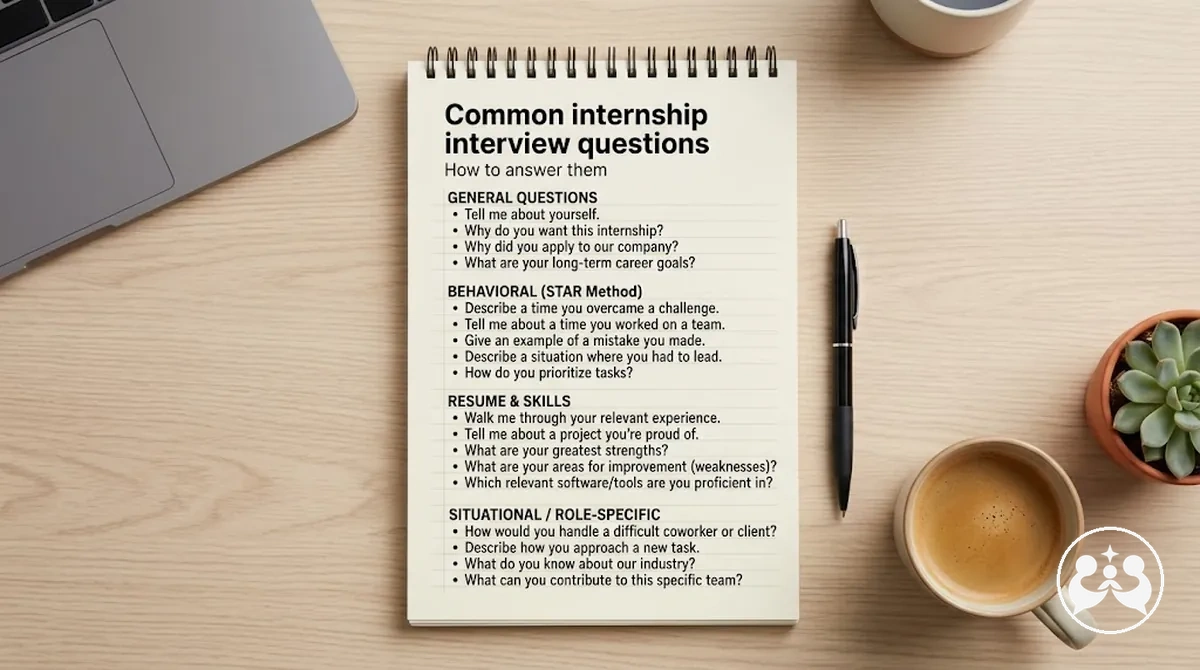
Internship interview answer planner
Use the question family to identify the likely assessment focus, then choose evidence that supports it and make the internship connection explicit. The focus is a preparation guide, not a guarantee of an interviewer’s exact intent.
Background & direction
- Likely focus
- Current study, relevant experience or interests, and career direction.
- Useful evidence
- Coursework, projects, activities, volunteering or work that genuinely relates to the role.
- Make the link
- Explain why the internship is a logical next step without turning the answer into a life story.
Motivation
- Likely focus
- Why this internship, this organisation, and this learning opportunity matter to you.
- Useful evidence
- A specific responsibility, a verifiable company fact, and a relevant interest or development goal.
- Make the link
- Balance what you hope to learn with a realistic contribution you can already make.
Skills & fit
- Likely focus
- A capability that relates to a stated or reasonably implied role requirement.
- Useful evidence
- A concrete task, responsibility or result that demonstrates the capability.
- Make the link
- Show how the underlying skill may transfer to the internship rather than relying on adjectives alone.
Teamwork & situations
- Likely focus
- Collaboration, problem solving or judgement in a relevant situation.
- Useful evidence
- A real past example for a behavioural question; a reasoned response for a hypothetical situational question.
- Make the link
- Keep your own action, reasoning and result clear, including when guidance would be appropriate.
Use the same evidence differently when the assessment focus changes; do not force one rehearsed story into every question.
Effective answer preparation starts with the question purpose. Select relevant evidence from study, projects, activities, volunteering, previous experience or other suitable situations, decide what that evidence demonstrates, and make its relevance to the role explicit.
Because employers can phrase similar assessment needs in different ways, prepare reusable evidence and connections instead of a script for every wording. For a background question, for example, choose the education or experience most relevant to the role, explain what it demonstrates, and connect it to the internship.
Background, education, and career direction form the first major question family to prepare.
Table of Contents
Questions About Your Background, Education, and Career Goals
Questions about a candidate's background, education, and career goals help establish what the student is studying, the experience and interests shaping their current direction, and what they hope to pursue.
These dimensions give the interviewer context for understanding how the candidate's course or major, present interests, and career direction relate to the internship.

Background evidence at a glance
- Evidence sources
- Study, projects, activities, volunteering or work can all support a credible answer; formal employment is not required.
- Selection rule
- Choose education or experience because it supports internship relevance, not simply because the detail is available.
- Interests
- Use genuine interests to clarify your present direction and the work or capabilities you want to explore.
- Career direction
- Explain how the internship may contribute to that direction while allowing your goals to evolve with experience.
Together, these attributes provide the context needed for a focused first-person introduction.
Tell Me About Yourself
A focused professional introduction should connect the candidate's current study or focus, one relevant experience or interest, and the reason the internship is a logical next step.
Select details for their relevance to the role rather than giving an extended personal history.

For example, a student studying marketing might briefly summarise their current study, mention an interest in audience research developed through a relevant university project, and connect that experience to the internship.
The specific details can vary by candidate and role, but the background summary should stay focused on information that supports internship relevance rather than becoming a biography.
Why Did You Choose Your Course or Major?
A strong answer should explain the genuine reason for your course or major choice and connect that academic choice to a relevant interest, skill, or present career direction.
Focus on what attracted you to the field of study and what the course helped you develop rather than forcing a direct link to the internship.

For example, a student may have chosen a communications major because of an interest in how people understand information, then developed research and presentation skills through coursework that now support internship relevance.
If the connection is indirect, explain the transferable learning or later-developed interest honestly and show how it influenced your current direction rather than presenting the course as part of a predetermined career path.
What Are Your Career Goals?
A realistic career goal gives a credible near-term direction, such as developing a particular capability or exploring a field, and explains how the internship may contribute to that direction.
For a student who is still exploring, the goal can remain flexible as long as it identifies a meaningful area for skill development and treats the internship as a learning opportunity.

For example, a student interested in marketing might aim to develop practical research and communication skills while exploring which roles in the field suit their interests, rather than naming one fixed future position.
The internship may provide relevant learning and experience that contributes to this career direction, while the professional goal can evolve as the student gains more information about the field.
Questions About the Internship and Your Motivation
Internship motivation questions assess whether a candidate can give specific reasons for wanting the internship and the organisation, rather than relying on general enthusiasm.
A strong response connects motivation to relevant responsibilities, the company context, and what makes the opportunity meaningful to the candidate.

These questions separate three related dimensions of internship motivation.
Each reason should be specific enough to show its relevance to the opportunity without relying on flattery or unsupported claims about the company.
- Role interest: connect specific internship responsibilities to work, tasks, or capabilities the candidate genuinely wants to explore or develop.
- Company interest: identify a relevant and verifiable aspect of the organisation and explain why it matters to the candidate.
- Learning expectations: describe plausible learning goals or development areas that the internship may support without assuming a particular outcome.
Answering these motivation questions is separate from deciding what to ask at the end of the interview; candidates can prepare questions for the interviewer as a distinct preparation task.
For motivation answers, specificity about the role, organisation, and learning opportunity is more informative than enthusiasm alone.
Why Do You Want This Internship?
A strong answer gives a specific reason for wanting the internship and connects that reason to the candidate's genuine interest, relevant skills, or development goals.
The reason should relate to the role's responsibilities or learning exposure rather than a generic desire to gain experience.

Relevant evidence can come from coursework, projects, activities, or previous experience that relates to the internship.
Balancing what the candidate hopes to learn with a realistic contribution makes the connection between the opportunity, current skills, and development goals explicit without implying guaranteed fit or future performance.
Why Do You Want to Work With This Company?
A strong answer identifies a specific, verifiable fact about the company, such as an activity, project, service, or area of focus, and explains why that organisation attribute matters to the candidate interest behind the internship.
The reason should connect the fact to the role rather than rely on generic compliments.
The company attribute provides evidence for the motivation, while the candidate's explanation establishes its relevance to the internship.
For a less well-known organisation, one modest and accurate reason connected to the role is sufficient; exaggerated enthusiasm or unsupported claims are unnecessary.
What Do You Know About the Company?
Fact-to-relevance answer path
- State the core activity.Explain what the organisation does using an accurate main service, industry focus or role-relevant area of work.
- Add one current, verifiable fact.Use a specific activity, project, service or area of focus that helps explain the internship; avoid unverified details.
- Explain its relevance.Say what the fact reveals about the role context or work you may encounter. Keep the answer focused rather than turning it into a company profile, trivia list or research tutorial.
What Do You Hope to Learn From the Internship?
A strong answer names one or two specific capabilities or types of experience the candidate hopes to learn or develop through the internship.
The learning goal should reflect the candidate's current starting point and connect to plausible exposure in the role rather than assume a guaranteed training outcome.
The answer should explain why the internship could reasonably support that development aim while acknowledging that available learning opportunities may vary by employer and role.
Framing the goal around a specific capability, relevant experience, and realistic contribution creates a balanced connection between learning and what the candidate can already bring.
Questions About Your Skills, Experience, and Fit
Skills, experience, and fit questions ask candidates to connect their capabilities and supporting evidence to the internship's role requirements.
A useful answer does more than name a skill; it shows what the candidate has done, how that experience relates to the role, and what it may indicate about fit.
Three criteria help distinguish a credible capability claim from unsupported self-description: relevance shows whether the skill or experience relates to a role requirement, evidence quality shows whether the claim is demonstrated through a concrete task or result, and transferability shows whether a capability from study, projects, work, volunteering, or activities can reasonably apply in the internship context.
Fit should therefore be supported by evidence rather than adjective-only claims or unsupported proficiency.
- Relevance: the skill or experience relates directly to a stated or reasonably implied role requirement.
- Evidence quality: a concrete task, responsibility, or result demonstrates the capability rather than merely describing it.
- Transferability: evidence from another context explains how the underlying capability may apply to the internship, while recognising that future performance still depends on the new role context.
What Skills or Experience Make You a Good Fit for This Role?
A relevant skill or experience supports fit when it connects directly to a role requirement of the internship.
From role requirement to evidence
For example, organising information and communicating findings.
A research project can provide relevant evidence when your own responsibility is clear.
Gathering information, organising findings and presenting the result shows the underlying transferable skill.
Explain how that capability may support a contribution. Fit still depends on the specific internship context and future performance.
What Are Your Strengths and Weaknesses?
A credible answer supports a relevant strength with evidence and presents a genuine, manageable weakness with an honest improvement action.
The strength should demonstrate role relevance through something the candidate has actually done, while the weakness should show self-awareness without being disguised as another strength.
The weakness should be appropriate to the role context, and any claimed improvement should reflect a current action rather than a guaranteed result.
Candidates who need a fuller method can learn how to answer strengths and weaknesses questions; for this common-question example, the key distinction is evidenced strength versus genuine weakness with a credible improvement action.
Tell Me About a Project or Achievement You Are Proud Of
Choose a project or achievement that demonstrates a relevant capability for the internship, rather than simply selecting the most impressive-sounding example.
The strongest choice gives enough context about the objective or challenge to make the candidate's individual contribution clear.
The result should be described accurately, followed by the learning gained from the experience and its role relevance.
Explaining what the candidate learned about organising information, contributing within a team, or communicating work can show how that relevant capability may transfer to the internship.
Questions About Teamwork, Challenges, and Work Situations
Teamwork, challenge, and work-situation questions assess how a candidate collaborates, responds to problems, and uses judgement in situations relevant to an internship.
Some prompts ask about a past experience and therefore expect evidence from something the candidate actually did, while others present a hypothetical situation and ask how the candidate would respond.
Match the evidence type to the question
Past-experience / behavioural
- Use
- A real example from something you actually did.
- Show
- Your behaviour, personal contribution and the result or learning from the situation.
- Example cue
- Resolving a disagreement in a previous group project calls for evidence from that past experience.
Hypothetical / situational
- Use
- A reasoned response to the stated conditions.
- Show
- What you would do, why it makes sense, and how you would use judgement or seek guidance.
- Example cue
- Handling an unfamiliar internship task calls for a reasoned response rather than an invented past event.
These different evidence expectations are the main distinction between behavioural and situational questions, although individual interview prompts may not fit neatly into one universal category. Both question types can assess readiness for workplace challenges.
Tell Me About a Time You Worked as Part of a Team
Choose a concrete team situation with a clear objective and identify your own role and responsibility within it.
The example should show a specific contribution to the collaboration rather than relying on a vague claim about teamwork.
Describe how communication and collaboration supported the team objective, then state the outcome without taking credit for work completed by others.
Close by making your personal responsibility explicit and explaining how your contribution supported the team outcome.
Tell Me About a Problem or Challenge You Solved
Choose a meaningful challenge or problem that makes the key constraint and your own reasoning clear.
The example should show a specific action you took to address the issue rather than relying on dramatic context or a vague claim that you solved everything.
Describe the result accurately, including a mixed outcome if the problem was only partly resolved, and explain the learning or adjustment that followed.
The useful evidence is the candidate's problem solving: how they recognised the constraint, chose an action, responded to the result, and learned from the situation.
How Would You Handle an Unfamiliar Work Situation?
A sound response to an unfamiliar situation should show that the candidate would clarify what is happening, gather the necessary information, act within their competence, and seek guidance when appropriate.
The sequence should reflect the priority and risk of the situation rather than treating independent action as the goal.
- Clarify the situation: confirm the task, expected outcome, immediate priority, and any uncertainty so the candidate understands what needs attention.
- Gather relevant information: check available instructions, context, or resources to determine what can be handled confidently and what remains unclear.
- Act within competence: proceed with reasonable low-risk actions that fall within the candidate's knowledge and responsibility, while avoiding unsupported assumptions.
- Seek guidance when appropriate: ask a supervisor or relevant colleague for help when the risk, urgency, uncertainty, or limits of competence make independent action inappropriate.
For a low-risk unfamiliar task with clear information, the candidate may be able to clarify a few details and continue independently.
If the situation is urgent, higher risk, or still unclear after checking the available information, seeking guidance earlier may be the better response; the key quality being demonstrated is judgement about when to proceed and when to ask for support.
How to Plan a Relevant Answer for Each Question
Answer planning means matching the question purpose with relevant evidence so the response focuses on what the interviewer is likely assessing rather than becoming a memorised script.
The assessment criterion may differ by question and internship, so the candidate should identify the likely intent before deciding which experience or information deserves emphasis.
The planning sequence separates question purpose, evidence choice, role relevance, and the main point so each decision supports a focused response.
- Infer the question purpose: identify the likely assessment criterion, such as motivation, a relevant capability, or judgement, based on what the question asks.
- Select evidence: choose an experience, example, or fact that provides relevant support for that criterion rather than using the same evidence for every answer.
- Connect the evidence to the role: check its role relevance by identifying how the experience or capability relates to the particular internship.
- Define the main point: decide what the interviewer should understand from the evidence and emphasise that connection when planning the answer.
For example, the same university group project could provide evidence of collaboration when the question purpose concerns teamwork, or evidence of judgement when the question concerns resolving a problem; the experience stays the same, but the assessment criterion changes what deserves emphasis.
Once the evidence, role relevance, and main point are defined, the candidate can build a clear interview answer without turning answer preparation into a fixed script.
Detailed arrangement and delivery belong to that next stage rather than this content-planning decision.
Identify What the Interviewer Is Assessing
The question wording and the internship's stated requirements can suggest the likely assessment focus before the candidate chooses evidence.
A question cue may point to a criterion such as motivation, teamwork, judgement, or a relevant skill, but the wording alone does not establish the interviewer's exact intent.
- Motivation cue: questions about why the candidate wants the internship or organisation may indicate that motivation is the likely criterion, so the evidence should explain specific role or organisation relevance.
- Teamwork cue: questions about working with other people may indicate collaboration or communication as the assessment focus, so the evidence should show the candidate's identifiable contribution within a team.
- Judgement cue: questions about what the candidate would do in an unfamiliar or difficult situation may point to judgement, so the evidence should emphasise reasoning, priorities, risk, and appropriate use of guidance.
- Skill cue: questions about capability or experience may indicate a role-relevant skill as the criterion, so the evidence should connect a concrete project, responsibility, or experience to that requirement.
These cue-to-criterion mappings are useful guides rather than fixed interpretations because similar wording can serve different assessment purposes depending on the internship and surrounding questions.
Role requirements provide an additional check on the likely criterion and help determine the evidence type and answer emphasis.
Choose the evidence only after identifying the most plausible assessment focus.
Choose Evidence That Supports Your Main Point
The strongest evidence is the example or fact that most directly supports the answer's main point and fits the specific question being asked.
Evidence from study, a project, work, volunteering, or another activity is useful when it has clear relevance rather than simply sounding impressive.
- Relevance: choose evidence that fits the question and directly supports the main point the answer needs to make.
- Specificity: prefer a concrete example with identifiable actions, responsibilities, or circumstances over a generic claim such as saying you are organised or good at teamwork.
- Personal contribution: select an example in which your own role is clear, so the evidence demonstrates what you actually contributed rather than relying only on a group outcome.
- Credibility: use an example you can describe accurately and consistently, without inventing experience or overstating what happened.
A university project may provide stronger evidence than a more impressive-sounding activity when it has greater relevance to the question and provides specific, credible details about the candidate's personal contribution.
Evidence from work, volunteering, study, or another activity can also fit when those same criteria are satisfied.
The strongest fitting example is therefore the one that most clearly supports the main point for the specific question, not the one that merely sounds most impressive.
Connect Your Answer to the Internship Role
Make the relevance between your evidence and a specific role requirement explicit rather than expecting the interviewer to infer the connection.
Identify the transferable capability demonstrated by the evidence and explain how it relates to the internship, including a plausible contribution or learning implication.
The first version describes the evidence but leaves its relevance implicit, while the second connects the evidence to a role requirement through a transferable capability.
The connection should reflect the actual internship requirements and support a realistic contribution or learning implication rather than certainty about future performance.
How to Prioritise the Questions You Prepare
Question prioritisation means allocating preparation time according to recurrence, role relevance, and answer readiness rather than trying to prepare equally for every possible prompt.
A recurring question family deserves attention, but recurrence is only one signal because company context, internship requirements, and personal difficulty can change the preparation priority.
The prioritisation process combines these criteria so preparation effort reflects both likely relevance and where additional work is most useful.
- Identify recurring question families: start with question types that commonly appear across internship interviews, treating recurrence as a useful indicator of likelihood rather than a guarantee that a particular question will be asked.
- Adjust for role relevance: increase priority when a question family closely relates to the specific internship, company context, responsibilities, or capabilities the role is likely to explore.
- Increase effort where answer readiness is weak: give more preparation time to questions that are difficult to answer clearly, where your evidence is uncertain, or where your current response is less developed.
For example, a less common technical or judgement question may deserve more preparation time than a generic low-stakes question when it is highly relevant to the role and your answer readiness is weak.
The aim is to allocate preparation time across question families using recurrence, role relevance, and difficulty together, not to predict the exact questions that will appear.
Start With Questions That Recur Across Internship Interviews
Recurring questions are an efficient starting point because each question family commonly tests an underlying assessment need such as background, motivation, fit, skills, strengths and weaknesses, or career goals.
Recurrence makes these families useful preparation targets, but it does not mean an employer will use the same wording or emphasis.
- Background: self-introduction and education questions can assess which experiences and interests are relevant to the internship.
- Motivation: internship and company-interest questions can assess why the candidate wants the opportunity and organisation.
- Fit and skills: capability and experience questions can assess how the candidate's evidence relates to role requirements.
- Strengths and weaknesses: these questions can assess relevant strengths, supporting evidence, self-awareness, and improvement actions.
- Career goals: career-direction questions can assess how the internship relates to the candidate's current development aims.
Preparing these recurring themes at the question-family level helps candidates focus on the underlying assessment need instead of trying to anticipate every wording variant.
The preparation order should therefore begin with recurring families while allowing the exact questions and emphasis to vary by internship and employer.
Add Questions Tied to the Role and Company
Role- and company-specific preparation should supplement generic interview question families by using the internship's stated role duties, required skills, and relevant company context.
These attributes can suggest a more specific question theme and indicate which evidence is worth preparing, without implying that the interviewer will ask a particular question.
- Role duties: a stated responsibility such as analysing information or supporting projects may suggest a question theme about how the candidate has handled similar tasks, so the candidate should prepare evidence that demonstrates relevant experience or a transferable capability.
- Required skills: a listed capability such as communication, organisation, or technical knowledge may prompt questions about how that skill has been used, so the candidate should prepare a specific example that shows the skill in context.
- Company context: a clearly stated organisational activity or area of work may make a related motivation or relevance question more plausible, so the candidate should prepare evidence explaining why that context matters to the internship.
For example, if an internship explicitly includes preparing research summaries, that role duty may suggest a more focused question about organising and communicating research rather than a generic question about strengths.
The preparation value comes from identifying the relevant question theme and selecting supporting evidence, not from trying to predict confidential interviewer plans.
Spend More Preparation Time on Difficult Questions
A difficult question deserves more preparation time when uncertainty is high, evidence availability is weak, answer readiness is low, or there is a greater risk of giving an unclear answer.
Difficulty should be judged by the specific reason the candidate struggles with the question and its relevance to the internship, not by whether the wording sounds intimidating.
- High uncertainty: if the candidate is unsure what the question is assessing or how to approach an unfamiliar situation, targeted preparation should focus on clarifying the likely purpose and identifying a sensible reasoning path.
- Weak evidence availability: if no obvious example comes to mind, preparation should focus on finding credible evidence from study, projects, work, volunteering, or activities rather than forcing an unsuitable story.
- High role relevance: if a challenging question relates closely to an important internship requirement, its relevance justifies additional preparation time even when the question is less common.
- Risk of an unclear answer: if the candidate tends to ramble when discussing a weakness or another difficult topic, preparation should focus on defining the main point and supporting evidence clearly rather than rehearsing a fixed script.
For example, if a candidate finds a weakness question difficult because their evidence is unclear and they tend to ramble, the preparation need is to identify one genuine weakness, the relevant context, and a credible improvement action rather than repeatedly memorising wording.
Difficult-question work is only one part of broader internship interview preparation, so extra effort should be targeted at the source of difficulty while leaving enough preparation time for other high-priority questions.