
Managing Nerves Before and During an Internship Interview
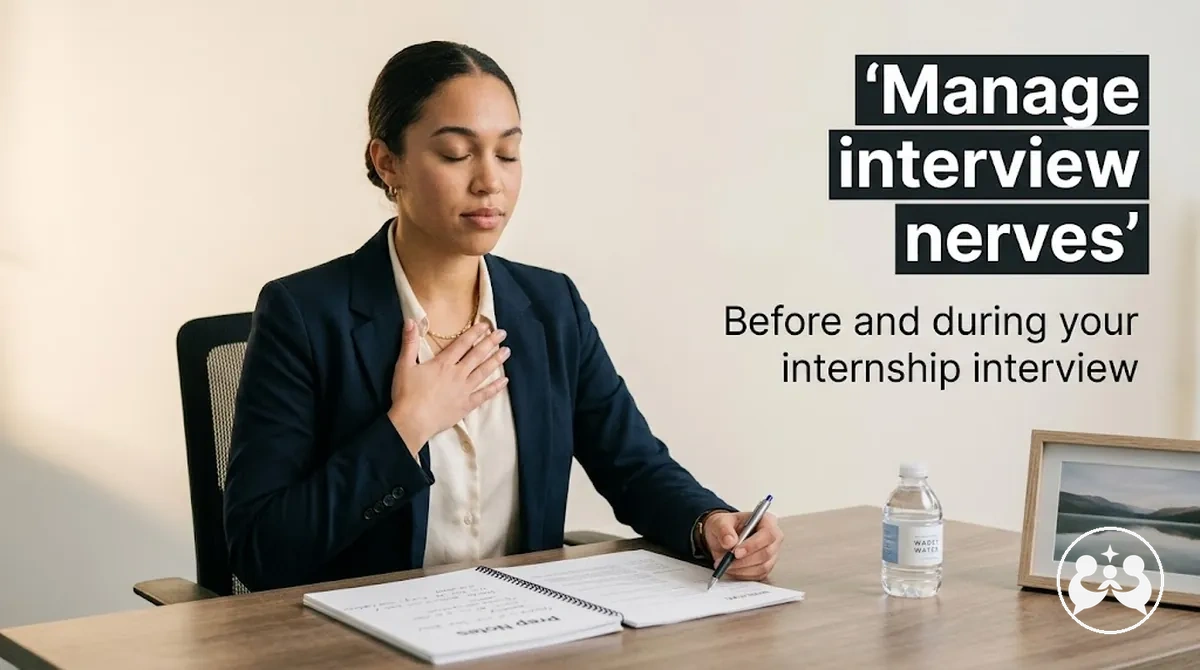
Internship interview nerves are a common response to a high-stakes or uncertain situation. To manage them, match the response to the disruption: before the interview, use focused preparation for avoidable uncertainty, realistic practice for unfamiliarity, and simple settling steps when pace or tension rises; during the interview, pause, re-anchor to the question, make one corrective adjustment, and continue. The goal is clear thinking and delivery, not complete calm.
At a glance
Interview nerves: choose the next move
Use the signal that best matches what is happening. The aim is to reduce the disruption, not to prove that you feel no nerves.
Before the interview
- Unknown questions or an unclear format
- Use focused preparation. Clarify what can reasonably be known, select role-relevant examples, and resolve practical gaps.
- The interview situation feels unfamiliar
- Use realistic practice. Answer aloud, vary question wording, and include follow-up interaction so the task becomes more familiar without memorising fixed wording.
- You feel keyed up, rushed, or physically tense
- Settle attention and pace. Stop adding new preparation, slow your breathing comfortably, release obvious tension, and focus on the first interview task.
- Travel, timing, location, or connection details are worrying you
- Resolve avoidable logistics. Confirm the supplied location or online platform, timing, and other practical details before the interview.
During the interview
- Your mind goes blank
- Pause and re-anchor to the question. Check whether this is a retrieval lapse, unclear wording, or a genuine knowledge gap, then restart from one clear point.
- Your speech starts rushing
- Reset the delivery. Pause after the question, steady your breath, begin with one short sentence, and develop one idea at a time.
- You stumble, ramble, or leave a sentence unfinished
- Make one brief correction and continue. Restart from the main point instead of turning the moment into a lengthy apology or explanation.
- You do not understand the question
- Ask for repetition or clarification. Treat unclear wording differently from blanking or not knowing the answer.
Boundary: visible nervousness such as pausing, rushing, or a shaky voice does not by itself establish poor preparation or limited capability.
The Royal College of Nursing describes nervousness before an interview as a normal response to a challenging situation and notes that people experience it differently.
Perceived stakes or uncertainty can contribute to a nervous response, with possible effects on attention, recall, speech pace, and answer delivery.
Drexel University’s Steinbright Career Development Center notes that interview stress can involve racing thoughts, difficulty focusing, sweating, a faster heartbeat, or changes in the voice, but these effects are not a fixed pattern for every candidate.
Visible nervousness does not necessarily indicate poor preparation or poor capability.
A pause, shaky voice, rushed sentence, or temporary difficulty organising an answer can occur even when a candidate is prepared.
Managing interview nerves therefore means limiting their disruption before the interview and regaining control when they affect thinking, speech, or answer delivery during it.
Table of Contents
How Interview Nerves Affect Thinking, Answers, and Delivery
Interview nerves may disrupt attention, recall, answer organisation, or answer delivery during an internship interview.
The effects can appear when nervousness makes it harder to focus on the question, retrieve relevant information, organise a response, or maintain a clear speaking pace.
Drexel University’s Steinbright Career Development Center identifies racing thoughts and difficulty focusing among possible signs of interview stress and notes that stress affects people differently.
These effects are therefore possible performance disruptions rather than a fixed response every candidate will experience.
When attention shifts from the interviewer’s question to nervous thoughts or excessive self-monitoring, maintaining focus can become harder.
Racing thoughts may interfere with recall, so information a candidate already knows can be temporarily harder to retrieve or express.
A candidate may also lose the thread of an answer if attention moves repeatedly between the response itself and concerns about how they appear or sound.
The effects can be grouped by where they become noticeable in the interview.
These are possible changes in performance, not fixed symptoms or proof of a candidate’s ability.
Where nerves can disrupt performance
- Thinking: Reduced focus or racing thoughts can make recall less reliable in the moment, including difficulty bringing a prepared example to mind.
- Answers: Losing the train of thought can weaken answer organisation, relevance, or clarity even when the candidate knows the underlying information.
- Delivery: Nervousness may contribute to rushing, stumbling over words, or changes in the voice. A faster or less controlled pace can reduce clarity and make an otherwise relevant answer harder to follow.
For example, an internship candidate may know a suitable university project for a teamwork question but momentarily struggle to recall its details or organise them into a clear response under pressure.
Observable effects such as pausing, rushing, or losing the thread of an answer do not by themselves establish poor preparation or limited competence; stronger or persistent symptoms that extend beyond ordinary interview nerves are outside this page’s scope.
The image illustrates the relationship between interview pressure and possible changes in thinking or delivery without implying that every candidate experiences the same effects.

What Is Triggering Your Interview Nerves
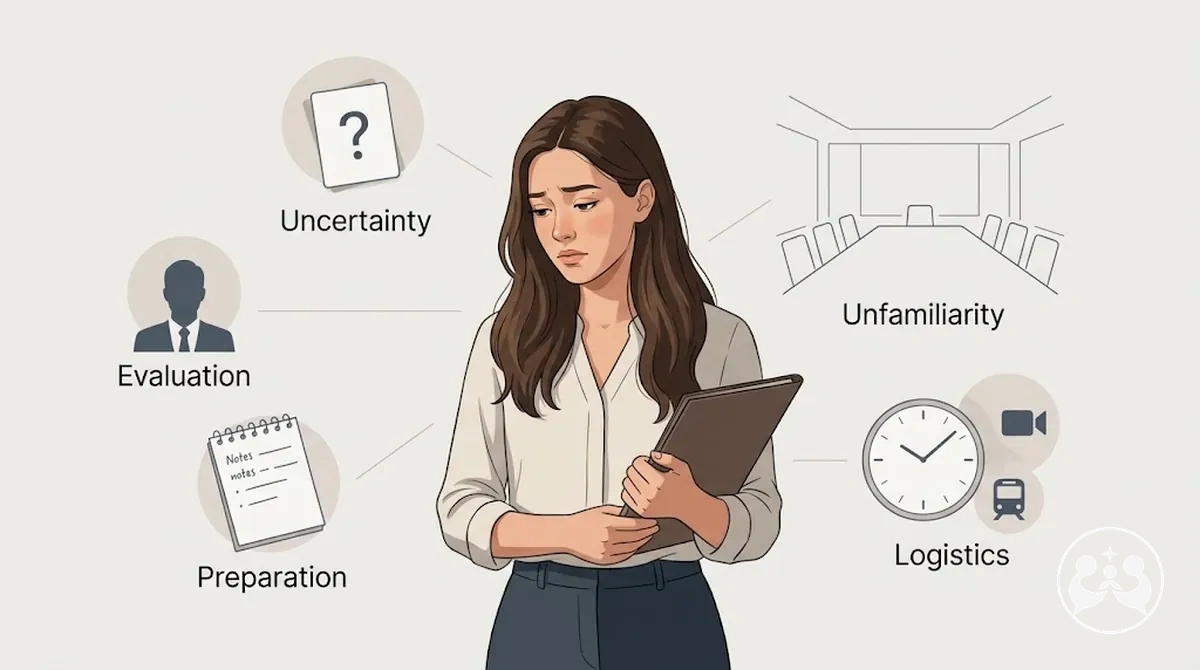
The timing of your interview nerves and what you are worried about can help identify the most plausible trigger.
Nervousness that begins while anticipating unknown questions may point towards uncertainty, while worry centred on being judged or making a strong impression may reflect evaluation or high stakes.
If the nerves are tied to gaps in readiness, unfamiliar interview conditions, or practical pressure around getting there on time, feeling unprepared, unfamiliarity, or logistics may be contributing instead.
The useful differentiating dimensions are whether the worry centres on uncertainty about what will happen, evaluation or high stakes, feeling unprepared, unfamiliarity with interview conditions, or avoidable timing and logistics pressure.
Match the worry to the likely trigger
- Uncertainty: If the signal is worry about unknown questions or an unclear interview format, interpret uncertainty as a plausible trigger. Check whether knowing what to expect would address the main worry; if so, focus next on clarifying the interview conditions.
- High stakes or evaluation: If the signal is fear of judgment or pressure to demonstrate your ability, perceived evaluation may be contributing. Check whether the worry remains even when you feel prepared; if so, distinguish performance pressure from a preparation gap.
- Feeling unprepared: If the signal is concern about missing examples, role knowledge, or questions you cannot yet answer, readiness may be the more relevant trigger. Check whether you can name the specific preparation gap; if so, that gap becomes the next informational priority.
- Unfamiliarity: If the signal is nervousness about having little interview experience or encountering unfamiliar interview conditions, unfamiliarity may be contributing. Check whether the concern is about the experience itself rather than a specific knowledge gap; if so, familiarity is the next distinction to examine.
- Timing or logistics: If the signal is worry about travel, arrival time, finding the location, or connecting to a video interview, avoidable logistics pressure may be contributing. Check whether resolving that practical uncertainty reduces the main worry; if so, treat logistics as the immediate priority.
Nerves that build before the interview may be associated with anticipation, uncertainty, preparation concerns, or perceived high stakes, whereas nerves that intensify only once the interview begins may be more closely connected to the immediate experience of evaluation or unfamiliar conditions.
Neither pattern proves a single trigger, so use the distinction to select the most plausible contributing factor rather than treating sweating, rushing, blanking, or another nervous response as its cause.
The image illustrates how the timing and focus of interview worry can help distinguish likely triggers without treating nervous responses as a clinical diagnosis.
How to Reduce Nerves Before the Interview
Reducing pre-interview nerves starts by matching your response to the likely trigger rather than stacking unrelated calming tips.
If uncertainty is driving the nerves, focused preparation can improve readiness; if unfamiliarity is the main issue, realistic practice can make the interview conditions more familiar.
When the immediate problem is feeling keyed up, rushed, or physically tense, simple settling techniques can help steady attention and pace.
These approaches may reduce disruption without requiring you to feel completely calm.
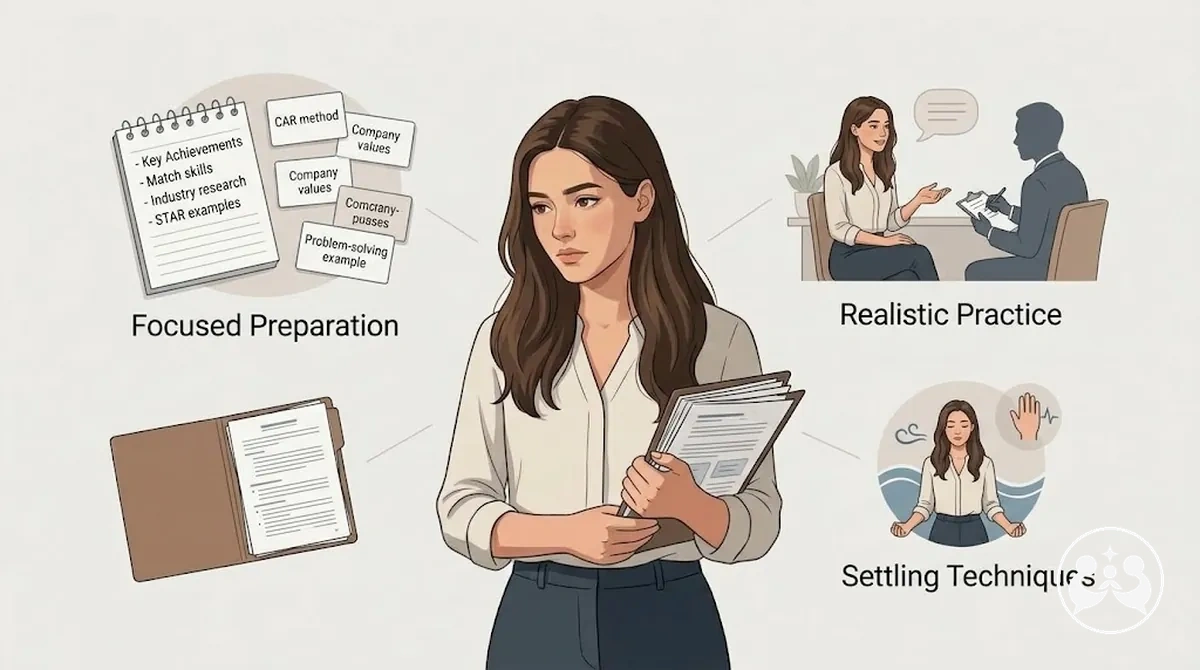
Different sources of nervousness call for different responses.
Use the main condition behind your nerves to choose the broad method before deciding how to carry it out.
Trigger → practical response
- Uncertainty → focused preparation: Choose focused preparation when your main concern is not knowing what to expect, what questions may arise, or which examples you could use.
- Unfamiliarity → realistic practice: When the interview format or interaction itself feels unfamiliar, use mock interviews for realistic practice.
- Nervous activation → settling techniques: When you feel keyed up or your attention and pace are becoming harder to control, choose simple settling techniques such as slowing your breathing, releasing unnecessary muscle tension, or redirecting attention to the immediate interview task.
- Evaluation pressure → task focus: When you feel prepared but remain worried about being judged, stop treating more preparation as the main fix. Focus on controllable interview actions such as listening to the question, pausing, answering one point at a time, and correcting briefly when needed.
- Timing or logistics → practical confirmation: Confirm the supplied location or online platform, interview time, and other practical details that can reasonably be checked in advance.
The goal is to reduce how much pre-interview nerves disrupt your preparation or performance, not to require complete calm.
Focused preparation, realistic practice, and settling techniques address different conditions, so choose the method that best fits the likely trigger.
Use Focused Preparation to Reduce Uncertainty
Focused preparation reduces avoidable uncertainty by confirming the information and role-relevant examples you need for the interview rather than trying to prepare for every possibility.
Concentrate on what can reasonably be known in advance, such as the interview format, examples you may draw on, and key logistics.
Any remaining uncertainty should be something you cannot reasonably clarify beforehand rather than an overlooked preparation target.
The goal is readiness, not exhaustive study.
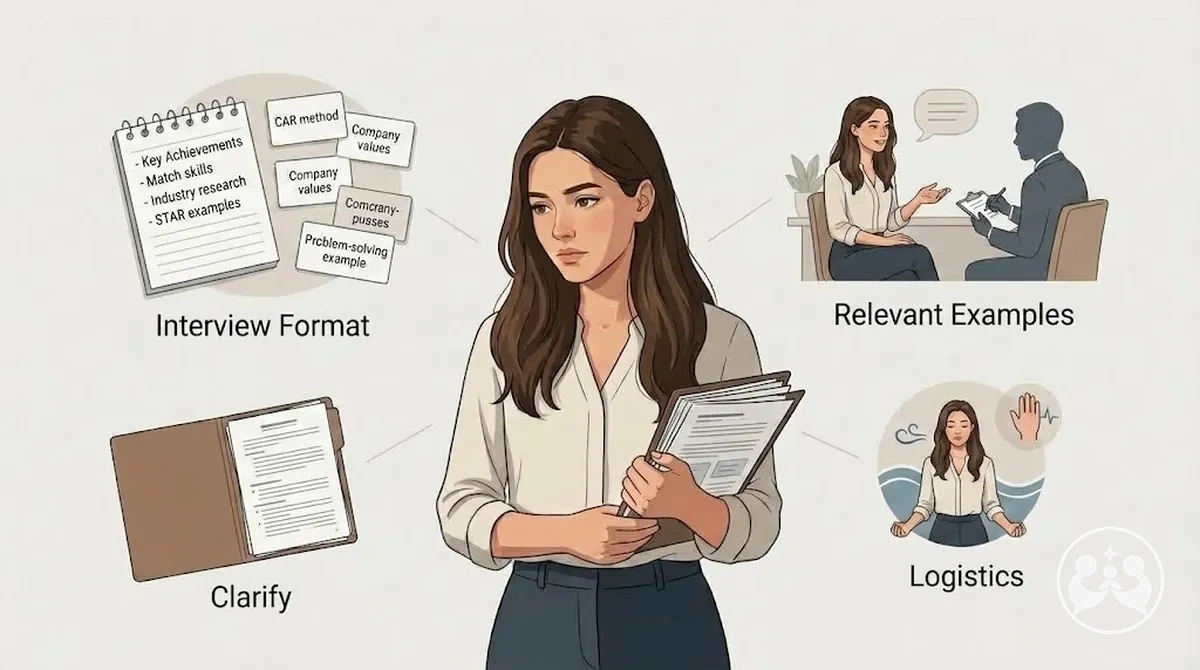
Use a short readiness check to identify specific gaps that can still be clarified.
Each item should leave you either ready for that part of the interview or with a clear preparation target.
Readiness check
- Interview format: Check whether you know the expected format and any information provided about timing or how the interview will take place. If available details are still unclear, clarify them before the interview so they do not remain an avoidable source of uncertainty.
- Role-relevant examples: Check that you can identify a few experiences that provide relevant evidence of your skills or actions. If suitable examples do not come to mind, selecting them becomes a focused preparation target rather than a reason to prepare for every possible question.
- Logistics: Confirm the location or online platform, timing, and other practical details supplied for the interview. Resolve practical gaps that can reasonably be checked in advance so they do not add avoidable uncertainty close to the interview.
- Remaining uncertainties: Identify what you still do not know and separate details you can clarify from those that will remain unknown until the interview. Prepare for the first category and accept the second as part of the interview rather than trying to eliminate every unknown.
Targeted preparation differs from last-minute cramming because it closes specific readiness gaps instead of adding more material simply because the interview is approaching.
Broader internship interview preparation can cover the wider preparation process; here, stop when the relevant information, examples, and logistics are sufficiently clear for you to proceed with readiness rather than exhaustive study.
Use Practice to Make the Interview Feel More Familiar
Interview practice can make the interview task more familiar and may make it easier to retrieve and organise answers when you feel under pressure.
Repeated exposure to answering questions aloud gives you practice turning relevant ideas into spoken responses instead of encountering that task for the first time in the interview.
Varying the question wording, timing, and interaction also helps you practise responding when the conversation does not follow one fixed pattern.
The aim is greater familiarity and flexibility, not a guaranteed level of confidence or performance.
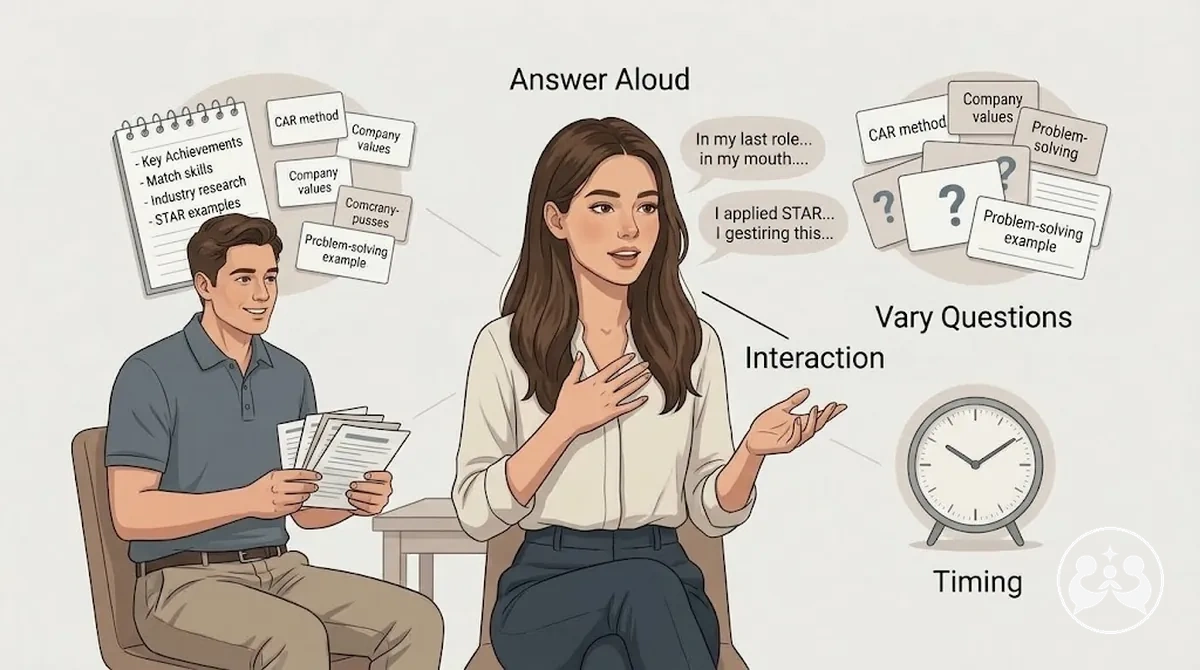
The following practice modes vary the same core task: retrieving an idea, organising it, and expressing it in response to an interview question.
To keep that practice flexible, practice answers without sounding scripted rather than memorising fixed wording.
Ways to practise for flexibility
- Answering aloud: Say your response instead of only thinking through it so that recalling and expressing the idea become part of the practice.
- Varying question wording: Practise the same underlying topic with differently phrased questions so that your response is not dependent on one familiar prompt.
- Varying timing: Practise beginning an answer after hearing the question and allow realistic pauses rather than relying on an immediate rehearsed response.
- Varying interaction: Include follow-up questions or another person when practical so that practice includes responding to changes in the conversation.
For example, instead of memorising one fixed teamwork answer, practise retrieving the same relevant experience when asked about teamwork, collaboration, or handling disagreement.
The details can remain consistent while the organisation and wording change with the question, building familiarity with the interview task while preserving flexibility.
Settle Your Body and Attention Before the Interview Starts
Use the final moments before the interview to reduce rushing and redirect your attention rather than trying to force complete calm.
Pause new preparation inputs, settle into a steady pace, and focus on what you need to do first.
Simple adjustments such as slow breathing or releasing obvious muscle tension can help you refocus without requiring a complicated routine.
The aim is a steadier starting state with your attention on the immediate interview task.

Choose the simple options that fit your immediate state and the available time.
Each adjustment should help reduce unnecessary rushing or redirect attention towards the first interview task.
In the final minutes
- Pause new inputs: If you are still reading notes or taking in new information, pause and shift your attention from preparation to starting the interview at a steady pace.
- Use slow breathing: If your breathing feels rushed, let it become slower and more deliberate while keeping the approach comfortable rather than following a rigid pattern.
- Release muscle tension: If you notice obvious tension in your shoulders, jaw, hands, or posture, loosen it gently and return your attention to the present moment.
- Focus on the first interview task: Instead of mentally running through the entire interview, orient your attention to the immediate start, such as listening to the introduction or first question and responding at a steady pace.
How to Regain Control When Nerves Rise During the Interview
When nerves rise during an internship interview, the immediate task is to pause, reorient, identify the immediate disruption, choose one corrective action, and continue with the conversation.
A nervous moment does not require abandoning the answer or hiding every visible sign of nervousness.
Drexel University’s Steinbright Career Development Center advises slowing down and pausing before responding when nerves cause a candidate to jump into an answer too quickly.
Use the same recovery sequence for different disruptions, but match the corrective action to what is happening in that moment.
Four-step recovery sequence
- Pause: Stop briefly rather than pushing through the disruption at the same pace.
- Identify the immediate disruption: Notice whether you are blanking, using rushed speech, or recovering from a nervous stumble so you know what needs attention.
- Choose one corrective action: Reorient to the question or conversation and make one local adjustment that addresses the immediate symptom.
- Continue: Regain your place and resume the answer or conversation without repeatedly apologising for a normal pause or stumble.
Blanking, rushed speech, and a nervous stumble require different local corrections: a retrieval problem calls for reorienting to the question, rushed speech calls for adjusting pace to improve clarity, and a stumble calls for a brief recovery before continuing.
The useful response is the correction that matches the immediate symptom rather than assuming every rise in nerves has one cause or one solution.
What to Do When Your Mind Goes Blank
When your mind goes blank during an internship interview, pause instead of filling the silence with rushed or unrelated speech.
Re-anchor to the question and check what you can retrieve from your available knowledge.
A brief retrieval lapse does not by itself show that you do not understand the question or do not know the answer.
The next response should depend on which of those states is actually causing the difficulty.
Use this recovery sequence to distinguish temporary blanking from difficulty understanding the question or a genuine knowledge gap, then restart from the clearest point available.
When your mind goes blank
- Pause: Stop briefly and bring your attention back to the question rather than continuing with an unrelated response.
- Check the question and your available knowledge: Decide whether you understand what was asked and whether the relevant information is available but temporarily difficult to retrieve.
- Ask for a moment or repetition if needed: If you need time for a retrieval lapse, take a brief moment to think. If the question wording is the problem, ask for repetition or clarification before answering.
- State one clear point: Begin with the relevant point you can retrieve instead of waiting for the entire answer to return at once.
- Restart and continue: Build from that point and continue the answer while staying anchored to the question.
Key distinction
- Retrieval lapse
- The relevant knowledge is available but temporarily difficult to bring into the answer.
- Not understanding
- The question itself needs repetition or clarification before you can answer it accurately.
- Not knowing
- The required information is not available to retrieve, so treat it as a knowledge gap rather than blanking.
For example, if a project example briefly disappears from memory, pausing and re-anchoring to the question may help you restart from one detail you do remember.
If you genuinely lack the knowledge needed to respond, the appropriate next step is to handle questions when you do not know the answer rather than treating the knowledge gap as blanking.
How to Slow Down and Speak Clearly When You Feel Nervous
Clearer speech when you feel nervous often starts by slowing your first sentence and allowing a deliberate pause between ideas.
Treat speech pace, sentence length, and pauses as controllable parts of delivery rather than trying to eliminate nervousness before you speak.
A short sentence followed by one idea at a time can make the answer easier for the listener to follow.
Slower speech alone does not resolve every effect of nervousness, but adjusting your delivery can improve clarity when rushing is the immediate problem.
Use the sequence to regulate speech pace and group ideas more clearly while you answer, rather than trying to sound perfectly confident.
Pace-reset sequence
- Pause after the question: Give yourself a moment to register what was asked before beginning the answer.
- Settle your breath: Let your breath become steady enough to begin without immediately rushing into the response.
- Begin with one short sentence: Make your first sentence direct and manageable instead of starting with a long, multi-clause answer.
- Develop one idea at a time: Complete one relevant point before moving to the next so the listener can follow the answer.
- Pause before the next point: Use a deliberate pause to separate ideas, reset your pace, and continue with clarity.
How to Recover After a Nervous Moment
Recovery after a nervous moment means making a brief correction and returning your attention to the current question or conversation.
If you notice a stumble, shaky voice, rambling start, or incomplete sentence, avoid extending the disruption through excessive self-monitoring.
Correct what needs correcting, restart from a clear point, and continue with the answer.
The aim is workable recovery rather than flawless delivery.
Use the same basic pattern for these moments: recognise the event, make a brief correction, and return to the interview task.
Match the moment to one brief correction
- Stumble
- Self-correct the word or sentence and continue.
- Rambling start
- Stop and restart with the main point.
- Incomplete sentence
- Finish the thought more clearly and move on.
This forward focus keeps attention on the current question instead of turning one nervous moment into a lengthy explanation of your nervousness.