Troubleshooting Common Review Article Writing Mistakes
Troubleshoot a review article by tracing the visible symptom to the earliest plausible source and checking that stage before revising. Use the sequence symptom → likely cause → check → corrective direction, because the same surface problem can arise from different conditions in the scope, evidence base, synthesis, or manuscript structure.
Review article troubleshooting map
Match the visible problem to the earliest stage worth checking. Confirm the condition before applying the corrective direction.
Scope and review question
Visible symptom
The review is diffuse, overextended, or unclear about what evidence belongs.
Check
Purpose, conceptual boundaries, breadth-to-depth fit, and whether the question defines evidence eligibility.
Corrective direction
Clarify or narrow only the boundary causing the mismatch so the scope and question support the intended inquiry.
Evidence selection
Visible symptom
Sources share the topic but do not adequately support the review question or intended claims.
Check
Question fit, methodological credibility, source appropriateness, currency where material, coverage, and inclusion consistency.
Corrective direction
Correct the specific selection criterion that failed rather than treating topical similarity as sufficient evidence.
Evidence synthesis
Visible symptom
The draft reports studies one by one or describes findings without a cross-source pattern.
Check
Agreement, disagreement, recurring themes, methodological differences, and conditions that may explain variation.
Corrective direction
Group evidence around the analytical relationship and keep the review-level claim proportional to the pattern and its limitations.
Structure and argument
Visible symptom
Sections are individually relevant but do not clearly advance the review question or connect into a coherent argument.
Check
Section purpose, evidence-to-claim alignment, explicit claim, implication, and logical connection to adjacent sections.
Corrective direction
Revise, combine, reposition, or remove material whose argumentative contribution remains unclear.
The diagnostic path moves from upstream definition problems through evidence selection and synthesis to manuscript structure. Correct the verified condition, not merely the visible symptom.
Table of Contents⌄
How to Diagnose the Source of a Review Article Problem
Diagnosing the source of a review article problem begins by tracing a visible symptom to the earliest plausible writing stage that could have produced it.
A downstream symptom can have more than one likely cause, so it should be treated as a clue rather than as evidence of one fixed upstream problem.
The diagnostic check should test plausible sources before a corrective direction is chosen.
The diagnostic sequence runs from review question clarity and scope through evidence fit and synthesis to manuscript structure.
A poorly defined review question may indicate that scope or evidence inclusion needs checking, while weak coherence later in the review article may instead reflect problems in synthesis or structure.
Because these stages are connected, an upstream condition can have a downstream effect without being the only plausible explanation for the observed symptom.
The diagram visualises where a downstream writing symptom may originate across the review question, scope, evidence selection, synthesis, and manuscript structure, without assigning each symptom to one predetermined source.
Observed Symptom
Likely Upstream Cause
What to Check
Corrective Direction
Included evidence addresses several loosely related issues
The review question or scope may be too broad or insufficiently bounded
Check whether the review question identifies a clear problem and whether the inclusion boundaries consistently match it
Clarify the review question or narrow the scope where the diagnostic check shows that unrelated evidence is being admitted
Relevant-looking sources do not support the same analytical focus
Evidence fit may be inconsistent with the review question or inclusion logic
Check each source for relevance to the defined question, concepts, and evidence boundaries rather than relying on topic similarity alone
Reassess evidence inclusion where sources do not fit the analytical purpose of the review
Paragraphs summarise studies but the argument remains fragmented
Synthesis may be organised around individual sources rather than relationships among findings
Check whether the review compares commonalities, disagreements, patterns, or other meaningful relationships across the included evidence
Reorganise the relevant material around evidence relationships when the check indicates source-by-source reporting
Individual passages are clear but the manuscript lacks overall coherence
The structure may not express a consistent relationship between the review question, synthesis, and sequence of ideas
Check whether each major part advances the same review question and whether the sequence makes the analytical relationship between parts explicit
Adjust the manuscript structure where the diagnostic check identifies a break in that relationship
These checks narrow the plausible source of a writing problem by distinguishing an upstream condition from its downstream manifestation; they do not establish one fixed cause for every similar symptom.
Once the relevant condition is identified, the corrective direction can target that stage of the review article rather than applying a surface correction indiscriminately.
Review Scope and Question Mistakes
Review scope and review question mistakes occur upstream because they shape what the review can cover coherently and what evidence can legitimately answer the inquiry.
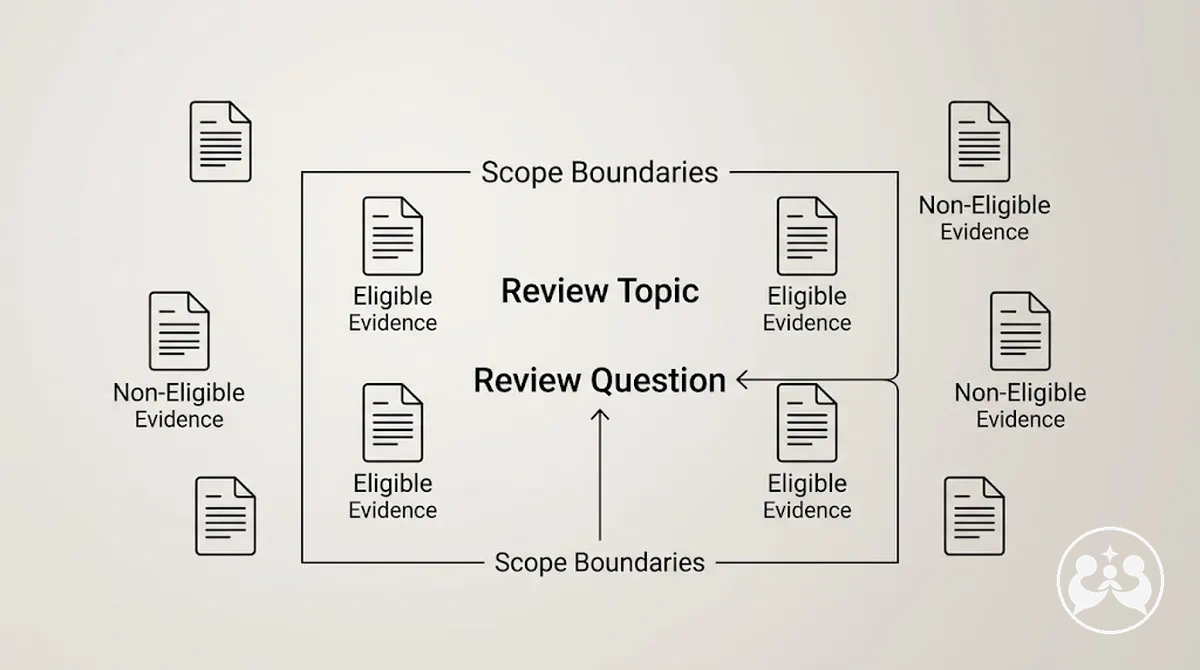
The scope defines the relevant boundaries and coverage limits, while the review question gives that bounded inquiry a specific focus.
When these elements are misaligned, the inclusion logic may admit evidence that is relevant to the general topic but does not fit the purpose of the review.
A broad scope is not automatically a mistake. Its appropriate breadth and depth depend on the review's purpose and method.
The relationship between scope, review question, and evidence eligibility can be assessed through two connected criteria groups: scope control concerns breadth, depth, boundaries, and feasibility, while question definition concerns clarity, answerability, and evidence fit.
Focus: The scope should define which concepts and context belong within the review so that the review question remains directed at the intended inquiry rather than the wider topic.
Feasibility: The planned breadth and depth should remain manageable for the review's purpose and method; an overextended scope may make consistent coverage difficult even when individual sources remain relevant.
Answerability: The review question should be clear enough to determine what evidence could address it and which material falls outside the inquiry.
Boundary consistency: The stated boundaries and the review question should describe compatible coverage limits; a mismatch may produce inconsistent inclusion logic.
Evidence fit: Included evidence should be relevant not only to the general review topic but also to the defined question and boundaries that determine eligibility.
Clearer boundaries make relevance judgments more explicit by defining which concepts, contexts, and evidence fall within the review, while question clarity helps determine whether that eligible evidence can answer the inquiry.
Feasibility depends on whether the intended breadth and depth can be handled consistently within the review's purpose and method, so evidence fit should be judged against both the question and its boundaries.
Misalignment among these elements can weaken focus and coherence even when individual sources appear relevant.
Correction means restoring alignment among the review purpose, scope, review question, and evidence eligibility rather than imposing one universally correct breadth or question format.
Once those elements are consistent, the inclusion logic has a clearer basis for determining what evidence belongs within the review.
The Scope Is Too Broad to Support a Focused Review
A review scope is too broad when its breadth prevents sufficient depth, coherent synthesis, or feasible coverage for the review purpose.
Breadth alone is not the problem; a broad scope can remain workable when its boundaries match the purpose, method, and available evidence.
The diagnostic issue is whether the intended coverage exceeds the analytical depth the review can sustain coherently.
The main cues indicate a mismatch between breadth and review purpose rather than a fixed ideal scope size.
Relevant boundary dimensions can include the subject, population or context, timeframe, concepts, and outcomes, depending on what the review is intended to cover.
Excessive subtopics: The scope includes more distinct areas than can receive the analytical depth required for the review purpose, indicating that one or more boundaries may require narrowing.
Superficial treatment: Important parts of the scope receive description without enough depth to support coherent synthesis, indicating a mismatch between breadth and intended analysis.
Inconsistent boundaries: A review boundary cannot be applied consistently across relevant material, indicating that the boundary may need to be clarified before coverage can remain coherent.
Unmanageable evidence volume: The available evidence volume exceeds what can feasibly be examined at the depth required by the chosen purpose and method, indicating that a meaningful boundary may require narrowing.
Weak synthesis: The breadth of coverage leaves evidence groups too loosely connected for coherent synthesis at the intended analytical level, indicating that the scope may be overextended for its stated purpose.
The compact contrast is broad but workable versus overextended for the stated purpose: the first retains feasible analytical depth within its boundaries, while the second requires narrowing when its breadth prevents consistent analysis.
The annotated example shows how changing one meaningful boundary can alter this breadth-to-depth fit without implying that a narrower scope is inherently better.
For example, an overextended review spanning several populations and contexts may become more workable by limiting one relevant population or context while leaving the central subject unchanged.
The correction is to narrow or clarify the boundary responsible for the mismatch so that coverage better fits the required depth, feasibility, and review purpose.
The Review Question Does Not Clearly Define What Evidence Belongs
A review question is too weak for evidence selection when it does not define enough conceptual boundaries to judge evidence relevance consistently.
A usable conceptual boundary clarifies which evidence can address the inquiry and which evidence falls outside it.
The necessary boundaries depend on the review type and may involve the subject, relationship of interest, context, population, outcome, or timeframe where those attributes are genuinely applicable.
The diagnostic cues test both question clarity and question-to-evidence fit rather than prescribing one question format.
Ambiguity and an undefined key concept can leave the intended inquiry open to competing interpretations, while competing questions can create different inclusion boundaries within the same review.
A mismatch also occurs when included evidence addresses the general topic but does not fit the concepts, context, or other boundaries actually expressed by the review question.
Ambiguous wording: The review question permits materially different interpretations of the inquiry, so the same evidence may be judged relevant under one interpretation and outside the inquiry under another.
Undefined key concept: A concept central to the review question lacks a usable boundary, making evidence relevance difficult to apply consistently until that concept is clarified.
Competing questions: The wording combines distinct inquiries that require different evidence, indicating that the intended question definition or inclusion boundary needs clarification.
Missing applicable boundary: The review question omits a relevant attribute such as context, population, outcome, or timeframe when that attribute is necessary to distinguish eligible evidence from evidence addressing a different inquiry.
Question-to-evidence mismatch: Included evidence relates to the broad topic but does not address the relationship or conditions expressed by the review question, indicating that inclusion decisions need to be checked against the stated inquiry.
A concise vague-versus-bounded contrast shows how question wording can change evidence eligibility without requiring every review question to contain the same attributes.
Highlighting only the boundaries that matter to the inquiry makes the change in inclusion logic visible.
For example, the vague question “How does remote work affect employees?” leaves the relevant outcome and context open, whereas “How does remote work affect job satisfaction among employees in fully remote roles?” bounds the outcome and work context.
Evidence about unrelated employee outcomes may fit the broader wording but would not meet the same evidence eligibility condition once those boundaries are explicit.
Evidence Relevance and Selection Mistakes
Evidence selection fails when the evidence base does not adequately fit the review question or is unsuitable for the claims the review needs to support.
The problem can arise from weak evidence relevance, limitations in source quality, outdated evidence where currency matters, incomplete coverage, or inconsistent inclusion logic.
Topical similarity alone does not establish source fit because a source can discuss the same general subject without directly helping answer the review question.
Each dimension should therefore be evaluated separately before evidence is used in synthesis.
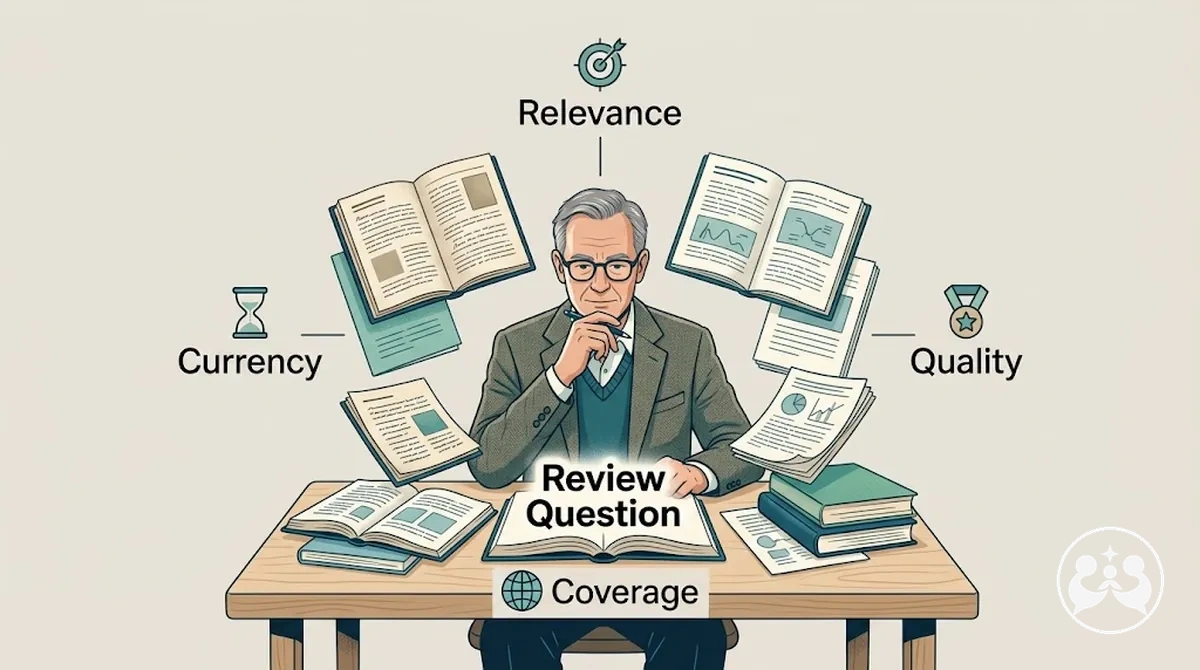
The image illustrates this distinction by showing a researcher comparing sources with the review question and checking relevance, source quality, currency, and coverage rather than relying on topic overlap alone.
Evidence relevance asks whether a source helps answer the review question, whereas evidence suitability concerns whether the evidence base can adequately support the intended synthesis.
Source quality concerns the strengths and limitations of the evidence itself; currency matters when changes in the field could make older evidence inadequate for a current claim, while older foundational evidence may remain necessary for established concepts or earlier developments.
Coverage concerns whether important evidence needed for the review purpose is represented, and consistent inclusion logic helps prevent comparable sources from being treated differently without a relevant reason.
These are separate dimensions, so strength on one does not automatically compensate for weakness on another.
Criterion
What to Check
Possible Implication
Relevance
Whether the source fits the review question and contributes usable evidence to the inquiry rather than sharing only the general topic
Poor source fit can introduce material that does not support the synthesis being made
Source quality
Whether the source's methodology, credibility, and relevant limitations are adequate for the claim for which it is being used
Important limitations may weaken how strongly the evidence can support the synthesis
Currency where applicable
Whether changes in the field make current evidence necessary for the claim, while distinguishing this need from cases where older evidence remains foundational
An outdated evidence base can misrepresent a changing field, while excluding foundational evidence solely because of age can leave a relevant gap
Coverage
Whether the evidence base represents the important evidence needed to address the review question within its defined boundaries
Material gaps can limit the completeness or balance of the resulting synthesis
Inclusion consistency
Whether comparable sources are included or excluded using the same question-relevant conditions
Inconsistent inclusion logic can distort which evidence is represented in the synthesis
Correction depends on which evidence-selection criterion failed: poor question fit requires a relevance correction, while limitations in quality, currency, coverage, or inclusion consistency require the corresponding suitability issue to be addressed.
The next diagnostic step is to determine whether the main mistake is selecting evidence that does not fit the review question or relying on an evidence base that is inadequate for the claims being made.
Sources Are Related to the Topic but Not Relevant to the Review Question
Topic overlap alone does not establish source relevance to the review question.
A source has direct relevance when its purpose and findings contribute evidence that helps answer the review question within its defined boundaries.
A source that discusses the same broad topic but does not support the claim being examined may still provide useful background context rather than direct evidence.
Question fit should be tested against the source purpose, the relevant context or population where applicable, the concepts or variables addressed, the findings reported, and the claim the review needs to support.
Two hypothetical sources can therefore address a similar topic while differing substantially in their usefulness for the same review question.
The comparison applies the same fit dimensions to both sources so that topical similarity is not mistaken for usable evidence.
Fit Dimension
Topic-Related Source
Question-Relevant Source
Implication
Purpose
Addresses the broad subject but investigates a different question
Investigates the relationship represented by the review question
Matching the broad topic can provide background context, while matching the inquiry contributes more directly to answering it
Context or population
Examines a context or population outside a boundary that matters to the review question
Examines the context or population specified by the review question where that boundary is relevant
Question fit depends on whether the source represents conditions required for the claim
Findings
Reports findings about the topic but not the concepts, variables, or relationship needed by the review
Reports findings that address the concepts, variables, or relationship needed by the review
Directly applicable findings provide usable evidence for synthesis; other findings may remain contextual
Support for the needed claim
Provides background context but does not contribute evidence for the specific claim
Contributes evidence that supports evaluating the specific claim within the review question's boundaries
Stronger source fit provides a clearer basis for a defensible synthesis without making background sources useless
The controlling distinction is whether a source contributes to answering the review question and supporting the claim under review, not whether it merely mentions the same topic.
Direct evidence can support the synthesis itself, while background context can clarify concepts or surrounding conditions without serving as evidence for that specific claim.
Evidence Quality, Currency, or Coverage Is Too Weak
An evidence base is too weak when its evidence quality, currency, or coverage is insufficient for the claims the review is trying to make.
Evidence adequacy therefore depends on the condition of the selected evidence and its suitability for the intended synthesis.
A weakness in one dimension can limit confidence even when the other dimensions are adequate.
Methodological credibility concerns whether limitations in how evidence was produced constrain the conclusions it can support, while source appropriateness concerns whether the source type is suitable for the particular claim.
Currency becomes material when changes in the field mean older evidence no longer represents the conditions addressed by a current claim.
Foundational evidence can remain relevant despite its age when it establishes concepts or findings that continue to matter, whereas a coverage gap occurs when an important perspective or body of evidence needed for the review purpose is missing.
Evidence Criterion
Condition to Check
Possible Implication
Methodological credibility
The methods or reported limitations constrain what the evidence can reasonably support
May reduce confidence in conclusions that depend on those limitations
Source appropriateness
The source type or evidence form is unsuitable for the specific claim being supported
May leave the claim without evidence adequate for the required inference
Currency where material
The field or relevant conditions have changed enough that older evidence may no longer represent the current claim
May produce an outdated interpretation when current conditions are material
Foundational relevance
An older source establishes a concept, relationship, or historical foundation that remains pertinent to the review
Can provide necessary context or foundational evidence despite not being recent
Coverage gaps
An important perspective or body of evidence required for the review purpose is absent
Can leave missing context or contribute to distorted conclusions when the omission materially affects the synthesis
Do not apply a universal evidence-adequacy threshold across reviews. Methodological limitations may reduce confidence, insufficient currency may affect interpretation, and a material coverage gap can leave the synthesis incomplete, while older foundational evidence is not equivalent to evidence that is outdated for the current claim.
Judge evidence adequacy against the field, review purpose, and claim being supported rather than fixed age cutoffs, universal source hierarchies, or an assumption that complete coverage is always possible.
Descriptive Writing and Weak Evidence Synthesis
Weak evidence synthesis occurs when individual findings remain isolated instead of being integrated into cross-source relationships.
Descriptive writing reports what each source says, while synthesis groups evidence around shared patterns, agreement, disagreement, or other relationships that matter to the review question.
The analytical step is to explain what those relationships suggest rather than leave the reader to connect isolated source details.
Evidence synthesis therefore links source-level information to a defensible review claim.
Cross-source analysis can identify recurring themes, areas of agreement, and points of disagreement, while a methodological difference may help explain why findings do not align.
Context, population, measurement, or other conditions can also change how apparently similar individual findings should be interpreted.
These relationships matter because a review claim should reflect the pattern and limitations of the evidence rather than assume that all sources support the same interpretation.
Critical writing in this context means evaluating and interpreting those relationships, not adding unsupported negative judgment.
Key distinction: description versus synthesisThe same hypothetical findings become more useful when the relationship between them is made explicit.
Descriptive
One hypothetical source reports improved engagement, while another reports little change.
The sources remain separate, so the relationship between their findings is unexplained.
Synthesized
The same sources show disagreement about engagement, so the review checks whether method, context, or another condition could explain the variation before making a broader interpretation.
The findings are grouped around a cross-source pattern that can support a qualified review-level interpretation.
Review-level interpretation is more defensible when the reasoning from individual findings to the cross-source pattern is explicit and the review claim remains proportional to the evidence.
Where evidence is sparse, inconsistent, or context-dependent, the claim should remain correspondingly qualified; the specific synthesis mistakes that follow arise when writers either report sources separately or make interpretations that are not adequately grounded in cross-source relationships.
Studies Are Summarized One by One Instead of Synthesized Across Sources
An author-by-author sequence becomes a synthesis problem when each study summary reports source detail separately without connecting the sources through a shared analytical relationship.
The problem is not the presence of individual study information, but the absence of grouping that shows how findings relate across sources.
The unit of analysis therefore remains the individual source instead of moving toward a cross-source claim.
Grouping can organize evidence around a shared theme, finding, method, condition, or disagreement according to the analytical purpose of the review.
Necessary source detail can remain when it explains how a particular study contributes to, qualifies, or differs from the grouped evidence.
The following hypothetical contrast shows how the same source details can be organized either as isolated summaries or around a shared analytical relationship.
Isolated summaries: Two hypothetical studies examine the same issue using different methods, and each study summary reports its method and finding separately.
The source details remain disconnected, so the relationship between the studies is not interpreted.
Grouped synthesis: The same hypothetical studies are grouped around their methodological difference, with each source detail retained where it helps explain that relationship.
The grouped evidence then supports a cross-source claim about how method may condition the interpretation of the findings.
The correction is to subordinate source-specific detail to the analytical relationship that the synthesis needs to establish, without removing detail that remains necessary for interpretation.
This shifts the organizational unit from separate studies to grouped evidence, allowing source detail to support a cross-source claim.
The Review Describes Findings Without Developing Patterns or Relationships
A review remains analytically weak when it describes findings accurately but does not identify a pattern or relationship across the evidence.
Interpretation requires more than reporting individual results because the review must show how relevant findings converge, diverge, or vary under particular conditions.
A relationship cue supports interpretation only when multiple relevant pieces of evidence provide a basis for connecting the findings.
Agreement may suggest convergence or a recurring theme, while contradiction can indicate divergence that requires explanation rather than an assumption that one finding is erroneous.
A methodological difference may reflect why findings differ when methods affect what is observed, and a condition such as context or population may help explain why a finding changes across evidence.
These cues are not guaranteed patterns: each relationship must be supported by the evidence before it can contribute to a review claim.
The interpretive question is therefore whether the observed relationship is sufficiently supported and what limitation or condition should qualify it.
Agreement: When multiple relevant findings show agreement, does their convergence suggest a pattern that can support a cautious interpretation?
Contradiction: When relevant findings differ, what evidence could explain the divergence without treating contradiction as an error or forcing consensus?
Recurring theme: When a theme appears across multiple relevant findings, is it sufficiently consistent to inform the review claim, and where are its limits?
Methodological difference: When findings differ alongside a methodological difference, may the method help explain the variation without implying causation?
Condition-dependent change: When findings vary under a particular condition or context, does the evidence support an interpretation that the pattern is context-dependent?
An observed cross-source relationship supports a defensible interpretation when the review claim states what the evidence suggests and remains proportionate to the strength and consistency of that relationship.
When evidence is sparse, inconsistent, or strongly condition-dependent, the interpretation should preserve that uncertainty rather than present a firm pattern that the evidence does not support.
Review Article Structure and Argument Mistakes
Review article structure becomes a writing problem when the order or purpose of manuscript sections no longer supports a coherent answer to the review question.
Each section needs an identifiable function in the argument, with evidence and claims positioned so that the reader can follow how one part contributes to the next.
Structural weakness therefore appears when section purpose, evidence placement, or sequence obscures the relationship between the review question and the argument being developed.
The issue is not whether every review follows one fixed architecture, but whether its parts perform the functions required by that review.
Local section function depends on how clearly the evidence supports the claim being advanced, while article-level progression depends on how those claims connect across adjacent sections.
A transition should make the relationship between successive parts explicit rather than merely signal that the topic has changed.
Proportional emphasis also matters when space given to a point is out of proportion to its relevance or evidential weight, although the appropriate balance varies by review purpose and type.
These criteria together determine whether the manuscript advances a coherent argument rather than presenting disconnected sections.
Section purpose: Does each section have a clear argumentative function, and does that function contribute directly to answering the review question?
Evidence-to-claim alignment: Does the evidence presented in the section support the claim the section advances, with the implication made explicit rather than left disconnected?
Logical progression: Does each section build on the preceding argument or establish the basis for what follows, so the review question is developed through a coherent sequence?
Transitions: Do transitions explain the relationship between adjacent sections, such as continuation, contrast, qualification, or change in analytical focus, rather than simply marking a new topic?
Proportional emphasis: Does the amount of attention given to a point reflect its relevance and evidential weight within the review, without implying that one fixed section length or balance applies to every review type?
The correction principle is to align each section with the argument it must advance: section purpose should determine which evidence belongs there, that evidence should support a clear claim, and the claim should contribute to the overall review argument.
Exact ordering and emphasis can vary, but the resulting manuscript should preserve argument coherence by making each section's contribution to the review question identifiable.
Sections Do Not Advance the Review Question or Build a Coherent Argument
A manuscript section is structurally weak when its content may be relevant in isolation but does not clearly advance the review question or the analytical argument.
A useful section contribution requires more than topical relevance because the section must serve an identifiable argumentative purpose.
It needs revision when the reader cannot see how its evidence, claim, or implication contributes to the review's overall reasoning.
Section contribution chainVerify the argumentative function in this order.
Section purpose State what part of the review question the section is meant to advance.
Evidence support Check that the evidence supports the claim required by that purpose.
Claim State what the evidence supports without exceeding its strength or scope.
Implication Explain why that claim matters to the wider review argument.
These checks assess argumentative function rather than formatting compliance, section length, or adherence to one fixed manuscript structure.
Clear purpose: Can the section's function be stated in relation to the review question? It needs revision when its content lacks a discernible argumentative contribution.
Relevant evidence: Does the evidence support the section purpose and the claim being advanced? It needs revision when evidence is present but does not provide the required support.
Explicit claim: Does the section make clear what conclusion or analytical point the evidence supports? It needs revision when evidence is presented without a corresponding claim.
Stated implication: Does the section explain how its claim contributes to the wider argument or answer to the review question? It needs revision when the significance of the claim remains unstated.
Logical transition: Does the section connect coherently with the adjacent section by showing continuation, contrast, qualification, or another relevant relationship? It needs revision when the transition breaks argumentative continuity.
Connection to adjacent sections matters because a locally sound claim can still weaken coherence if its relationship to what precedes or follows is unclear.
A transition should preserve the logical connection between sections rather than merely signal a change of topic.
Exact placement and emphasis can vary with manuscript context, but the argumentative contribution should remain identifiable.
Correction means revising, combining, repositioning, or removing material when its contribution to the review question or argument remains unclear.
The aim is local coherence within the argument, not a complete pre-submission audit or a universal section pattern.