
Practising Internship Interview Answers Without Sounding Rehearsed
Practise the message, examples and factual details until they are familiar, but keep the wording flexible. A useful readiness test is that you can answer a reworded question, shorten or expand the response, and still preserve the same core meaning without relying on exact sentence recall.
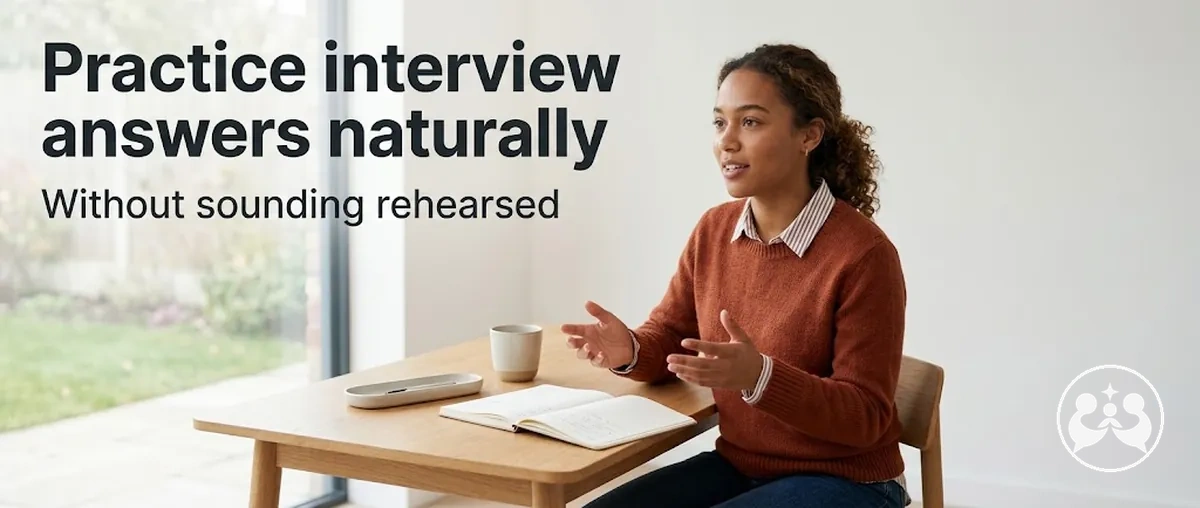
Practice model
The flexible-answer practice loop
Use the same core content through each pass, but deliberately change the language or delivery. The aim is reliable meaning with adaptable expression.
- Fix the meaningDecide the point, facts and example that must stay accurate.
- Reduce to cuesUse key points instead of complete memorised sentences.
- Speak it aloudPractise communicating the answer as speech, not reading it back.
- Vary the expressionChange wording, sentence order, length or emphasis.
- Verify the resultCheck that the answer still fits the question and preserves the same facts and meaning.
Natural delivery does not mean improvising without preparation. Rehearsal should build familiarity with what you want to communicate while leaving enough flexibility to change phrasing, emphasis or detail when the question wording changes.
The amount of practice needed varies with how familiar you are with the example, the type of question and how easily you can adapt the answer without losing its meaning. If an answer only works when you reproduce the same phrasing in the same order, the practice has become too dependent on exact recall.
Table of Contents
Signs an Interview Answer Sounds Rehearsed
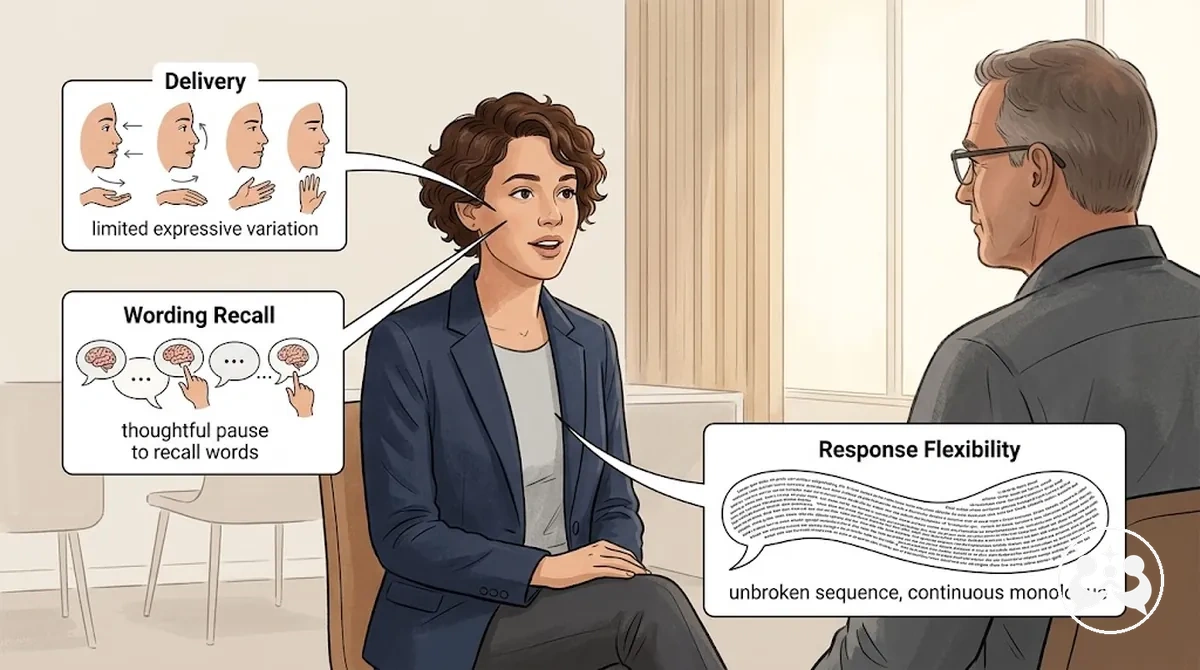
Signs of a rehearsed interview answer are more meaningful when several cues of rigid delivery occur together, rather than as one isolated behaviour.
A single pause, a calm tone, or a polished response does not establish that an answer is scripted.
The stronger pattern is reduced flexibility across delivery, wording recall, and responsiveness to the exact question.
The main signal classes are changes in delivery, pauses that appear connected to recalling wording, and responses that remain speech-like instead of adapting to the conversation.
These cues may suggest an over-rehearsed answer when they occur together, but calmness, thoughtful hesitation, and ordinary preparation can produce similar behaviours on their own.
The illustration groups these suggestive cues for pattern recognition; each signal can then be examined separately.
The Delivery Sounds Flat or Robotic
Flat delivery or a robotic speaking pattern can suggest that attention is focused on wording recall rather than communicating meaning, but delivery alone does not establish that an interview answer is memorised.
Limited variation in tone, pace, or emphasis is only one diagnostic signal.
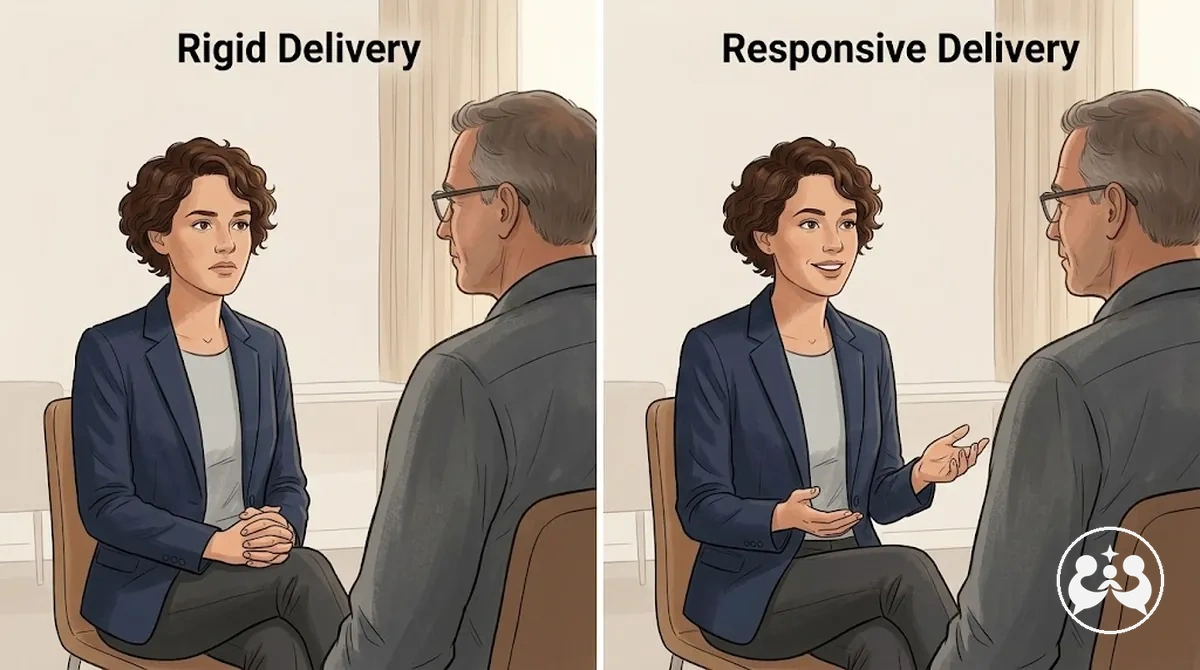
A mechanical response may keep a similar tone, pace, and emphasis even when the question changes, while a calm but responsive response can still adjust emphasis or phrasing to fit what the interviewer asked.
A naturally calm voice, accent, introversion, or temporary nervousness can also involve limited vocal variation without indicating scripting.
The stronger contextual check is responsiveness: look for rigidity in both delivery and wording when the candidate needs to adapt.
Pauses Happen While You Recall Exact Wording
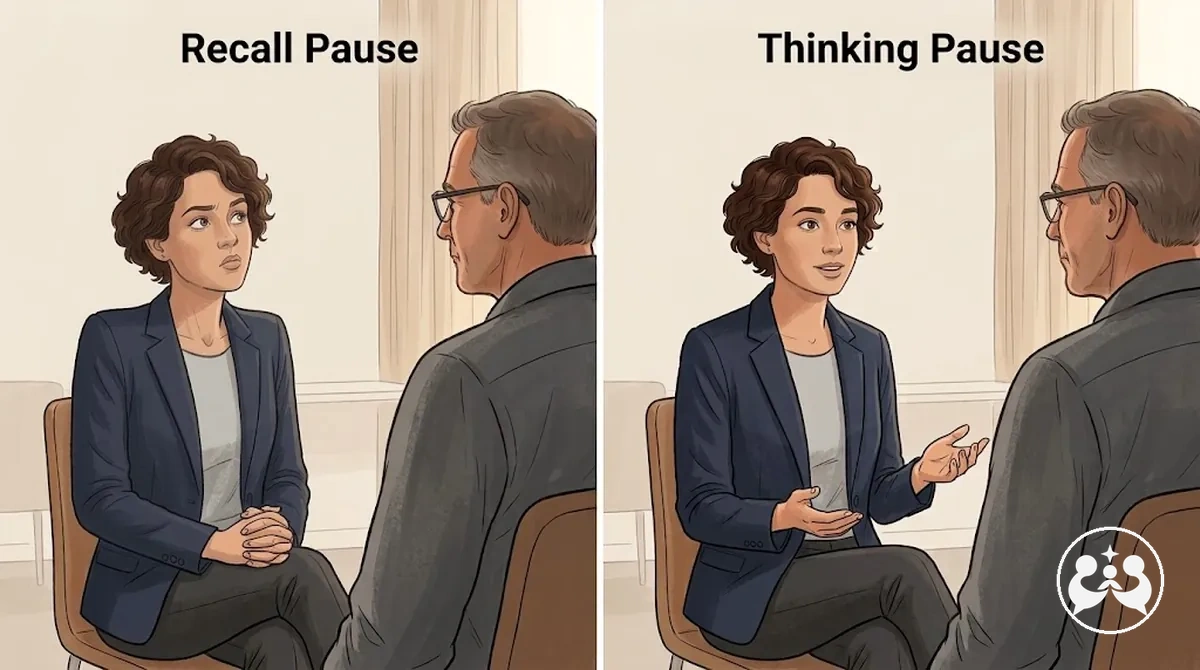
A pause is more suggestive of wording recall when it repeatedly occurs at points where a candidate appears to be retrieving exact wording, rather than simply taking a thinking pause before developing a response.
Hesitation alone does not establish over-rehearsal because a pause can also reflect thought, nerves, surprise, or an unexpected question.
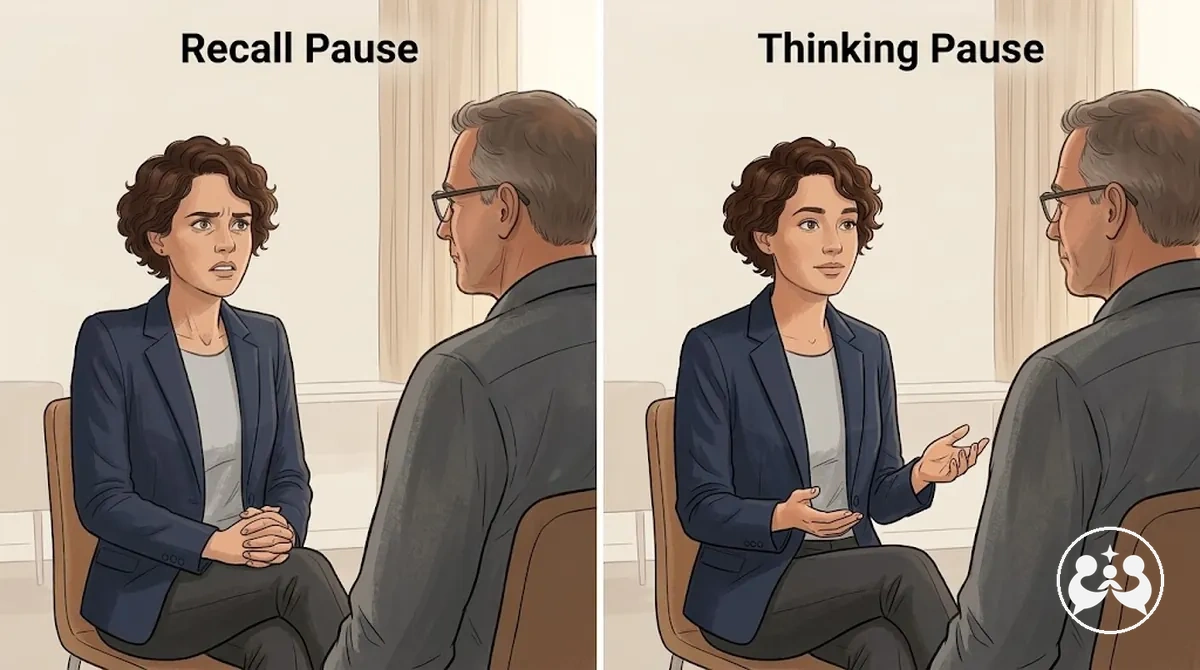
Check where the pause occurs and what follows it: repeatedly stopping between parts of an otherwise fixed phrasing may suggest recall of the next memorised line, while pausing to consider the question and then rephrasing the idea is more consistent with active thinking.
Nervous hesitation can also interrupt an answer, so learning to manage interview nerves is a separate issue from identifying a wording-retrieval pattern.
As a practical check, consider whether the candidate can paraphrase the same point after the pause; flexible wording supports a different interpretation from repeatedly resuming with the same exact phrasing.
The Answer Feels Like a Speech Rather Than a Response
An interview answer can feel like a speech when the candidate follows the same fixed monologue regardless of the question wording, while a prepared response remains conversational by adapting the same core message to what the interviewer actually asked.
A polished or well-structured answer is not necessarily scripted; the key distinction is adaptability.
For example, the same prepared point about teamwork might be shortened when asked for a specific contribution, then expanded or reframed when asked what the candidate learned from the experience.
A responsive answer acknowledges the question, adjusts answer length and emphasis, and can change direction when a follow-up narrows or extends the topic.
A speech-like answer may instead continue through its fixed sequence even when part of that sequence is less relevant to the prompt.
The differentiating criterion is whether the candidate can preserve the core message while adapting its length, framing, and emphasis to the interviewer's actual question.
Why Practised Answers Start to Sound Scripted
Practised interview answers can start to sound scripted when attention shifts from communicating meaning and adapting to the question toward reproducing exact wording.
Word-for-word memorisation is a direct mechanism because exact-language recall can make flexibility harder when the question changes, but it is not the only contributor.
Repetition is not inherently the problem; repeatedly practising the same version without variation can reinforce fixed wording instead of familiarity with the underlying message.
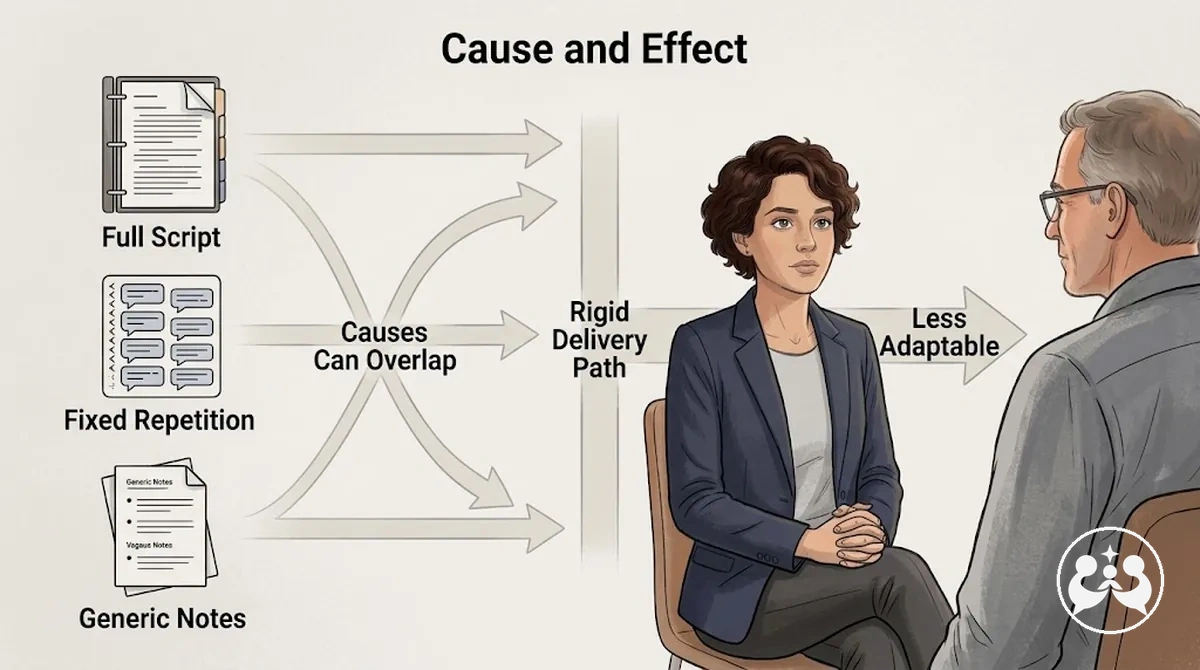
- Word-for-word memorisation: Practising an answer as exact language makes successful delivery depend more heavily on recalling that wording. This can contribute to inflexibility or hesitation when the candidate needs to depart from the script.
- Identical repetition: Repeating the same version in the same sequence can make that sequence habitual rather than building flexibility around the core meaning. The answer may then retain fixed phrasing even when the interviewer changes the emphasis of the question.
- Performance over meaning: Focusing on reproducing a polished performance can direct practice toward how the prepared version should sound rather than what each point needs to communicate. The resulting delivery can be less adaptable when the response needs to be shortened, expanded, or reframed.
- Generic preparation: Practising generic statements with little personal detail gives the candidate fewer specific details to draw on when adapting an answer. The response can therefore remain broad or generic instead of becoming more relevant to the question.
Stress and low familiarity with an example are better treated as contributing conditions than as direct evidence that practice itself caused scripted delivery.
Stress can coincide with hesitation, while low familiarity can make it harder to move away from a prepared version; neither condition establishes word-for-word memorisation on its own.
Different delivery effects can therefore reflect overlapping practice behaviours and contributing conditions rather than a single cause.
Memorising Scripts vs Practising Key Points
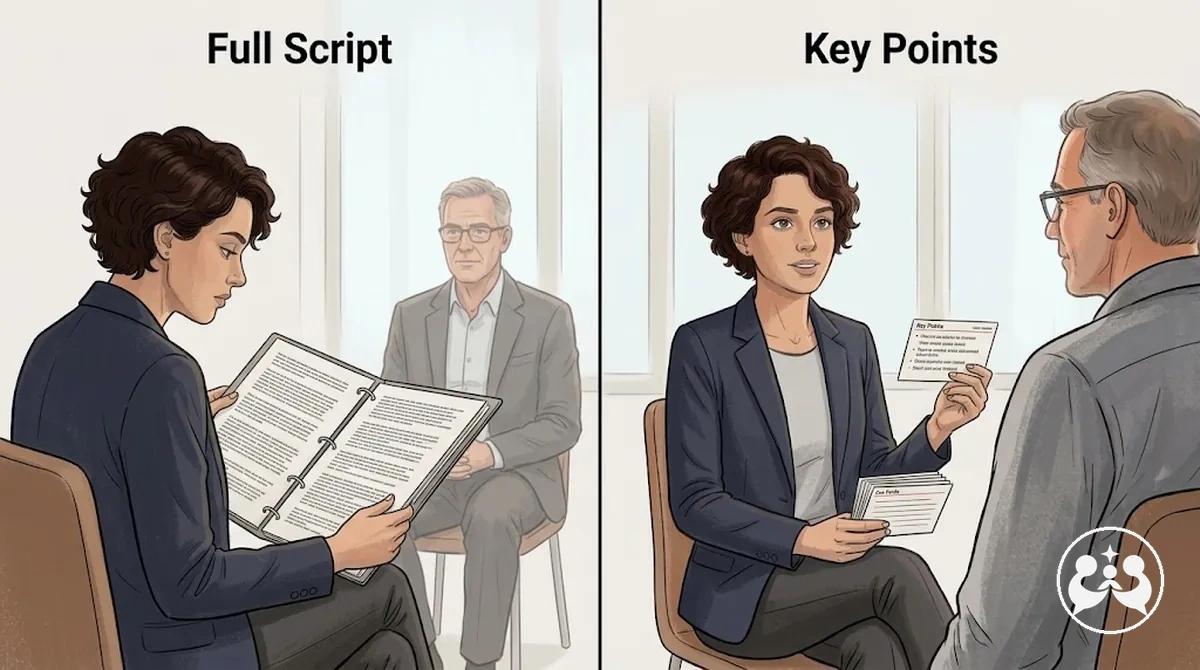
Memorising a script and practising key points share the goal of preparing a clear interview answer, but they differ in what the candidate tries to remember and reproduce.
Memorising a script targets exact wording and often a fixed sequence, whereas key-point practice targets the meaning, examples and cue words that need to appear in the response.
The comparison is therefore about what is stored, recalled, and adapted during an answer, not whether preparation itself is good or bad.
| Criterion | Memorising a Script | Practising Key Points |
|---|---|---|
| Memory target | Exact wording and a fixed sequence of sentences | Meaning, examples, cue words, and key points |
| Wording flexibility | Flexible phrasing can be harder when the memorised sequence controls the response | Generally allows the same meaning to be expressed with different phrasing |
| Recall under pressure | Can increase reliance on recalling the next exact phrase or sentence | Recall centres on the point or example rather than reproducing every sentence |
| Rephrased question | Can require departing from the memorised sequence to stay relevant | Generally allows key points to be selected, shortened, expanded, or reframed for the question |
| Risk of sounding rehearsed | Tends to be higher when exact wording and sequence remain fixed despite changes in the question | Tends to be lower when flexible phrasing keeps the prepared meaning responsive to the question |
These trade-offs do not mean a candidate should never write a full answer: drafting one can be a temporary planning step for clarifying ideas without memorising it word-for-word.
Under pressure or when facing a rephrased question, exact-sentence recall can make adaptation more demanding, while meaning-based key points generally leave more room to adjust wording, length, and emphasis.
Key-point practice is therefore usually more adaptable when the aim is clear preparation with natural delivery.
How to Practise Answers for Natural Delivery
Practise interview answers by keeping the key message stable while repeatedly changing how you express it aloud.
Start with the meaning and factual details you need to communicate, reduce them to key points, then speak from those cues rather than reproducing exact sentences.
Vary wording as you practise so the answer can respond to the exact question without losing its core meaning.
- Identify the key message: Decide what the answer needs to communicate and which factual details must remain accurate.
- Reduce it to key points: Turn the message into a small set of cues that preserve the essential ideas without prescribing complete sentences.
- Speak aloud: Give the answer from the key points so you practise spoken delivery rather than silent recall of fixed wording.
- Vary wording: Rephrase the answer and adapt its length or emphasis while keeping it responsive to the question wording.
- Verify stable meaning: Check that the key message and factual details remain accurate even though the flexible phrasing changes. If the meaning changes or an important fact disappears, correct the answer before repeating the cycle.
The verification condition is stable meaning, not identical language: wording, length, or emphasis can change while the key message and facts remain consistent.
Flexible phrasing also allows the response to adapt when the exact question changes instead of depending on one memorised version.
The result to test is whether the answer remains accurate and responsive as its language changes, rather than whether it sounds spontaneous for its own sake.
Answer From Key Points Without Reading a Script
Use key points as cue words for the ideas, facts, and examples you want to recall, rather than writing each point as an exact sentence.
Each cue should prompt a meaning unit that you can express in different words while keeping the factual content stable.
From sentence to cues
“I organised the project schedule and helped the team submit the work on time.”
project schedule · organised tasks · on-time submission
A small cue set can preserve the main point, example, result or learning, and a role-relevant detail without prescribing how each sentence must sound. Use as few cues as you need to recall the essential content; keep a fixed cue order only when the answer itself depends on chronology, cause and effect, or another meaningful sequence.
The practical check is whether you can use the notes to answer accurately without consulting a full script.
The cues should trigger content rather than wording:
- Main point
- The central idea you need to communicate.
- Example
- The experience or situation that supports the main point.
- Result or learning
- The outcome or lesson you need to remember accurately.
- Role-relevant detail
- A specific detail that connects the example to the internship or role.
Change the Wording on Each Repetition
Change the wording on each repetition to test whether you can recall and communicate the core message rather than depend on one sentence sequence.
Deliberate paraphrasing should change how the answer is expressed while preserving the same facts and meaning.
Use three controlled passes so each repetition introduces a specific type of variation:
- Answer normally: Give the answer in the wording that comes naturally so you have a first version of the core message and facts to preserve.
- Rephrase the opening and wording: Paraphrase the same answer with a different opening, alternate wording, or sentence order to practise retrieving the meaning without relying on the original sequence.
- Vary length or emphasis and check accuracy: Shorten or expand the answer, or place emphasis on a different relevant point, while preserving the same core message and facts. Check that the variation has not introduced a new claim, removed an essential fact, or changed what the answer means.
The opening, wording, sentence order, length, or emphasis can change, but the factual content and core meaning should remain stable.
This is controlled variation rather than mechanical synonym substitution: each version should still answer the same underlying question coherently.
If changing the language starts to reduce accuracy or makes the answer lose its point, correct the content before continuing the exercise.
Practise Out Loud at a Conversational Pace
Practise interview answers out loud because spoken practice exposes delivery issues that silent rehearsal may not reveal, including awkward phrasing, breath placement, and changes in conversational pace.
Hearing the answer also lets you evaluate how the wording works as speech rather than only how it reads on the page.
Use a short spoken routine to observe one delivery issue and make one controlled adjustment:
- Speak the answer: Answer out loud without notes where possible, focusing on communicating the message rather than reproducing written wording.
- Listen for one issue: Notice whether pace, tone, intonation, breath, sentence length, filler words, or awkward phrasing makes part of the answer difficult to deliver naturally.
- Change one variable: Adjust the specific feature you noticed, such as shortening an awkward sentence, changing emphasis, or allowing more space between ideas, while keeping the answer accurate.
- Repeat and compare: Say the answer again and compare the changed feature with the previous attempt. Check that the adjustment makes the answer easier to deliver at a conversational pace without changing its meaning or factual details.
A sentence that looks natural in written notes can feel stiff when spoken because its sentence length, phrasing, or breath pattern is difficult to sustain out loud.
Recording yourself or asking a listener to respond is optional rather than required and can add realism after solo verbal rehearsal.
When you want to extend that practice into a more realistic question-and-response setting, you can practise with a mock internship interview.
During solo practice, adjust the delivery variable you actually notice and repeat the answer rather than changing several features at once.
How to Know When You Have Practised an Answer Enough
There is no universal repetition count that determines when an interview answer has had enough practice.
A practical stopping point is when the key message remains clear and accurate, the wording stays flexible, and you can adapt to a reworded question without depending on exact recall.
Use these readiness signals to decide whether another practice round is useful or whether the practice method needs adjustment:
- Stable content: The important facts and core meaning remain accurate across repeated versions; if essential details keep changing or disappearing, more practice may still be useful.
- Flexible phrasing: You can express the same meaning in different words without searching for one memorised sentence sequence; dependence on exact recall suggests adjusting how you rehearse rather than simply adding repetition.
- Comfortable pace: You can communicate the answer without repeatedly rushing through or struggling to complete the prepared wording; comfort is useful when it accompanies accuracy and adaptability rather than acting as the only readiness signal.
- Appropriate length: You can shorten or expand the response to fit what the question requires while preserving the important information.
- Reworded question: You can recognise what a slightly different version of the question is asking and adapt the response instead of automatically reproducing the same prepared answer.
The rehearsal amount may differ because familiarity with the example, question complexity, and response stability affect how readily you can adapt while preserving accuracy.
A familiar example may reach stable content sooner, while a complex or less familiar answer may need further practice before its meaning remains consistent as the wording changes.
Use a stop-or-adjust test: if the answer stays accurate, flexible, appropriately paced and sized, and responsive to rephrasing, further repetition may add little; if those conditions break down or recall still depends on exact wording, adjust the practice approach before continuing.
How to Fix Answers That Still Sound Scripted or Generic
Match the correction to the symptom you can observe during practice because scripted wording, generic content and rambling need different corrective directions. The same undesirable result can have different contributing causes, so check what is actually happening before changing how you practise.
Symptom → check → correction
- Scripted wording
- Symptom: fixed phrasing is difficult to change when the question changes.Check: can you paraphrase the same message accurately?Correct: practise flexible phrasing while preserving the facts and meaning.
- Generic content
- Symptom: the answer is vague enough to apply to many candidates or situations.Check: does the answer contain a relevant example or concrete detail?Correct: add the smallest truthful specific detail needed to make the response relevant.
- Rambling
- Symptom: the answer loses structure or continues beyond the information the question needs.Check: does each part support the main response?Correct: remove unnecessary detail and restore a clear point, example and stopping cue.
These branches identify the corrective direction without assuming that one symptom proves one cause; the detailed adjustment should follow the specific failure mode you observe.
If the problem extends beyond these practice-specific issues, review how to avoid common interview mistakes without treating broader interview problems as evidence that rehearsal itself is the cause.
When the Wording Stays Identical Every Time
Identical wording across repeated interview answers can indicate reliance on a learned sentence sequence rather than a flexible core message, although repeated phrasing can also develop through habit.
The pattern is more informative when losing one phrase disrupts the rest of the answer or when you struggle to paraphrase the same facts accurately.
Check flexibility by giving the same answer without consulting notes and changing its length while preserving the core message and facts:
If both versions are difficult without recalling the original phrasing, switch to cue-based practice built around the core message and factual points, then deliberately vary sentence order, vocabulary, or level of detail.
Keep the variation controlled: if changing the wording reduces accuracy or coherence, correct the content rather than varying it further.
When Practice Makes the Answer Sound Generic
A practised answer can sound generic when rehearsal preserves a broad claim but drops the specific context, action, result or learning, and role relevance that make the example personally informative.
The correction is to add truthful factual detail rather than embellishment: vague context can make a claim harder to assess, while a concrete action or outcome can make the answer more specific.
Details that make an example specific
- Context
- Identify where or when the example happened.
- Action
- State what you actually did rather than relying on a broad quality claim.
- Result or learning
- Explain what followed or what you learned, without inventing achievements or metrics.
- Role relevance
- Connect the example to what the internship requires.
Use only the detail the answer needs: one or two relevant specifics may be enough to make a claim assessable without turning the response into an overlong story.
Use a generic-versus-specific check while keeping the core claim unchanged:
When Natural Delivery Turns Into Rambling
Natural delivery can become rambling when flexible wording is not anchored to a clear point, bounded detail, and a stopping cue.
Structure should constrain drift without turning the answer into a script, because an unclear purpose can cause drift, excessive detail tends to lengthen the response, and no closing point can leave it feeling unfinished.
- Opening point: State the clear point the answer needs to communicate so flexible wording has a defined purpose.
- One relevant example: Use one example that supports the point instead of allowing several examples to compete for attention.
- Bounded detail: Include supporting detail while it helps explain the example, then stop when further detail no longer advances the answer.
- Closing takeaway: End with the result, learning, or other relevant takeaway that completes the response.
Restore only enough structure to keep the answer conversational: state the main point, support it with one relevant example, limit the detail to what helps answer the question, and finish with a closing takeaway.
If loss of structure remains the main issue, you can improve the structure of your answers without treating one rigid formula as necessary for every response.
Bound the detail
An overlong version might describe every task, meeting, change and deadline in a group project. The same core message can be shortened to:
“In a group project, I helped organise the task list and checked progress with the team so our work stayed coordinated through to submission.”