
Preparing for an Internship Interview
To prepare for an internship interview, understand the role and employer, choose evidence that demonstrates relevant skills or potential, practise explaining that evidence naturally, prepare useful questions, and confirm the interview logistics. You are ready when you can do those things without relying on a memorised script; the exact format and assessment criteria still depend on the employer, role, interview stage, and interview setup.
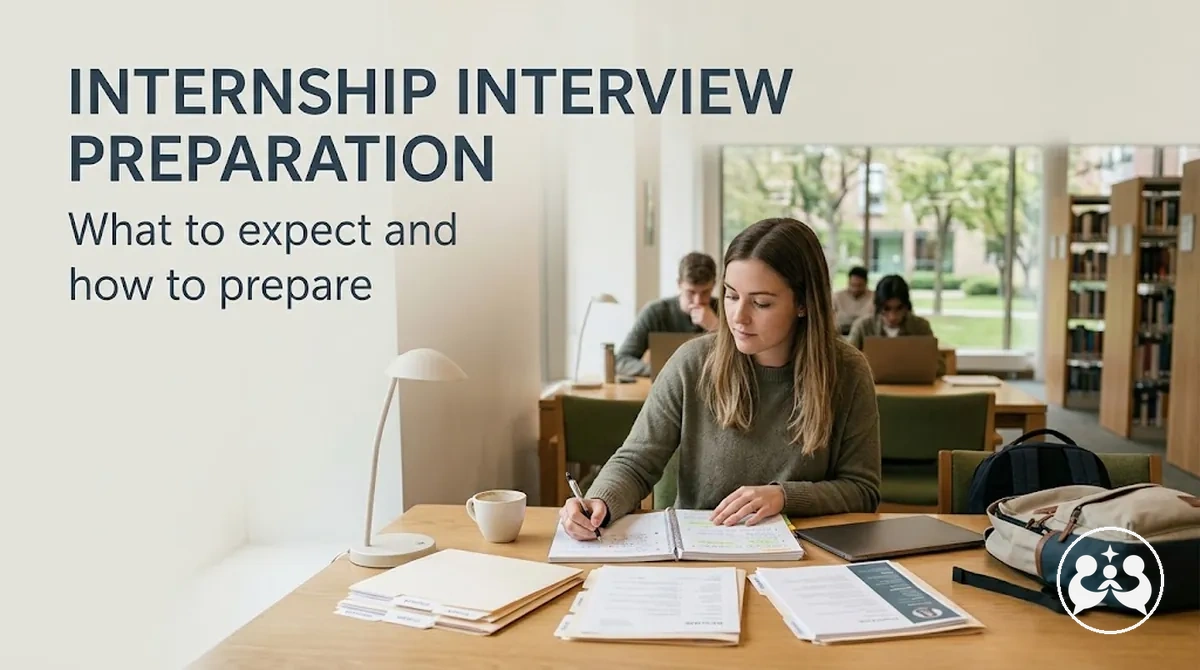
Internship interview preparation roadmap
Start with the first readiness cue you cannot yet meet. Each stage turns interview preparation into a concrete output you can check before moving on.
- Understand the opportunityKnow the role, employer context, main responsibilities, and relevant expectations.Ready cue: you can explain what the internship involves and why it interests you.
- Match evidence to the roleChoose genuine examples from study, projects, work, volunteering, or other responsibilities.Ready cue: you can state what you did, what it demonstrates, and why it is relevant.
- Practise adaptable answersRehearse the ideas and evidence aloud rather than memorising fixed wording.Ready cue: you can answer clearly in different wording while keeping the evidence consistent.
- Prepare useful questionsUse questions to close real information gaps about the role, team, expectations, learning, or next steps.Ready cue: your questions seek information you do not already have.
- Verify access and readinessConfirm time, location or meeting access, requested materials, and relevant contact details.Ready cue: no unresolved practical issue should prevent you from attending and participating.
First-time candidates and students with limited work experience can still prepare credible evidence from coursework, projects, volunteering, extracurricular activities, or other responsibilities that relate to the role.
Effective preparation focuses on identifying what those experiences show about your skills, motivation, and potential so you can explain them clearly during the employer's assessment.
The exact interview format, questions, assessment criteria, and expectations can vary by employer, role, interview stage, and whether the conversation is conducted in person or remotely.
Preparation can improve your readiness for those variations, but it cannot guarantee a particular hiring outcome.
Table of Contents
What to Expect in an Internship Interview
An internship interview usually involves a conversation between the candidate and interviewer about the role, the candidate's motivation, and evidence of relevant skills or potential.
It also gives both sides an opportunity to assess fit, although the exact interview process can differ by employer.
The interaction may involve one interviewer or several people, and the questions may explore the candidate's experience, goals, motivation, skills, and examples of how they have approached relevant situations.
The setup can vary with the employer, role, and stage of the interview process, so candidates may encounter an initial screening conversation or a more role-focused discussion.

Later stages may place greater emphasis on role-specific evidence, while an earlier stage may focus more broadly on the candidate and their interest in the opportunity; neither pattern is universal.
Knowing the broad areas that may arise provides a useful mental model, while detailed preparation for common internship interview questions is a separate task.
Interview Format and Typical Duration
Internship interview format and duration can vary by employer, role, and stage of the interview process.
The interview setup may be one-to-one or a panel, while the channel may be a video interview or an in-person interview; there is no single duration that applies to every internship interview.
These variables change what a candidate can expect from the conversation: an earlier screening may be shorter and broader, while a later role-focused interview may involve more detailed discussion or additional interviewers.
The image illustrates how one-to-one, panel, and remote setups can differ without implying a fixed interview length.
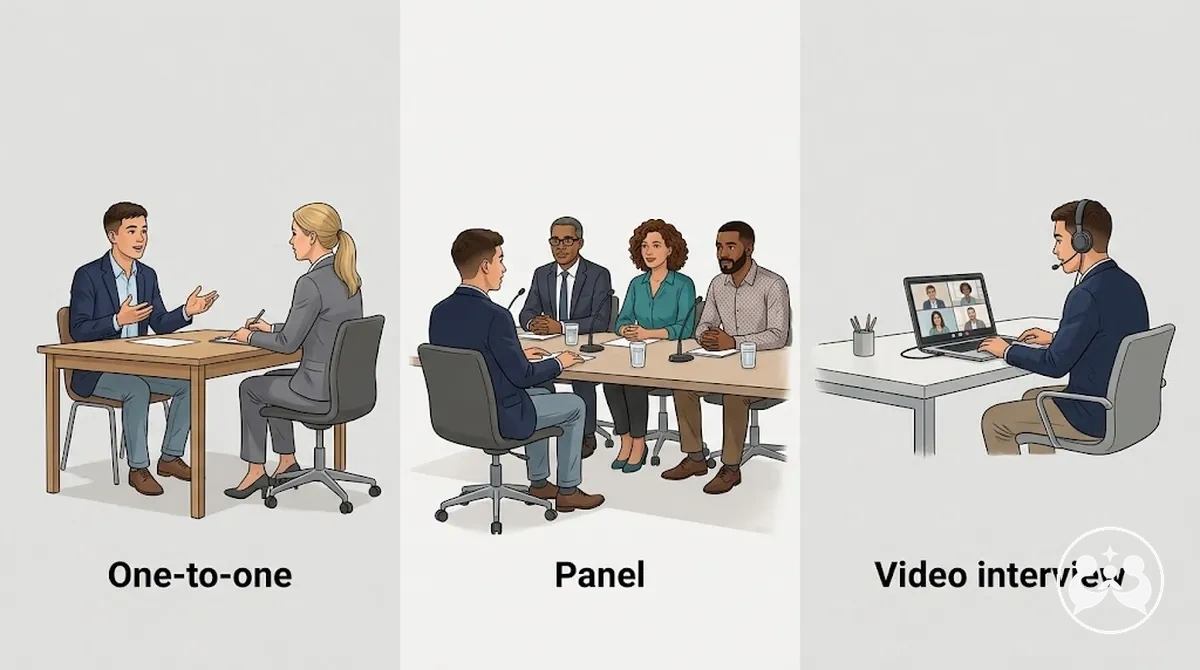
Duration should be interpreted in the context of the stage, role, employer, and interview setup rather than on its own.
Duration alone does not indicate interview quality or predict the hiring outcome.
What Interviewers Are Usually Assessing
Internship interviewers commonly assess a candidate's motivation for the role, relevant skills or potential, communication, learning orientation, and fit with the work.
They look for evidence that helps them judge how the candidate may contribute and develop in an internship context.
The exact assessment criteria and the weight given to each can differ by employer, role, and internship.
The image connects these assessment areas with the types of candidate evidence that may demonstrate them.
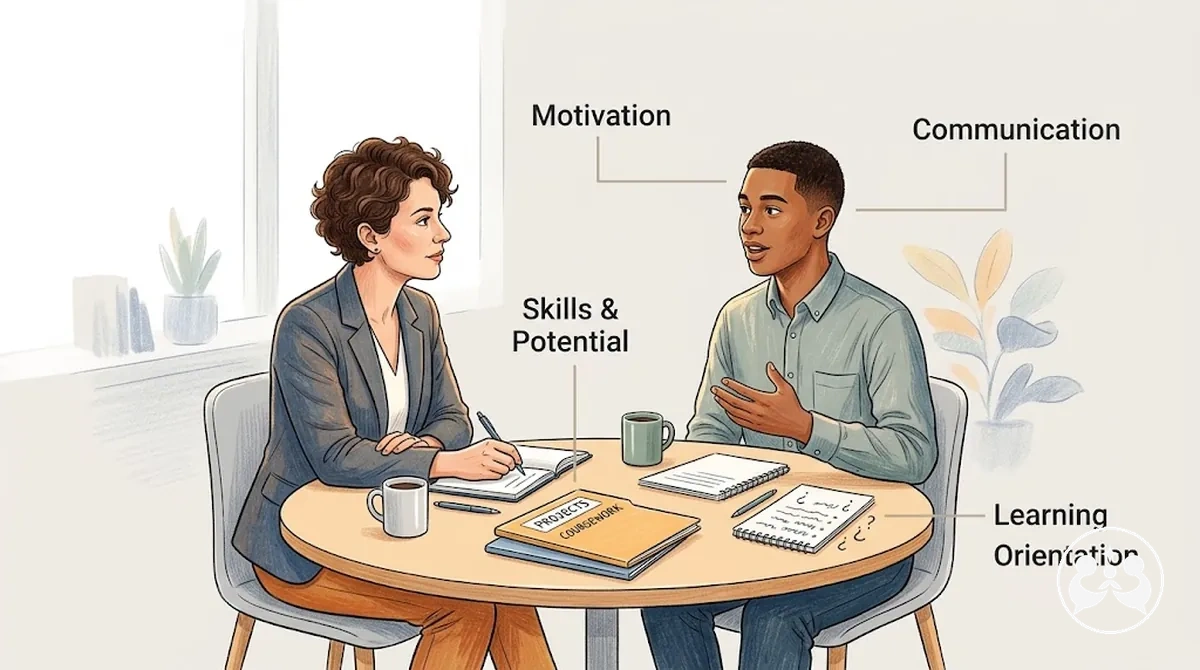
The criteria below show what an interviewer may assess, the evidence that can support that assessment, and why it may matter for the role.
- Motivation: Evidence such as a clear reason for applying, relevant interests, or goals connected to the role can demonstrate that the candidate understands the opportunity and has a considered reason for pursuing it.
- Skills and potential: Coursework, projects, volunteering, extracurricular activities, or previous responsibilities can provide evidence of relevant skills and the potential to apply them to the role, even when the candidate has limited employment experience.
- Communication: Clear explanations and specific examples can show how effectively the candidate communicates relevant information and help the interviewer understand the evidence being presented.
- Learning orientation: Examples of responding to feedback, learning a new task, or adapting to a challenge can demonstrate willingness and capacity to learn, which may be particularly relevant where an internship includes substantial development.
- Fit with the work: Evidence that connects the candidate's interests, capabilities, and working approach with the responsibilities can help an interviewer assess alignment with the role; fit is not established by polished delivery alone.
For a first-time applicant, demonstrated potential can come from relevant projects, study, volunteering, or other responsibilities rather than extensive prior employment.
No single criterion, including academic performance or previous work experience, determines suitability across all internships.
How to Prepare for an Internship Interview
Internship interview preparation should follow a practical sequence: research the company and role, select relevant evidence and examples, practise communicating your answers, prepare questions, and verify interview-day logistics.
The goal is readiness and flexible communication rather than memorising a perfect script.
Following this order helps connect what the employer expects with the evidence you plan to discuss before you practise delivering it.
It also leaves time to confirm timing, materials, and access requirements that depend on the employer and interview format.
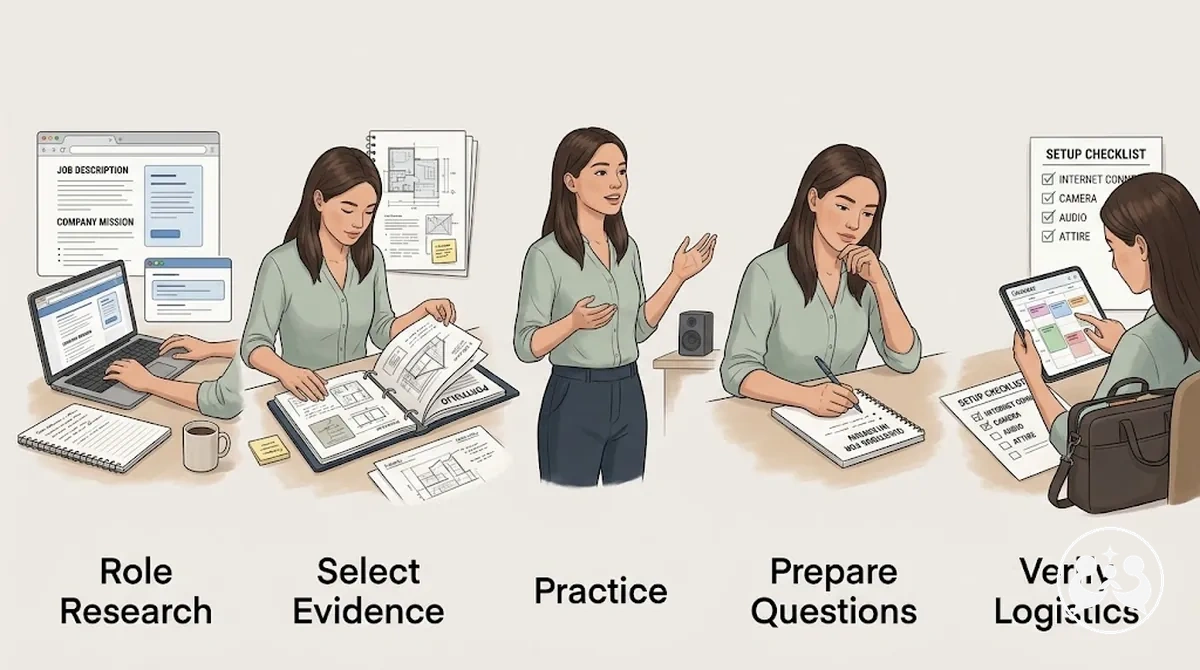
- Understand the opportunity. Research the company, role, responsibilities, and stated expectations so you know what the internship involves. This step is complete when you can explain the opportunity and identify the main qualities or skills it appears to require.
- Select relevant evidence. Choose examples from study, projects, work, volunteering, or other responsibilities that demonstrate skills relevant to the role, then structure strong interview answers so the evidence can be communicated clearly without scripting every response.
- Practise communicating your answers. Practise explaining your motivation and examples aloud so you can communicate them with clarity and adapt your response to the questions asked. Aim for familiarity with your evidence rather than memorised wording.
- Prepare questions. Identify questions that can help you understand the role, team, expectations, or internship experience more clearly. Keep them relevant to information you still need rather than repeating details already supplied by the employer.
- Verify logistics. Confirm the interview timing, location or video access, requested materials, and any employer-specific instructions. Readiness means knowing how and when to attend and having any required materials or access available beforehand.
Understand the Company and Internship Role
Useful company and internship role research should give you enough context to understand what the company does, what the role involves, and which interests or abilities are relevant to it.
Focus on information that can influence your motivation, examples, or questions rather than trying to collect every available fact.
The most useful findings connect the role description, team or function, company priorities, and expected skills with a specific preparation decision.
The annotations below illustrate how role and company information can be highlighted for that purpose.
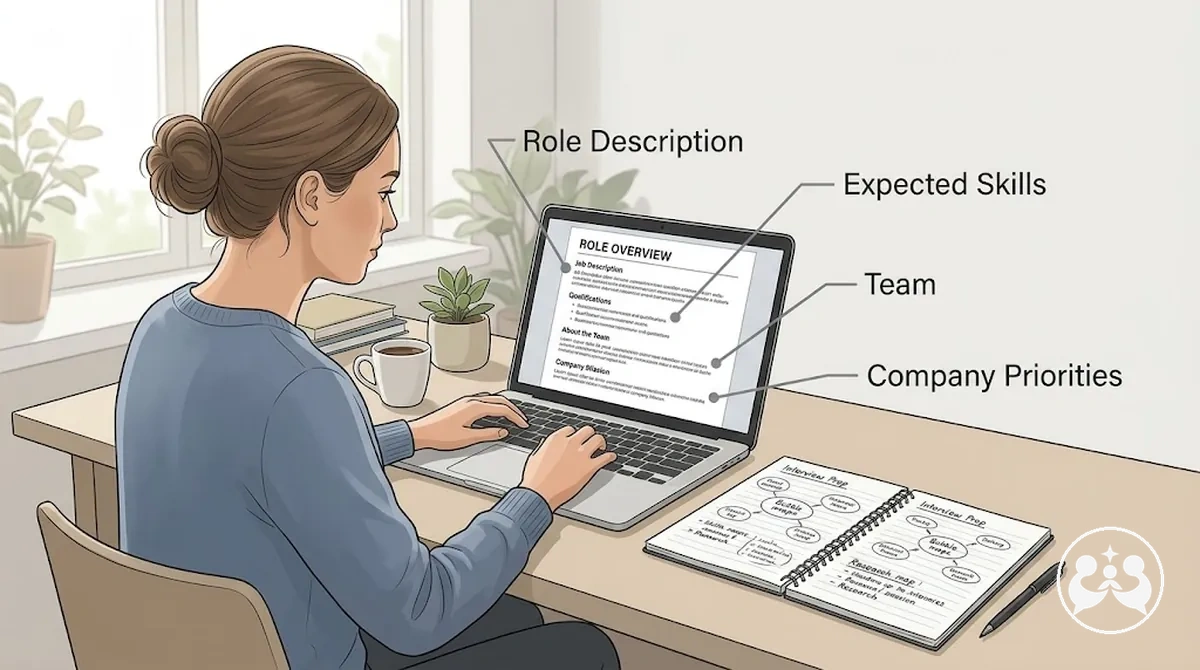
- Role description: Identify the main responsibilities and recurring tasks so you can select examples that demonstrate relevant experience, skills, or potential.
- Team or function: Note where the internship sits within the organisation and what that function appears to do so your motivation and questions reflect the work you may encounter.
- Company priorities: Use priorities that the company states publicly and that relate to the internship to understand which aspects of its work may be relevant to your motivation or questions.
- Expected skills: Identify skills or qualities stated in the role description and connect them with evidence from your own projects, study, work, volunteering, or other responsibilities.
These findings should help you explain why the opportunity interests you, choose relevant evidence, and prepare questions that address genuine information gaps; you can research the company before your interview in more depth where needed.
Role-specific information that changes an answer, example, or question is more useful for interview preparation than collecting generic company facts with no clear connection to the internship role.
Prepare Examples That Show Your Skills and Fit
Strong examples can come from paid work or from coursework, projects, volunteering, extracurricular activities, and other responsibilities when they provide relevant evidence of your skills, behaviour, motivation, or learning potential.
Part-time work can be useful evidence, but paid employment is not required for an example to be credible.
Select each example by identifying the situation or task, the action you personally took, the skill or other attribute that action demonstrates, and its relevance to the internship role.
The connection should be explicit: an activity is useful as evidence only when your own action supports the attribute you want the interviewer to understand.
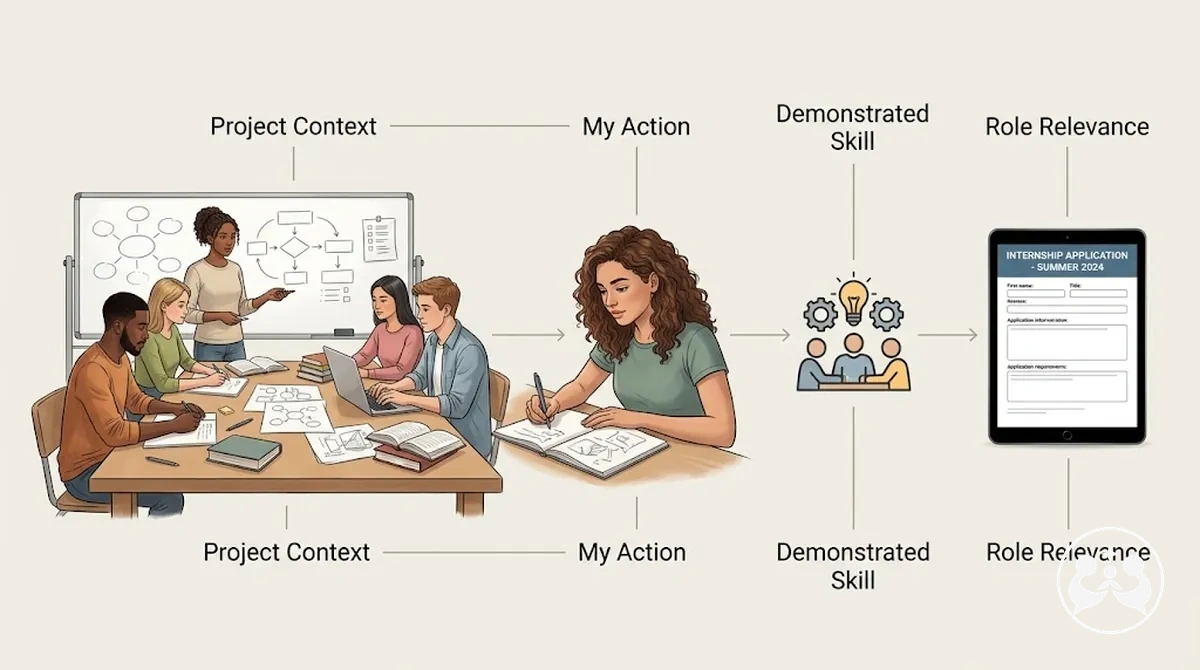
- Coursework: Use an assignment or academic task when your action demonstrates a relevant skill, such as analysis, communication, organisation, or collaboration, and connect that skill to the internship responsibilities.
- Projects: Select a project where your individual contribution is clear, then explain what you did and which role-relevant skill or learning potential that contribution illustrates.
- Volunteering: Use a volunteering responsibility when your action provides evidence of a relevant behaviour or skill, such as coordinating with others, solving a problem, or adapting to a new task.
- Extracurricular activities: Choose an activity only when you can identify a concrete responsibility or action that demonstrates an attribute relevant to the internship.
- Part-time work or other responsibilities: Focus on what you personally handled or learned and how that evidence relates to the role rather than treating the activity itself as proof of suitability.
For example, a student who coordinated tasks with classmates during a coursework project could use that experience as evidence of collaboration if they clearly explain their own action and why collaboration matters for the internship role.
Candidates who need to prepare with little or no work experience can apply the same test to projects, coursework, volunteering, or other genuine responsibilities without fabricating or exaggerating achievements.
Practise for Clear, Natural Answers
Interview answer practice should improve clarity, relevance, and recall while keeping your delivery natural and conversational.
Practise the ideas and evidence you want to communicate rather than turning each response into a memorised script.
Flexible recall means being able to explain the same relevant idea in different wording when the question or conversation changes.
The amount of rehearsal needed can vary by candidate and answer, so use the quality of your response—whether it addresses the question clearly and stays relevant—as the reason to repeat or adjust it.
- Answer aloud. Give your response as if you were speaking to an interviewer, using the evidence and main ideas you want to recall rather than reading or reciting fixed wording.
- Check relevance. Ask whether the response actually addresses the question and whether each point helps communicate the evidence or idea that matters.
- Tighten unnecessary detail. Shorten or clarify parts that distract from the main answer while retaining the context needed to understand your point.
- Repeat with variation. Answer again using different wording or a slightly different question so your recall depends on the underlying ideas rather than memorised phrasing.
Practising ideas allows wording to adapt to the conversation, whereas memorising wording can make recall depend on reproducing a fixed sequence.
You can practise answers without sounding rehearsed by keeping the evidence and key points stable while allowing the wording to vary.
Plan Questions for the Interviewer
Prepare genuine questions for the interviewer that address information gaps about the internship role, expectations, team, learning opportunities, success measures, or next steps.
Useful candidate questions help clarify information you still need while demonstrating informed interest based on what you already know about the opportunity.
Choose each question according to a real information need and the interview context rather than using a generic script.
Research should help separate useful information-seeking questions from questions answered by basic research; for example, if the role description lists responsibilities but does not explain how performance is assessed, asking about success measures can clarify expectations.
- Role expectations: Ask about priorities or responsibilities when the internship role description leaves an important part of the day-to-day work or expectations unclear.
- Team and work context: Explore how the intern works with the team when collaboration, supervision, or interaction with other functions is relevant but not clear from the available information.
- Learning opportunities: Ask about feedback, support, or development when understanding how the internship supports learning is important to your decision and has not already been explained.
- Success measures or next steps: Ask how success is evaluated when performance expectations remain unclear, or ask about next steps when the interviewer has not already explained the remaining process.
The most useful questions to ask the interviewer are specific enough to address a genuine information gap without repeating facts available through basic research.
For example, research that identifies a collaborative project-based role can support a more specific question about how interns contribute to team projects rather than a generic question about what the company does.
Prepare Interview-Day Essentials and Logistics
Interview-day logistics should remove avoidable access, timing, material, and presentation problems so you can focus on the conversation and assessment.
Confirm the practical details that affect whether you can join or arrive on time, access the interview, and use any requested materials when relevant.
The exact checks depend on whether the interview is in person or remote and on the employer's instructions.
Use the checklist to verify time and access first, materials second, and appearance or contingency details last rather than assuming one format, dress standard, or document requirement applies to every interview.
- Confirm the time and location or meeting link: Check the scheduled time, time zone if relevant, physical location, or remote meeting link so an incorrect detail does not delay access.
- Check the route if attending in person: Review how you will reach the location and allow a sensible arrival buffer based on the journey and venue rather than relying on a universal arrival time.
- Run a connection test if attending remotely: Test the meeting link, device, internet connection, camera, and audio in advance so access or technical problems are less likely to interrupt the start of the interview.
- Prepare requested documents: Bring or make accessible any documents the employer has asked for so missing materials do not limit your ability to provide requested information.
- Prepare work samples if requested or relevant: Make suitable work samples easy to access when the employer has asked to see them or when they directly support discussion of your experience.
- Keep contact details available: Save relevant contact details so you can communicate promptly if an access, travel, or scheduling problem occurs.
- Choose suitable attire for the context: Select attire appropriate to the organisation, internship role, and interview format rather than assuming a particular level of formality applies universally.
- Allow an appropriate arrival buffer: For an in-person interview, allow extra time based on the route and venue; for a remote interview, be ready to access the meeting link before the scheduled start without assuming one universal buffer applies.
How Long to Prepare for an Internship Interview
There is no single correct preparation duration for an internship interview. A fixed number of hours or days is not a reliable requirement for every candidate because the remaining work depends on your current readiness and the interview's demands.
What Changes the Preparation Time You Need
The preparation time you need changes with your current readiness and the demands of the interview.
Role familiarity, company research, interview stage, interview format, technical depth when relevant, prepared examples, and prior practice can increase or reduce the remaining work, but their relative importance depends on the particular internship and interview.
Assess each readiness factor by its current state and the preparation consequence that follows.
A lower remaining-work condition means the relevant preparation is already sufficiently developed for the interview, while a higher remaining-work condition identifies an area where additional research, evidence preparation, or practice may be useful.
- Role familiarity: If you already understand the internship's main responsibilities and requirements, less role-focused research may remain; limited familiarity increases the work needed to understand what the role involves and which evidence is relevant.
- Company research: If relevant company research is already complete, you can spend less remaining effort establishing basic context; important unanswered questions about the employer or internship increase the research still needed.
- Interview stage and interview format: A familiar general interview format or earlier-stage conversation may leave fewer format-specific gaps, while a specialised or later-stage interview may require additional preparation when its demands differ from what you have already prepared for.
- Technical depth: When the internship involves role-relevant technical discussion or assessment, limited readiness for that expected depth may require additional preparation; internships without that expectation do not create the same technical preparation need.
- Prepared examples: If you already have relevant, specific examples that demonstrate the evidence you may need to discuss, less example development remains; weak, incomplete, or irrelevant examples increase the work needed to select and clarify stronger evidence.
- Prior practice: If prior practice allows you to recall and communicate your main evidence clearly and naturally, less rehearsal may remain; difficulty recalling relevant points or explaining them clearly indicates where further practice may be useful.
How to Prioritise Preparation When Time Is Short
When preparation time is limited, give priority to the tasks that most directly affect your understanding of the role and your ability to provide relevant evidence.
Address high-impact readiness gaps before polishing, then use the remaining time for practice and logistics.
Prioritise by consequence: complete the work that would otherwise leave you unable to understand the opportunity, answer relevant question themes, support your answers with examples, or attend the interview without avoidable practical problems.
If some preparation is already complete, move past it and allocate the limited time to the next unresolved priority rather than repeating finished work.
- Confirm the role context and employer context. Establish what the internship involves and the relevant employer context so later preparation is based on the actual opportunity. This priority is complete when you can identify the main responsibilities and expectations relevant to your preparation.
- Identify likely question themes. Use the role and interview context to identify the main themes you may need to address, without trying to predict or memorise every possible question. Move on when you know which areas require evidence or explanation.
- Select strong examples. Choose a few relevant examples that provide evidence for the most important themes and make your own actions clear. Prioritise usable evidence over building a large inventory of examples.
- Practise for answer clarity. Practise explaining the main points and examples aloud so your answers are easy to follow and relevant to the question. Focus on communicating the evidence rather than memorising fixed wording.
- Prepare questions for the interviewer. Prepare one or two informed questions that address genuine information gaps about the internship, expectations, team, or next steps rather than spending limited time developing a long question list.
- Remove practical logistics risks. Confirm the timing, location or meeting access, requested materials, and other relevant logistics so an avoidable practical problem does not interfere with attending the interview.
For example, if you are preparing the evening before and still lack role context, relevant examples, or confirmed interview access, address those gaps before spending time polishing minor wording or presentation details.
Last-minute triage can improve minimum viable readiness, but it does not mean every preparation gap can be mastered in the available time.
How to Check You Are Ready for the Interview
Internship interview readiness is based on observable preparation conditions rather than feeling completely confident.
You are reasonably prepared when you can explain your interest in the role, recall relevant examples, respond without depending on memorised wording, ask useful interviewer questions, and attend without unresolved logistics problems.
Use the checklist to locate remaining preparation gaps rather than to measure perfection or predict interview success.
Each item has a practical pass cue that shows whether the area is ready enough for the interview or needs further attention.
Some nervousness or an imperfect answer can coexist with adequate preparation, so nervousness alone does not indicate that you are unprepared; separate emotional discomfort from actual preparation gaps when you manage internship interview nerves.
Repeated gaps in role knowledge, examples, answer recall, or logistics are more useful signals of what to revisit.
Checklist completion does not guarantee an interview outcome.
Where the checks reveal unresolved preparation problems, use them to identify what needs attention and distinguish those gaps from broader internship interview mistakes to avoid.