
How to Structure Strong Internship Interview Answers
Structure a strong internship interview answer by answering the question first, developing the most relevant example around your own actions and supporting evidence, and ending with the result and why it matters. Keep only the context and detail needed to make that chain clear; answer length should expand or contract with the question and evidence required.
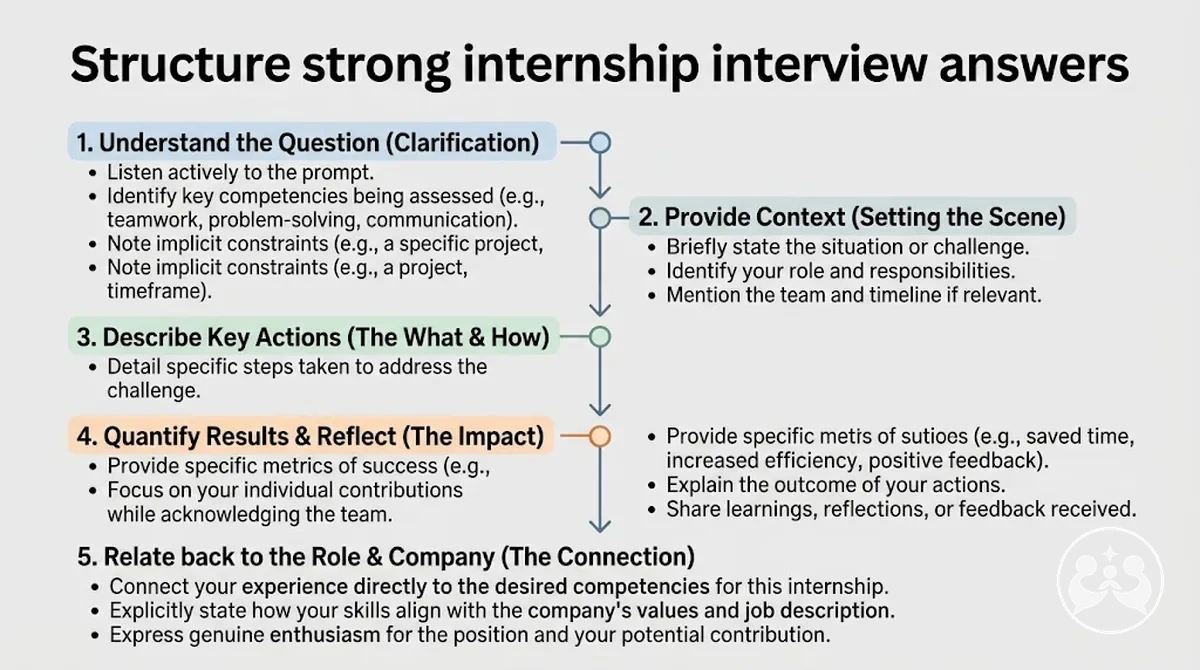
Internship interview answer blueprint
Build the response as one connected line of reasoning: answer what was asked, prove the point with relevant evidence, then show what followed and why it is relevant.
- Beginning: answerState the direct answer or the minimum context needed to understand it. Make the skill, experience, or claim being discussed explicit.
- Middle: evidenceShow the candidate’s most relevant decisions and actions. Use concrete detail that supports the claim, and compress background that does not.
- End: resultState the supported outcome, learning, improvement, or implication, then connect it back to the question and the contribution demonstrated.
- Example fit
- The behaviour and evidence should match what the question is assessing.
- Specificity
- Prefer observable, relevant detail over a larger quantity of detail.
- Length
- Use enough time to make the answer complete; do not force every response into one fixed duration.
- Final check
- Keep a detail when it adds necessary context, evidence, result, or clarity; otherwise consider cutting it.
The structure is adaptable rather than universal. Some questions need a specific example with clear action and result, while others need a concise explanation; in both cases, clarity comes from selecting information that supports the answer rather than including every available detail.
Table of Contents
Build Each Answer With a Clear Beginning, Middle, and End
The beginning–middle–end interview answer structure organises one response into a clear sequence, with each stage performing a different informational job.
It is most useful when the question requires enough context, evidence, and explanation to show how the candidate reached a result without turning the answer into an exhaustive story.
The beginning establishes the direct answer or essential context, the middle develops the candidate’s relevant actions and evidence, and the end states the result and its relevance.
The sequence helps keep those functions distinct while still connecting them as one complete interview answer.

- Beginning: Start with the direct answer or the minimum context needed to understand it. Before moving on, check that the response has addressed the question rather than only setting the scene.
- Middle: Develop the example through the candidate’s most relevant actions and supporting evidence. Before moving on, check that the actions show the candidate’s contribution and remain connected to the point being made.
- End: State the result, then explain its relevance or implication. Check that the result follows from the example and helps the interviewer understand what the experience demonstrates.
This structure is adaptable across appropriate interview questions, so the amount of context and evidence can change with the question rather than following one fixed formula.
Candidates who need the mechanics of a named framework can apply the STAR answer framework, but the broader beginning–middle–end sequence remains focused on clarity and evidence rather than memorised delivery.
Begin by Answering the Question Directly
The opening of an interview answer should answer the interviewer’s question or state the main point before unnecessary background detail.
A direct answer makes the requested skill, experience, or claim explicit so its relevance is clear from the start.

Brief context is useful when it changes how the interviewer should interpret the answer, such as clarifying the situation surrounding an experience or why a particular choice mattered.
Background that does not change that interpretation can usually wait or be omitted.
A useful check is whether the opening still communicates the main point when the scene-setting is removed; if it does, that extra setup may not be necessary.
Once the essential context is clear, the response is ready to move into the supporting example.
Develop the Example Around the Most Relevant Actions
The middle of the example should prioritise the candidate’s own action that best demonstrates the requested skill or contribution.
Select actions for their relevance to the main point rather than recounting all the background activity around the experience.

Keep the decisions, responsibilities, and steps that show what the candidate contributed, while compressing background detail that only explains the setting.
When the actions form a meaningful sequence, order them so the interviewer can follow how one decision or step led to the next; otherwise, prioritise them by relevance rather than chronology.
Team activity can provide context, but the response should distinguish the candidate’s contribution from the broader group effort.
At this stage, the focus is choosing the actions that belong in the example, while finer concrete detail can be added where it supports those selected actions.
Close With the Result and Why It Matters
The ending of the interview example should state the result of the candidate’s action and connect that outcome to the answer’s main point.
This closes the example by showing what happened and why the result is relevant to the skill or contribution being demonstrated.

A credible result does not need to be numerical or entirely positive; the evidence may support an observable outcome, learning, improvement, or a role-relevant implication.
If the outcome was mixed or limited, state that accurately and explain what the candidate learned or what the experience demonstrated without manufacturing a stronger effect.
Use metrics only when they accurately reflect the result and can be supported by the example.
The ending is useful because its relevance connects the outcome to the candidate’s actions and the skill being discussed, not because the result is positive by itself.
Make Interview Examples Specific and Evidence-Based
A specific example identifies a relevant situation, makes the candidate action and personal contribution observable, and uses evidence to support the skill being claimed.
Concrete detail adds credibility when it shows what the candidate did, why that contribution is relevant to the question or role, and what outcome supports the claim.
Specificity should therefore be judged by informational value rather than the amount of detail included.
The main criteria test whether the interview example makes the candidate’s contribution and supporting evidence easier to identify and evaluate.

- Relevance: The example should match the question or role closely enough that the experience demonstrates the skill being discussed.
- Personal contribution: The candidate action should distinguish the candidate’s own responsibility, decision, or contribution from the broader activity of a group.
- Concrete detail: Include a supporting fact such as a relevant decision, timeline, responsibility, or scope when it makes the action more observable and can be stated accurately.
- Supporting evidence: The details should support the claim being made rather than merely adding description, so the connection between the example and the claimed skill remains clear.
- Meaningful outcome: State a result, learning, improvement, or other supported outcome that shows what followed from the experience without manufacturing a stronger effect than the evidence allows.
Specificity is not the same as length, and an evidence-based example does not always require numerical detail.
The useful level of detail is the amount needed to make the relevant candidate action, supporting evidence, and outcome clear and accurate.
These criteria provide the evaluation frame for deciding which details deserve emphasis within an interview example.
Choose an Example That Directly Fits the Question
The strongest example is the one whose central behaviour and evidence match what the question is assessing.
Its relevance comes from demonstrating the requested skill or behaviour through the candidate’s own experience rather than relying on an unrelated experience that simply sounds impressive.

Assess the fit by comparing the question focus with the candidate role, actions, evidence, and outcome in the example.
Different prompts can require different forms of evidence, so it is useful to distinguish behavioural and situational questions when that difference changes what an appropriate response needs to demonstrate.
- Question focus: Identify the skill, behaviour, or contribution the question is asking the candidate to demonstrate.
- Example fit: Check that the candidate role and actions in the example actually demonstrate that skill or behaviour.
- Supporting evidence: Keep evidence that connects the candidate’s contribution to the question rather than detail that only makes the experience sound substantial.
- Outcome: Use an outcome that supports the relevance of the example and remains consistent with what the candidate actually contributed.
Show Your Actions With Concrete Details
Concrete detail makes the candidate’s own action observable by showing what they personally decided, changed, created, communicated, solved, or delivered rather than merely asserting a contribution.
- Responsibility
- Make the candidate’s responsibility clear without turning the answer into an exhaustive account of every task.
- Useful detail
- Add a decision, scope, timeline, or process detail when it materially clarifies the action and can be stated accurately.
- Team setting
- Distinguish the candidate’s responsibility from the wider group process so the individual contribution remains clear.
- Numbers
- Use figures only when they accurately support the evidence; exact numbers are unnecessary when an observable decision, task, process, or other detail already provides sufficient clarity.
Specificity should support the relevance of the action rather than add detail for its own sake.
Use Evidence That Supports the Skill or Claim
Evidence should support the exact skill or claim made in the interview answer rather than simply add detail.
- Relevant support: Use a fact, action, result, or corroborating detail that substantiates what the candidate says the example demonstrates.
- Action or fact: Connect the claim to something observable that shows what occurred and what the candidate contributed.
- Result or corroboration: Add an observable result or other supporting detail when it materially strengthens the claim.
- Implication: Make clear why the evidence matters for the skill being discussed rather than relying on detail that merely sounds impressive.
An assertion without supporting evidence leaves the claimed skill unsubstantiated, while relevant evidence shows how the candidate’s experience supports the claim. The amount of evidence matters less than the relationship between each detail and the claim.
Qualifications or training can support a claim when they are pertinent to the question and skill. When the interviewer asks for an example of behaviour or experience, however, those credentials do not automatically substitute for evidence of the candidate’s relevant action or result.
Match Answer Length to the Question and Evidence Required
Interview answer length should match the question scope and the evidence required rather than follow one fixed duration. A response should be concise enough to keep the main point clear while remaining complete enough to answer the question with relevant support.
For many interview responses, roughly 60–90 seconds can be a useful orientation, not a mandatory limit. Existing interview guidance varies more widely: InterviewCopilot suggests 30–60 seconds for a straightforward question and 90–120 seconds for a detailed example, while Indeed describes a broader range of 30 seconds to four minutes depending on the question context.
These differing ranges are best treated as contextual guidance rather than a universal threshold.
- Question type
- A simple factual question can usually be answered more briefly, while an example-based question often needs more time for the relevant evidence.
- Scope and complexity
- A narrow question usually needs less explanation; a complex question may require additional detail to make the response complete.
- Interview format
- Conversational interviews may invite follow-up questions, so the first response can stay focused instead of anticipating every possible detail.
- Interviewer cues
- Follow-up questions or cues can indicate whether further explanation is useful or whether the response should conclude.
Completeness and relevance should take priority over reaching a particular duration.
Check the Answer for Clarity, Focus, and Completeness
Check the finished interview answer for clarity, focus, and completeness before treating it as ready.
The verification should show whether the response answers the question directly, provides relevant evidence, and remains complete without unnecessary detail.
Each check tests a quality condition already established during answer construction rather than reopening the writing process.
Treat each item as a pass when the condition is clearly met; if it is missing, unclear, or contextually inappropriate, revise that part of the answer.
- Question alignment: Pass if the response clearly addresses the question; revise if its main point is only loosely related.
- Direct opening: Pass if the direct opening states the answer or central point promptly; revise if unnecessary background delays it.
- Relevant example: Pass if the relevant example supports what the question asks; revise if it does not demonstrate the required skill or behaviour.
- Candidate action: Pass if the candidate action and personal contribution are visible; revise if collective language makes individual responsibility unclear.
- Evidence and result: Pass if the evidence supports the claim and leads to a meaningful result or implication; revise if support is missing or irrelevant.
- Length and focus: Pass if the answer length suits the question and evidence required; revise if unnecessary detail weakens focus or missing detail reduces completeness.
- Revision signal: Any failed check indicates the specific part of the finished interview answer that needs revision.
Confirm That the Answer Addresses the Question Asked
The answer should maintain clear alignment with the specific question from the opening through the evidence to the result.
The opening should address the prompt directly, the evidence should support the requested skill, and the conclusion should reinforce the same point.
If a substantial part of the response could remain unchanged under a materially different question, that suggests the answer may be too generic and needs revision.
The check is not whether every sentence mentions the question, but whether the major answer elements remain relevant to what was actually asked.
- Opening: Pass if the opening directly addresses the question; revise if it begins with background that does not establish the relevant focus.
- Evidence: Pass if the example and evidence support the skill or behaviour the question asks about; revise if the support fits a different claim more closely.
- Closing: Pass if the result or conclusion reinforces the same point established by the question and evidence; revise if it ends on an unrelated outcome or lesson.
Remove Details That Do Not Support the Main Point
Retain a detail only when it helps the interviewer understand the main point by supplying necessary context, evidence, a result, or greater clarity.
A detail that adds length without supporting one of those functions is a candidate for removal.
Test each detail by asking what would be lost if it disappeared from the answer.
If removing it weakens essential background, evidence, relevance, or meaning, retain it; if the answer remains equally clear and supported, consider cutting it.
Repeated background, tangents, redundant adjectives, and process detail with no evidentiary value are common candidates for removal.
The aim is stronger focus, not the shortest possible response.
- Context: Retain the detail if removing it would make the situation or responsibility difficult to understand; otherwise consider cutting it.
- Evidence: Retain the detail if it supports the candidate’s action, contribution, or result; remove it if it adds no meaningful support.
- Relevance: Retain the detail if it reinforces the main point or question; cut a tangent that shifts attention to a secondary topic.
- Clarity: Retain the detail if it makes the answer easier to interpret; remove repetition or wording that adds no new meaning.
Brevity should not remove necessary evidence or context; after editing, practice structured answers naturally so the tighter structure remains clear in delivery.