
Behavioral vs Situational Questions in Internship Interviews
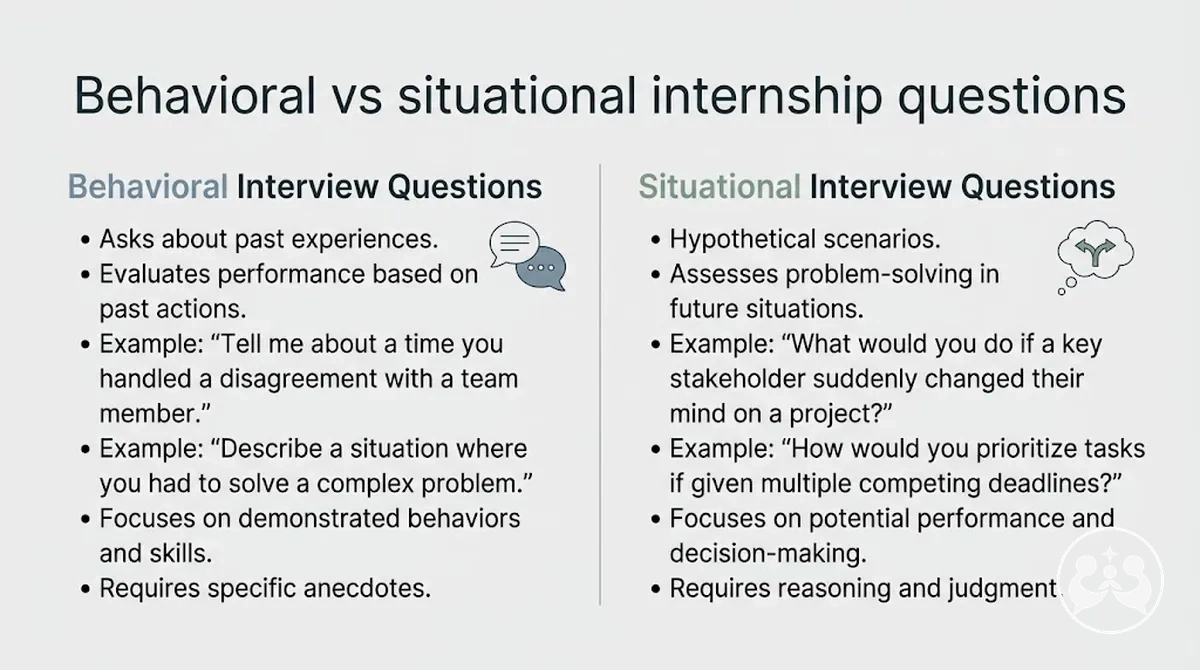
Behavioral internship interview questions ask for evidence from a real past experience—what happened, what you did, and what resulted—whereas situational questions ask how you would respond to a hypothetical scenario and why. Classify the prompt by the evidence it requests: use one specific past example for a behavioral question and a proposed action with reasoning for a situational question; if a prompt asks for both, answer each part on its own evidence basis.
Choose the evidence before you choose the answer structure
Start with what the prompt asks you to provide. Wording is a useful cue, but the requested evidence is the stronger practical classifier.
Prompt asks for an actual event
Behavioral question
- Evidence
- One relevant past experience.
- Show
- Your own actions, decisions, and contribution.
- Close with
- The outcome and, when relevant, what you learned.
Answer flow: context → your action or decision → outcome or learning.
Prompt asks about an imagined situation
Situational question
- Evidence
- A reasoned response to the proposed scenario.
- Show
- Priorities, constraints, proposed action, and trade-offs.
- Close with
- The expected consequence and any communication or escalation the situation warrants.
Answer flow: key condition → proposed action → reasoning → expected consequence.
Mixed prompt: if the interviewer asks what you would do and then asks whether you have faced something similar, give the hypothetical response first and then add the relevant past example.
Table of Contents
Behavioral Questions Ask What You Did While Situational Questions Ask What You Would Do
Behavioral questions usually ask what you did in a real past experience, while situational questions ask what you would do in a hypothetical scenario.
The shared comparison basis is the prompt’s time orientation, evidence source, and expected response basis.
The distinction changes how an internship candidate should interpret the prompt.
Behavioral questions draw on evidence from an actual event and the candidate’s actions, while situational questions request a proposed action and reasoning for a workplace situation.

| Dimension | Behavioral Question | Situational Question | Response Implication |
|---|---|---|---|
| Time orientation | Past: what the candidate actually did | Hypothetical: what the candidate would do | Identify whether the prompt requests a past event or a proposed response. |
| Evidence source | A specific past experience or actual event | A hypothetical scenario or proposed workplace situation | Use real experience for a behavioral response; use reasoned proposed action for a situational response. |
| Typical prompt form | Requests an example of previous behaviour or action | Presents a situation and asks how the candidate would respond | Interpret the requested evidence before deciding how to frame the response. |
| Expected response basis | What happened, what the candidate did, and the outcome | What the candidate would do and the reasoning behind that proposed action | Base the response on the type of evidence the interview prompt requests. |
How to Identify Behavioral and Situational Questions From Their Wording
Identify behavioral and situational interview questions by checking both the wording cue and the evidence requested.
Wording and time orientation provide useful signals, but the stronger classifier is whether the interview prompt asks for an actual event or a hypothetical response.
First, check whether the prompt points backward to a past example or forward to a hypothetical scenario.
Then check the response basis: a behavioral question asks for evidence from an actual event, while a situational question asks the candidate to reason through a proposed scenario.
Using both checks prevents classification from depending on an isolated word or phrase.

| Check | Behavioral Signal | Situational Signal | Interpretation |
|---|---|---|---|
| Time orientation | Points to a past experience or actual event | Points to a hypothetical or proposed scenario | Use time orientation as a classification signal, then confirm the evidence requested. |
| Evidence requested | Asks what the candidate actually did in a past example | Asks what the candidate would do in a hypothetical situation | Treat the requested response basis as the stronger classifier when other signals are ambiguous. |
| Common prompt wording | Requests a past example, experience, or action | Asks for a proposed response to an imagined situation | Treat wording as a supporting cue rather than definitive proof of the question type. |
Wording alone is not definitive because employers and sources may phrase or label similar interview prompts differently.
If a prompt contains mixed or ambiguous wording, classify it by the evidence requested: an actual event supports behavioral classification, while a proposed response supports situational classification.
Wording Signals That Indicate a Behavioral Question
Behavioral interview questions commonly ask the candidate to retrieve a specific past event rather than propose a future response.
A wording cue that points backward usually signals a request for a past experience and the candidate action within it.

- Tell me about a time: asks for a specific example from a past experience and what the candidate did.
- Give me an example: points to a real example where the candidate can describe an event, action, and result.
- Describe a situation: often points to a past example when the rest of the prompt asks what happened or what you did; by itself, “situation” does not determine the question type.
- What happened: asks for the relevant circumstances or events within the specific past example.
- What did you do: focuses the evidence request on the candidate action rather than only the surrounding situation.
- What was the result: asks what followed from the candidate's actions in that past event.
These phrases are useful indicators, but wording alone does not confirm that an interview prompt is behavioral.
The stronger diagnostic signal is the evidence request: whether the candidate must describe a real past experience, specific example, and their own action rather than a hypothetical plan.
Wording Signals That Indicate a Situational Question
Situational interview questions commonly present or imply a hypothetical scenario and ask what the candidate would do.
This wording signals a proposed response to a workplace situation rather than a completed past event.

- What would you do if: presents a hypothetical scenario and asks for the candidate's proposed action and reasoning.
- How would you handle: asks how the candidate would respond to a proposed workplace situation or challenge.
- Suppose you faced: introduces an imagined condition and invites reasoning about the candidate's intended action.
- Imagine a situation where: establishes a hypothetical workplace context before requesting a proposed response.
- What would you prioritise: asks the candidate to explain a priority or decision within a proposed scenario.
These wording cues direct the candidate toward intended action and reasoning rather than recollection of a completed event.
However, the words “situation” or “scenario” alone do not establish the question type.
Confirm the response basis by checking whether the prompt requests hypothetical reasoning and a proposed response.
When Behavioral and Situational Labels Overlap
Behavioral and situational labels may overlap because employers and career sources can use the terminology differently.
When terminology overlap creates ambiguity, classification should rely on the task the prompt gives the candidate and its evidence requirement.

A mixed prompt may present a hypothetical workplace situation and then ask whether the candidate has faced something similar before.
The first part invites hypothetical reasoning and a proposed action, while the follow-up requests past-event evidence from an actual experience.
When the label and requested task do not align neatly, the evidence requirement provides the practical boundary.
Past-event evidence points to behavioral responding, while a proposed action to an imagined situation calls for hypothetical reasoning.
What Each Interview Question Type Is Designed to Assess
Behavioral and situational questions can explore the same competency while giving the interviewer different kinds of evidence.
Behavioral questions can provide evidence from previous actions, while situational questions may reveal judgment and reasoning through a proposed problem.

| Assessment Dimension | Behavioral Question | Situational Question | What It May Indicate |
|---|---|---|---|
| Evidence source | Evidence from previous actions, decisions, and outcomes in an actual experience | Reasoning and proposed action within a hypothetical scenario | How the candidate demonstrates a competency through past-behavior evidence or hypothetical judgment |
| Decision making | How the candidate made a decision and handled trade-offs in a previous situation | How the candidate would evaluate options and make a proposed decision | Judgment, reasoning, and the factors the candidate considers when making decisions |
| Communication or collaboration | How the candidate communicated or worked with others in an actual experience | How the candidate proposes to communicate or collaborate in an imagined situation | How the candidate approaches a competency such as teamwork or conflict within the stated context |
| Prioritization | How the candidate set priorities when facing competing demands in a past situation | How the candidate would rank priorities when presented with competing demands | The reasoning used to identify priorities and explain trade-offs |
| Learning or reasoning | What the candidate learned from previous actions and their outcome | How the candidate reasons through an unfamiliar or proposed problem | How the candidate reflects on experience or develops a reasoned response |
These dimensions separate the evidence collected from the competency being explored.
For example, teamwork or problem solving may be assessed through either format, but one response draws on previous actions while the other shows hypothetical reasoning.
The resulting inference is limited to what the candidate's example or proposed response demonstrates in that interview context.
The assessment focus can vary with the role, employer, question wording, and quality of the candidate's example or reasoning.
Neither question type alone establishes future performance; each response can instead indicate how a candidate has demonstrated a competency or how they would reason through a proposed situation.
Behavioral Questions Assess Evidence From Previous Actions
A behavioral response provides evidence from an actual past event by showing a specific example, the candidate's action, and the outcome.
- Candidate contribution
- Specific actions and decisions can show how the candidate communicated, collaborated, made a decision, or responded to a challenge.
- Outcome and reflection
- A clearly described outcome adds context about what followed from those actions; reflection may indicate what the candidate learned.
- Evidence quality
- Relevance and specificity make the example easier to interpret, especially when it closely matches the competency and separates the candidate's contribution from the group's actions.
- Interpretation limit
- One example supports only a limited inference about that competency and does not establish how the candidate will perform in every future situation.
Situational Questions Assess Judgment in a Hypothetical Scenario
A situational response shows how a candidate reasons through a proposed problem in a hypothetical scenario rather than reporting a past event.
- Judgment
- The proposed action and reasoning may indicate the candidate's judgment under the conditions described in the scenario.
- Priorities and trade-offs
- The priorities named can show what the candidate considers most important, while the trade-offs show how they balance competing consequences.
- Communication and escalation
- Communication choices may indicate how the candidate would involve others, while escalation conditions clarify when they would seek additional authority or support.
- Decision logic
- Connecting the scenario's conditions to the proposed action makes the intended reasoning easier to interpret.
- Interpretation limit
- A situational answer does not prove future behavior. More than one response can be defensible when the scenario allows different reasonable approaches.
Behavioral and Situational Internship Interview Question Examples
Paired prompts show how the same competency can be explored through a past experience or a hypothetical scenario.
A behavioral example asks for evidence from an actual experience, while a situational example asks for reasoning about a proposed situation.
Both prompts use prioritisation as the same competency, but they ask the candidate to support the response differently.
This matched distinction also applies within broader sets of common internship interview questions: the behavioral prompt asks for past-event evidence, while the situational prompt asks for a proposed response and its reasoning.
Examples of Behavioral Internship Interview Questions
Behavioral internship interview questions ask for a specific example from a real past event, including the candidate's actions or outcome.
These examples vary the competency while keeping that past-experience evidence requirement constant.
- Teamwork: Tell me about a time you worked with others to complete a difficult project. What did you contribute?
- Problem solving: Describe a past situation where you encountered an unexpected problem. What decision did you make, and what was the result?
- Deadline: Give an example of when you had to meet a tight deadline. How did you respond?
- Mistake: Describe a mistake you made during work, study, or a project. How did you address it, and what did you learn?
- Initiative: Tell me about a time you took initiative without being asked. What action did you take, and what happened?
- Learning: Give an example of a past experience where an outcome changed how you approached a later task. What did you learn?
Examples of Situational Internship Interview Questions
Situational internship interview questions place the candidate in a hypothetical scenario and ask for a proposed response rather than recall of an actual event.
Each example presents a different decision context and asks what would you do or how you would respond.
- Conflicting priorities: Two internship tasks become urgent at the same time. How would you decide what to prioritise and communicate your decision?
- Unclear instructions: You receive a task but the instructions are unclear. How would you seek clarification and decide what action to take?
- Disagreement: A teammate disagrees with your approach to a shared task. How would you handle the disagreement and move the work forward?
- Mistake: You notice that you have made a mistake in work that has already been shared. What would you do next, and why?
- Deadline risk: You realise that an assigned task may not be finished by its deadline. How would you respond and communicate the risk?
- Asking for help: You become stuck on an unfamiliar task after trying to resolve it yourself. How would you decide when and how to ask for help?
How to Adapt Your Answer to the Question Type
Adapt the evidence basis of your answer to the question type.
A behavioral answer should center on one real example and the candidate's actions, while a situational answer should present a proposed action and the reasoning behind it.
| Response Dimension | Behavioral Answer | Situational Answer |
|---|---|---|
| Evidence basis | One real example from a previous experience | A plausible response to the proposed situation |
| Opening context | Briefly establish the relevant situation and circumstances | Identify the important conditions or priorities in the scenario |
| Candidate action or proposed action | Explain the candidate action taken in the real example | Explain the proposed action the candidate would take |
| Reasoning | Connect important decisions to the circumstances of the real example | Explain why the proposed action fits the scenario, priorities, and likely trade-offs |
| Outcome or expected consequence | State the outcome that followed the candidate's actions | Describe the expected consequence of the proposed action |
The sequencing and level of detail should follow that evidence basis.
A behavioral answer moves from relevant context to candidate action and outcome, with enough reasoning to make important decisions understandable.
A situational answer moves from scenario conditions to proposed action, reasoning, and expected consequence.
The exact detail can change with the wording and complexity of the question.
For example, a teamwork question might ask a behavioral candidate to explain a real disagreement, their action, and the outcome.
A situational version might present a new disagreement and ask what action the candidate would take, why, and what consequence they would expect.
After choosing the appropriate answer shape, candidates can compare STAR and CAR answer methods separately when selecting a more detailed framework.
Use a Specific Past Example for Behavioral Questions
Build a behavioral answer around one relevant real event or specific past example.
Keep the candidate action and decision clear so the interviewer can distinguish your contribution from the surrounding context.
One concrete example provides clearer evidence than several vague references because it connects behavior to a specific result or learning.
You can use STAR for behavioral questions when you need a more detailed framework for presenting that evidence.
- Select the example: Choose one real event relevant to the competency or behavior the question asks about.
- Give necessary context: Explain only the background needed to understand the situation and your role.
- Explain your actions and decisions: Make each candidate action and important decision explicit as evidence of your contribution.
- State the result or learning: Close with the outcome or relevant learning that followed from your actions.
Explain What You Would Do and Why for Situational Questions
For a situational answer, address the hypothetical scenario directly by stating your proposed action and explaining why you would take it.
Link the scenario's main priority or constraint to your decision rather than relying on an unsupported response.
Priorities, constraints, assumptions, and trade-offs shape whether the reasoning fits the scenario.
If important information is missing, state a reasonable assumption and adjust the proposed response to that context.
Communication or escalation should depend on what the situation requires rather than being treated as an automatic step.
- Identify the priority or constraint: Determine which condition should guide the response before choosing an action.
- State the proposed action: Explain what you would do in response to the identified condition.
- Explain reasoning and trade-offs: Connect the decision to relevant benefits, limitations, and likely consequences.
- Add communication or escalation: State who you would involve when the scenario warrants coordination or additional authority.