
Common Internship Interview Mistakes to Avoid
Common internship interview mistakes are usually preventable problems with preparation, answer relevance, listening, or recovery. Prepare enough company and role context to tailor your answers, use specific evidence that answers the question instead of relying on memorised wording or irrelevant detail, and correct only mistakes that materially change meaning or create confusion. A single slip is not an automatic failure; severity, repetition, context, and how you recover can all affect its impact.

Mistake map: recognise the cue, then choose the correction
Read each pattern as a behaviour or condition → recognition cue → likely effect → corrective direction. The useful response changes depending on whether the problem is preparation, answer relevance, interview interaction, or a meaning-changing mistake.
Before the interview
Preparation gap or rigid script
- Recognition cue
- Answers sound generic, role context is missing, or you depend on exact wording.
- Likely effect
- Answers become harder to tailor to the internship and harder to adapt when the interviewer changes the question or asks a follow-up.
- Better move
- Know the company’s basic purpose, the internship’s main responsibilities, and relevant skills; rehearse talking points and evidence rather than complete sentences.
While answering
Weak relevance or weak evidence
- Recognition cue
- The main point is delayed, a claim is unsupported, or the example does not demonstrate what the question asks.
- Likely effect
- The interviewer receives less clear evidence of what you did, why it matters, or how the example supports the question.
- Better move
- Answer the requested information early, then add specific context, your action or contribution, and only the evidence needed to support the point.
During the interaction
Listening or communication breakdown
- Recognition cue
- You respond before the question or clarification is complete, known logistics disrupt the interview, or one behavioural cue is being overinterpreted.
- Likely effect
- The question can be misread, the conversation can be disrupted, or an ambiguous behaviour can carry more interpretive weight than it should.
- Better move
- Listen for the full question, plan reasonably foreseeable logistics, and interpret engagement from words, behaviour patterns, and context rather than a single cue.
After a mistake
Choose a proportionate recovery
- Recognition cue
- Ask whether leaving the mistake alone would leave a materially inaccurate or unclear understanding.
- Likely effect
- Inaccurate or unclear information can remain in the interviewer’s understanding, while unnecessary overcorrection can create extra disruption.
- Better move
- Correct inaccurate meaning, clarify incomplete or confusing meaning, and continue when a harmless stumble changes nothing important.
Decision rule: prioritise relevance, accuracy, and the least disruptive correction that resolves the actual information problem.
Table of Contents
Preparation Mistakes Before an Internship Interview
Preparation mistakes can make internship interview answers less relevant to the role and harder to adapt when the interviewer changes the question or asks a follow-up.
A preparation gap matters when the candidate lacks enough company context or role context to connect an answer to the internship, while practice can become counterproductive when it fixes the response too tightly to rehearsed wording.
The extent of these effects can differ with the candidate's prior knowledge, the complexity of the role, and the questions the interviewer asks.
Useful preparation materials should support role-aware answers without becoming a script.
The image illustrates this distinction by showing concise company and role notes connected to adaptable interview responses rather than fully written answers.

Preparation is insufficient when essential company context or role context is missing, and it becomes too rigid when practice limits the candidate's ability to adjust answers to the question being asked.
The corrective direction is preparation that provides enough context for relevance while leaving room for adaptability in delivery and follow-up questions.
These principles sit within the wider process of internship interview preparation without requiring every answer to be predetermined.
Going In Without Enough Company or Role Context
Too little company and role context makes internship interview answers harder to tailor and can make motivation sound generic.
Without enough information about the organisation and internship role, a candidate has less context for connecting their evidence to the responsibilities and expectations being discussed.
This increases the likelihood of answers that could be used for many different internships rather than being clearly relevant to this one.
The minimum useful context for tailoring answers is a basic understanding of what the company does, what the internship involves, and which responsibilities or skills are relevant to the role.
These categories define the context needed for answer relevance, not a full company research plan.
- Company context: understand the organisation's basic purpose so motivation can refer to something specific about the company rather than an interchangeable employer.
- Role responsibilities: identify the main work or expectations described for the internship role so answers can connect experience to relevant responsibilities.
- Relevant skills: recognise the skills associated with those responsibilities so examples and evidence can be selected for their relevance to the role.
The image labels how a small amount of company context and selected role information can connect a candidate's answer to a relevant responsibility.
It makes the relationship between the role description and a more role-specific response visible without turning the preparation into a full research checklist.
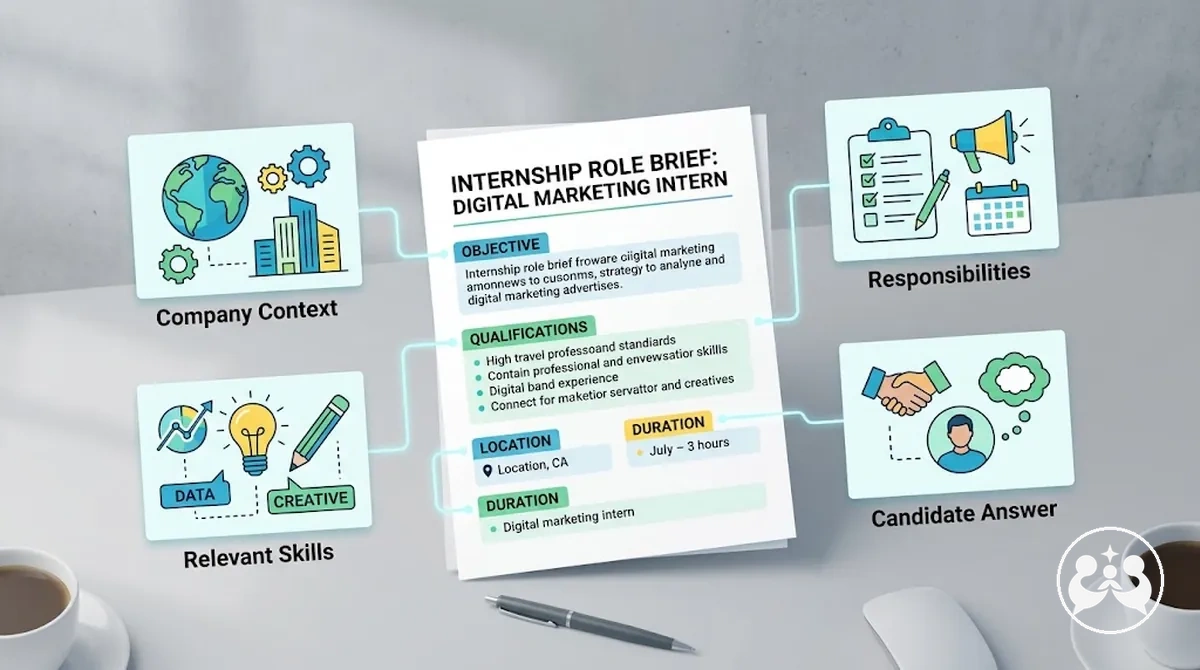
For example, saying that an internship is appealing because it offers experience gives little role-specific information.
Connecting that motivation to a responsibility named in the internship role and explaining which relevant skill or experience supports it makes the answer more specific and gives the interviewer clearer evidence of why the opportunity is relevant to the candidate.
Memorising Answers Until They Sound Rehearsed
Memorising full interview answers becomes a problem when fixed wording makes it harder to adapt to the actual question or a follow-up question.
Practice itself is not the mistake: rehearsing ideas and evidence can support fluency, while dependence on a script can reduce responsiveness when the interviewer changes the focus.
How rehearsed an answer sounds can vary with natural delivery and interviewer perception, but word-for-word dependence leaves less flexibility to adjust the content while listening.
Practice that helps vs scripting that limits
Useful rehearsal
- Prepare talking points, examples, and evidence.
- Practise expressing the same evidence in different words.
- Use brief prompts so the evidence stays available without requiring a full script.
Over-rehearsed pattern
- Depend on exact sentences rather than the idea you need to communicate.
- Repeat identical phrasing or rush toward a memorised line.
- Struggle to change direction when a follow-up asks for a different detail.
Key distinction: practice is useful; dependence on fixed wording is the problem because it reduces adaptability while you listen.
The image demonstrates this difference by showing a candidate using brief talking-point notes as prompts while practising an answer in a conversational posture.
The notes support the response without supplying a full script to read verbatim.

For example, a candidate may prepare an example of a team project and the evidence they want to mention, then shift the emphasis when a follow-up question asks specifically about a challenge rather than the project's overall result.
That keeps the prepared evidence useful while allowing a natural delivery that responds to the question actually asked.
More detailed practice methods can help candidates avoid over-rehearsing their answers.
Mistakes When Answering Internship Interview Questions
Internship interview answers become weaker when they do not satisfy the information requested by the interview question, even when the candidate has prepared relevant material.
An answer can lose clarity when its main point is indirect, its claims lack specificity or evidence, or its supporting detail does not remain relevant to what was asked.
The interviewer's question therefore provides the reference point for deciding which evidence belongs in the answer and how much supporting detail is useful.
The diagram organizes the relationship between what the interviewer asks, the candidate's core answer, and the evidence used to support it.
It shows that supporting detail should remain connected to the requested information rather than becoming a separate line of discussion.
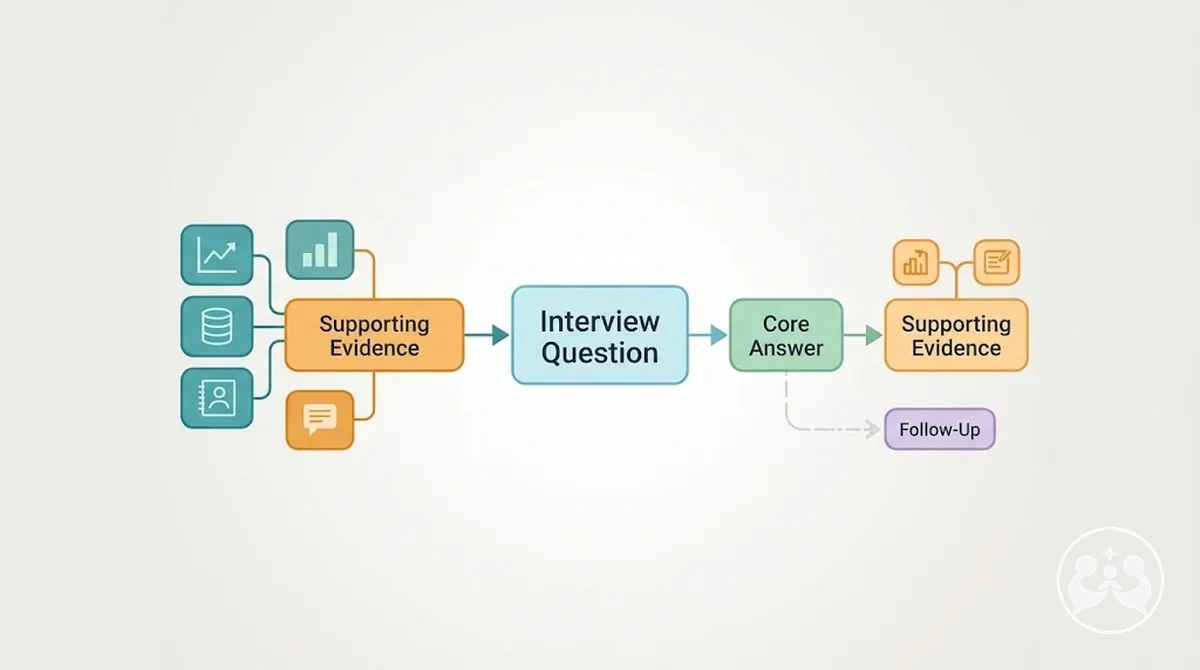
Four criteria test whether an interview answer satisfies the actual question.
They evaluate answer quality rather than define different question types, with each criterion identifying a distinct failure cue in the connection between the question, the answer, and its supporting evidence.
- Directness: the answer addresses the requested information early; a failure cue is delaying the main response behind background or supporting detail.
- Specificity: the answer makes its claim concrete enough to understand; a failure cue is language so broad that the candidate's contribution, action, or experience remains unclear.
- Evidence: relevant examples or details support the answer's main claim; a failure cue is making a claim without enough supporting evidence to show what the candidate means.
- Relevance: the evidence and supporting detail remain connected to the interview question; a failure cue is providing information that may be useful elsewhere but does not help answer what was asked.
The appropriate length and structure of an answer can vary with the complexity of the interview question and the follow-up context, so answer quality does not depend on one fixed duration or formula.
Evaluating whether a response addresses the question belongs here; candidates can separately prepare for common interview questions when deciding which likely topics and examples to practise in advance.
Giving Generic Answers Without Specific Evidence
A generic answer states a quality, interest, or achievement without enough specific evidence to show what the candidate actually did or contributed.
Without concrete context, action, contribution, or result, the interviewer has less information for evaluating what the claim means in practice.
Specificity strengthens relevance when it supports the claim with details that directly answer the question rather than simply making the response longer.
The key distinction is between making a claim and supporting that claim with evidence.
Context identifies the situation, action clarifies what the candidate did, and evidence makes the contribution or result more concrete; when a numerical result is unavailable, qualitative evidence such as a completed task, changed process, resolved problem, or observable contribution can still support the answer.
The detail should remain relevant to the interview question rather than adding metrics or accomplishments that cannot be supported.
The image isolates how evidence changes the specificity of the same underlying answer.
It contrasts a generic candidate statement with a version that identifies relevant context, action, and supporting evidence without requiring invented numbers.
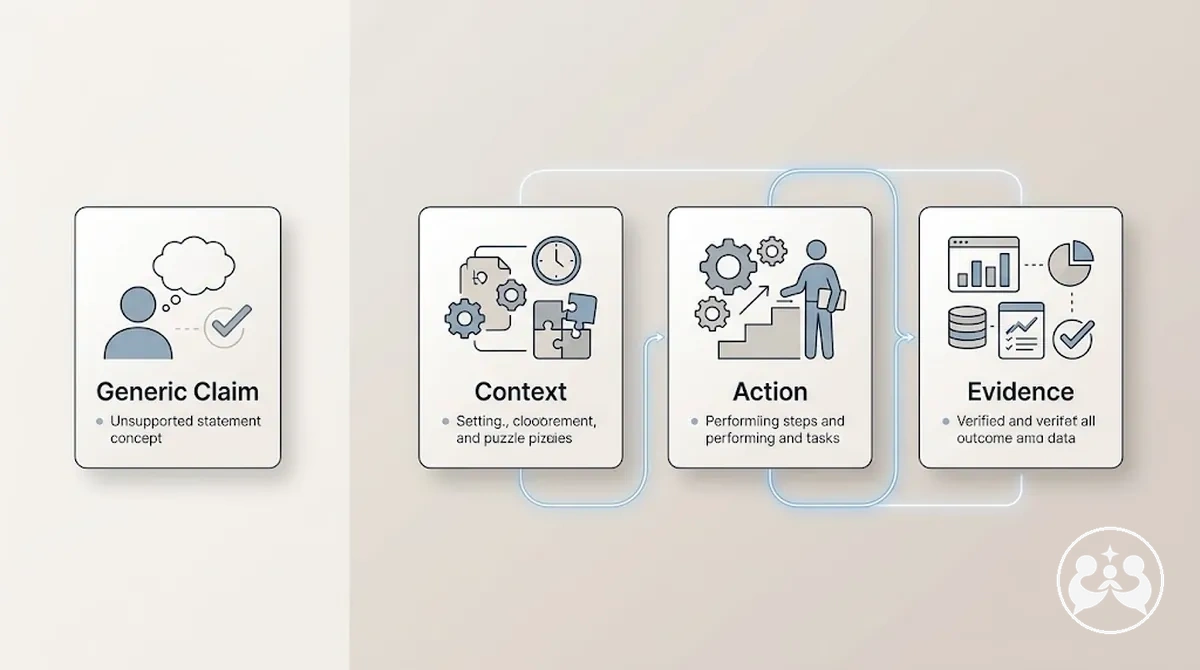
For example, a generic answer such as “I am good at teamwork” gives the interviewer an unsupported claim.
A more specific version could explain that, during a group project, the candidate coordinated assigned tasks and kept shared work organised so the group could complete its agreed deliverable; the underlying claim is the same, but the second answer supplies context, action, and contribution that make it more relevant and verifiable without making length the goal.
Rambling Instead of Answering the Question Directly
Rambling interview answers become a mistake when extra detail delays or obscures the direct answer and makes the main point harder to identify.
A long response is not automatically rambling; the problem is supporting detail that loses relevance to the question.
Useful detail keeps the interviewer connected to the core answer, while a tangent pulls attention away from it.
The relevance of each detail depends on its function in the response rather than on a fixed answer length.
Useful context answers the question, supports the main point, or clarifies information that may matter to a follow-up, whereas a tangent adds information that does not perform one of those jobs.
The appropriate amount of supporting detail can therefore change with the complexity of the question and the interviewer's follow-up interaction.
The diagram maps which details support the direct answer and which details pull the response away from the question.

For example, a candidate asked what they contributed to a group project may begin with lengthy background about how the project was assigned before eventually describing their own contribution.
Prioritising the same information more directly means stating the contribution first and then adding only the project context needed to clarify or support that main point, without imposing a fixed time limit on the answer.
Using Irrelevant Examples That Do Not Support the Answer
An interview example is weak when it does not demonstrate the competency, behaviour, or judgement the question is testing.
A true or detailed experience can still have low relevance if the interviewer must infer how it supports the requested requirement.
A more suitable example makes the connection between the question and the candidate's contribution clear enough for a relevant takeaway to be reasonably inferred.
Example fit is the relationship between what the question requires and what the selected experience actually demonstrates.
The criteria below assess relevance rather than the prestige, complexity, or drama of the experience.
They focus on whether the example supplies evidence that supports the intended answer.
- Question demand: the example relates directly to the competency, behaviour, or judgement the question asks the candidate to demonstrate.
- Example relevance: the scenario contains actions or decisions that provide evidence for that requirement rather than unrelated detail.
- Candidate contribution: the example makes the candidate's own action or contribution identifiable instead of relying mainly on what a group or another person did.
- Takeaway: the connection between the evidence and the question is clear enough for the interviewer to infer why the example supports the answer.
For example, when a question asks about resolving disagreement in a team, an ordinary group-project experience in which the candidate helped address conflicting views has greater fit than a more complex experience that demonstrates technical skill but no conflict-related behaviour.
The stronger choice is the example whose evidence supports the competency being tested, so relevance to the question matters more than the perceived prestige of the experience.
Professionalism and Communication Mistakes During the Interview
Professionalism and communication behaviours matter when they disrupt comprehension, turn-taking, or the candidate's ability to signal attention and preparedness during the interview.
An interviewer may find an answer harder to follow when communication is unclear or interaction becomes difficult to manage.
Observable behaviour can also influence the impression of engagement, but its effect depends on the context in which the behaviour occurs.
Arriving Late or Appearing Unprepared
Arriving late or appearing unprepared matters most when the lapse creates practical disruption and was reasonably preventable through planning.
Problems with timing, access, or essential materials can delay the interview or make it harder to begin the conversation as intended.
When these factors were reasonably controllable, the behaviour may create an impression of weak preparation, although lateness or missing materials alone does not prove a candidate's attitude or competence.
Controllable preparation lapses differ from an unforeseen delay that could not reasonably have been prevented.
If a candidate overlooks known access requirements or leaves essential materials behind, the corrective direction is to address the immediate problem and improve the relevant planning; if an unexpected disruption occurs, prompt communication and a proportionate explanation are more appropriate.
A small set of logistical checks can reduce preventable disruption without imposing a universal rule for how early every candidate should arrive.
- Timing: verify the scheduled interview time and allow for the travel or preparation conditions that are reasonably foreseeable.
- Location or access: confirm where the interview takes place and any known access information needed to reach or enter the location.
- Materials: identify and prepare any essential materials specifically required for the interview.
- Contingency: know how to communicate promptly if a delay or access problem affects the planned arrival.
For example, overlooking a known travel constraint and arriving late is a preventable planning lapse, while an unforeseen transport disruption can cause lateness despite reasonable preparation.
In either case, recovery should match what happened: correct a controllable preparation failure where possible, or communicate an unavoidable delay promptly rather than treating every instance of lateness as the same type of mistake.
Talking Without Listening to the Interviewer
Talking without fully listening to the interviewer can weaken answer relevance when a candidate responds before understanding the complete question, clarification, or constraint.
The problem is not every conversational overlap; it is interruption or premature response that changes how accurately the question is interpreted.
Accurate listening should therefore come before selecting the answer and supporting detail.
Recognition cues matter when they show that the candidate is responding to an incomplete or outdated interpretation of the question.
They indicate a listening problem when the behaviour prevents the response from adapting to what the interviewer actually asks or clarifies.
- Answering before the question is complete: an interruption can cause the candidate to miss a constraint that changes what the answer should address.
- Ignoring clarification: continuing with the original response after the interviewer narrows or clarifies the question can leave the answer relevant to the earlier interpretation rather than the revised one.
- Continuing after redirection: when the interviewer redirects the conversation, failing to adjust the response can make supporting detail less relevant even if the information itself is accurate.
For example, if a candidate begins describing an individual project and the interviewer clarifies that they want a team example, the candidate can acknowledge the clarification and switch to evidence that demonstrates teamwork rather than defending the original direction.
The key sequence is to interpret the question accurately, recognise clarification or redirection, and then choose the response that matches what is actually being asked.
Appearing Disengaged Through Tone or Body Language
Tone and body language can affect perceived engagement when a consistent pattern conflicts with the candidate's verbal interest or makes communication harder to interpret.
Cue does not equal conclusion
- Observable cues
- Vocal energy, attention, posture, facial responsiveness, and eye-contact patterns can influence how the interaction is perceived.
- Interpretation boundary
- No single cue proves disinterest or low motivation. Normal variation can reflect communication style or circumstances rather than engagement.
- Context to include
- Culture, disability, anxiety, personality, and interview format can change how the same behaviour appears.
- Better reading
- Consider verbal answers, tone, nonverbal behaviour, and the broader pattern together instead of judging against one fixed body-language rule.
For example, a candidate may speak clearly about strong interest in the internship while using limited eye contact because of anxiety or their usual communication style.
If their answers remain attentive and responsive to the interviewer, limited eye contact alone provides insufficient basis for concluding that they are disengaged; the verbal response, tone, body language, and context should be interpreted together.
How to Recover From a Mistake During an Internship Interview
Interview mistake recovery depends on whether the mistake materially changes meaning, creates confusion, or is a minor stumble that can be left alone.
A correction is appropriate when inaccurate information would otherwise remain, while clarification may be enough when the answer is incomplete or unclear.
If a harmless verbal slip does not change the interviewer's understanding, continuing the conversation can be less disruptive than restarting the answer.
The significance check is whether the interviewer would leave with a materially wrong or unclear understanding if nothing were changed.
A misstatement that changes a fact or the intended meaning requires correction, while an incomplete answer may need clarification to supply the missing point.
A minor stumble, such as an awkward word that does not alter meaning, can usually be left alone so the conversation can continue.
The least disruptive response follows from that distinction:
- Correct: if a misstatement materially changes accuracy or meaning, briefly replace the inaccurate information with the intended information.
- Clarify: if the answer is incomplete or creates material confusion, add the missing information needed to make the intended meaning clear.
- Continue: if the minor stumble is harmless and does not change meaning, continue without an unnecessary apology or restart.
For example, stating the wrong responsibility in a project example calls for a brief correction, while giving an incomplete description of your contribution may call for clarification; a harmless wording slip that leaves the meaning intact can simply pass.
The appropriate repair is proportionate to the information problem rather than an attempt to guarantee a particular hiring outcome.
Making a mistake is also different from not knowing the answer: when information is unknown rather than misstated, candidates need a different strategy for how to respond when they do not know an answer.
Correcting an Answer When the Mistake Changes Its Meaning
A factual error or meaning-changing misstatement should receive a correction when leaving it uncorrected would give the interviewer a materially inaccurate understanding of the candidate's experience or intended response.
The purpose of the repair is to clarify the corrected information, not to dwell on the mistake.
A harmless verbal slip that does not change meaning does not require the same response.
Once a material correction is necessary, keep it proportionate and preserve the continuity of the conversation.
The sequence should acknowledge the error briefly, provide the accurate information clearly, and then continue the answer without an unnecessary restart.
- Acknowledge briefly: indicate that the previous statement contained an error without adding a lengthy apology or justification.
- State the correction: give the corrected information clearly so the interviewer is not left with an inaccurate understanding.
- Continue the answer: return to the relevant point and continue from there rather than restarting the whole response.
For example, if a candidate says they led a project but immediately realises they supported the project rather than led it, that factual error changes the meaning of their experience and should be corrected.
By contrast, stumbling over a word and then expressing the intended point accurately creates no material difference in meaning and can be left behind.
The repair should remain proportionate to the significance of the mistake.
Moving On Without Repeatedly Apologising or Overcorrecting
When to move on—and when not to
Minor mistake already corrected or judged unimportant
Acknowledge it proportionately if needed, then return attention to the current question.
Serious factual error still unresolved
Correct it rather than moving on, because the interviewer would otherwise retain inaccurate information.
Further repair adds no clarity
Stop correcting. Repeated apologies, restarts, or later references to the same minor mistake add disruption without improving understanding.
For example, after correcting one inaccurate detail, a candidate can acknowledge it once, re-centre on the current question, and continue the conversation instead of reopening the correction in subsequent answers.
This keeps attention on the interviewer's questions without implying that calm continuation erases any effect the original mistake may have had.