
Answering Strengths and Weaknesses in an Internship Interview
A strong internship interview answer uses one role-relevant, truthful strength backed by a specific example and one genuine weakness that does not undermine a core role requirement, followed by the concrete action you are already taking to improve it. For both answers, keep the claim specific, use evidence from your actual experience, and connect the takeaway to the internship rather than reciting a generic script.

Interview answer framework
Build both answers from role fit, evidence and honest reflection
Use the strength track to prove a capability the internship needs. Use the weakness track to show a real development area, its practical effect and improvement already underway.
Strength answer
- Select: choose one truthful strength linked to a stated task, behaviour or learning demand of the internship.
- Prove: give one specific situation and describe what you actually did.
- Substantiate: state a result or feedback you can support, giving shared outcomes shared credit.
- Connect: explain how that demonstrated capability could help with the role.
Weakness answer
- Select: choose one genuine limitation that does not directly conflict with a core requirement.
- Show the effect: use a concise example of how the weakness affected your behaviour, work or participation.
- Show action: explain a corrective step you have already started, such as practice, feedback or a changed routine.
- State progress: describe the change you have actually observed while acknowledging any remaining limitation.
Decision rule: keep an answer only when it is truthful, specific, relevant to the internship and supportable from your own experience.
Table of Contents
How to Choose a Relevant Strength for the Internship
Choose a relevant strength by checking its role relevance, authenticity, specificity, and whether you can support it with a specific example before considering how impressive it sounds.
The interview strength should match a real requirement of the internship role and be something you can support with a truthful example from your experience.
Use these criteria to filter possible strengths by interview usefulness rather than popularity.
Role fit tests whether the strength matters to the internship, while proof tests whether you can demonstrate it with specific evidence.

- Role relevance: Keep a strength when it matches a requirement, task, or capability that matters to the internship role; otherwise, its relevance is limited.
- Evidence: Prefer a strength you can support with a real example of your behaviour, action, or result rather than an unsupported positive label.
- Specificity: Choose a strength precise enough to show what you actually do, so the interviewer can connect the quality to the internship requirement.
- Authenticity: Use a strength that reflects your truthful experience and that you can discuss consistently when asked for evidence or an example.
For example, organisation may be relevant to an internship that requires coordinating several tasks or deadlines, but less relevant to a different internship if the stated requirements emphasise another capability.
The deciding question is whether the strength supports an identifiable requirement of the internship role and whether you have evidence to demonstrate it.
Match the Strength to What the Internship Requires
A strength is relevant when it connects to an actual task, behaviour, or learning demand of the internship.
Compare the strength with a specific internship requirement and identify the contribution that capability could support, including when the strength is a transferable skill such as communication, teamwork, adaptability, organisation, or problem solving.
Relevance depends on what the internship actually asks the candidate to do.
The comparison below shows how the same strength can support different role needs to different degrees.

- Internship context 1: Organisation could be relevant when the internship requirement involves coordinating several tasks or deadlines, because the strength could contribute to keeping that work structured.
- Internship context 2: The same strength may have less relevance when the internship requirement centres on a different capability, such as frequent team communication, because organisation does not directly demonstrate that role need.
The same strength can therefore have different interview value across internships: its relevance depends on the connection between the strength, the specific requirement, and the contribution it could support.
Choose a Strength You Can Support With a Specific Example
Choose a strength only if you can show where you used it.
A specific example should connect the strength to real behaviour and an observable result or credible feedback, so the candidate's student experience provides evidence for the claim rather than leaving it as an unsupported adjective.
The image traces this relationship from a claimed strength to behaviour and supporting evidence.
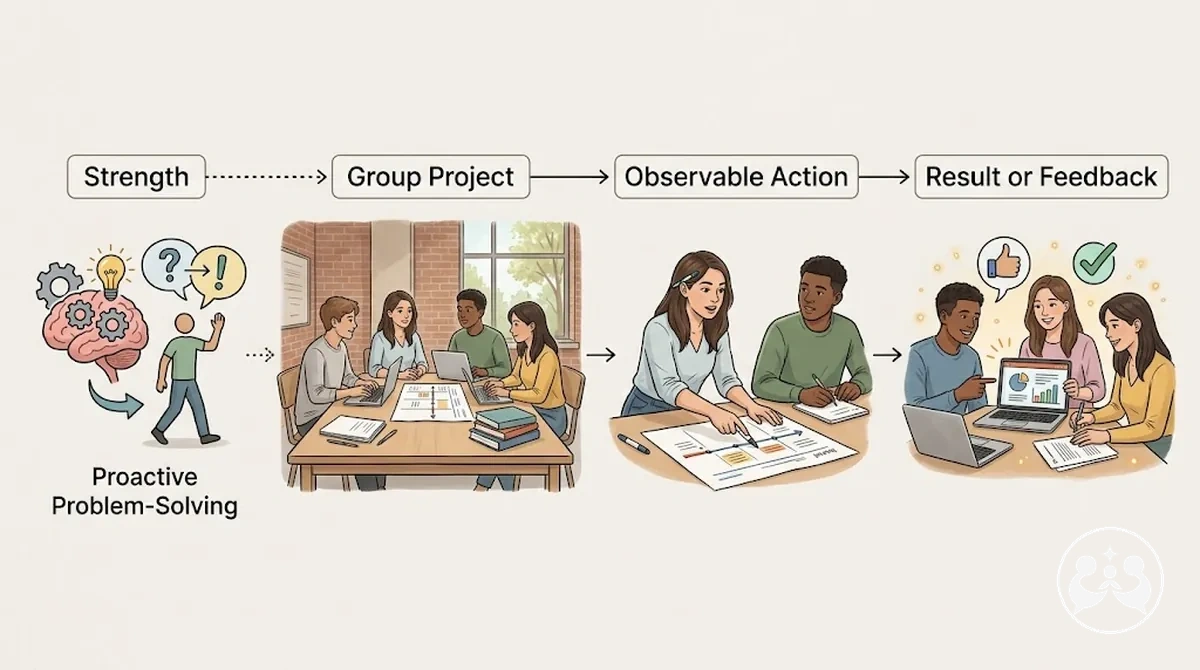
Evidence can come from coursework, projects, volunteering, extracurricular activity, part-time work, or previous internships; paid work is not required.
Academic experience can demonstrate a strength through behaviour in coursework or a project, while practical experience can provide evidence through volunteering, extracurricular activity, or work.
Use only a result or feedback you can substantiate, and describe shared outcomes as shared when other people contributed.
At this stage, select evidence that supports the strength rather than structuring the complete interview answer.
How to Build Your Strength Answer
Build the strength answer as a short evidence chain: name one relevant strength, show it through a specific situation and action, state an outcome or credible feedback, and connect that evidence to the internship.
The example can come from study, volunteering, clubs, part-time work or previous practical experience; what matters is that it is truthful and demonstrates the capability you claim.
- Name the strength. Choose one capability that matters to the role.
- Show the behaviour. Give one specific situation and explain what you did.
- Give the evidence. State a result or feedback you can substantiate, describing shared outcomes accurately.
- Connect it to the role. Explain how the demonstrated capability could support a stated internship task or team need.
State the Strength Clearly and Specifically
Name one strength at the start of your answer using plain language and specific wording.
A clear strength statement gives the interviewer clarity about the behaviour behind the capability instead of stacking several vague traits together.
The image shows how specificity changes the meaning of a strength statement.
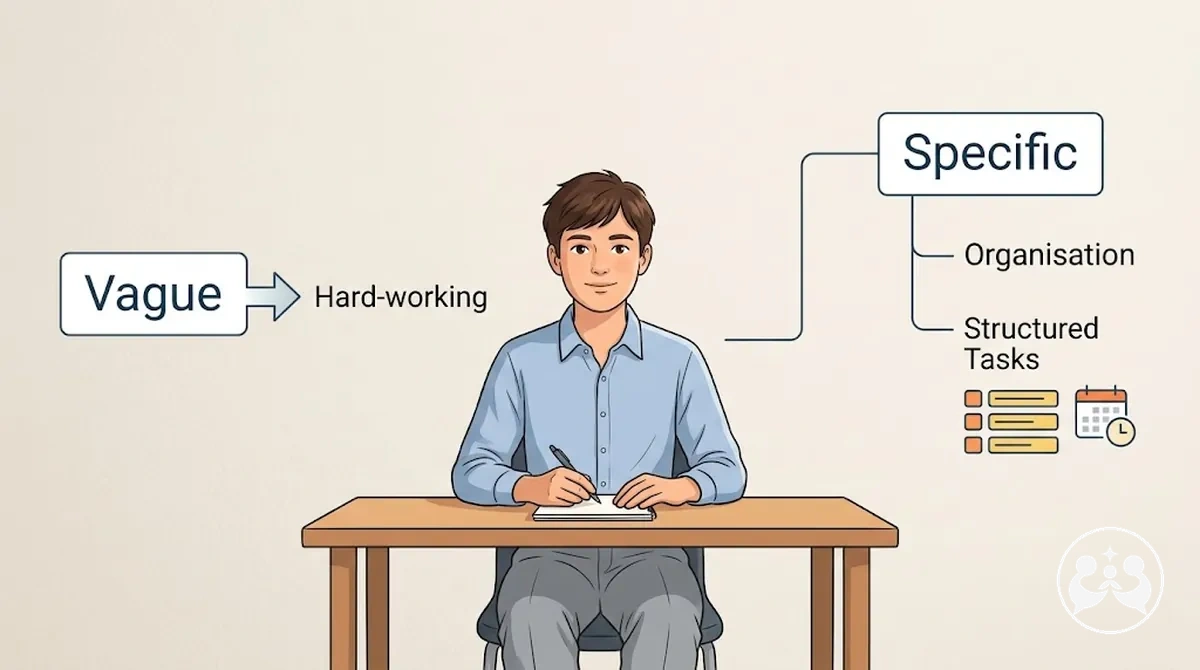
Vague
“I am hard-working.”
It names a positive trait but does not show the behaviour behind it.
Specific
“One strength is organisation: I keep tasks and deadlines structured when I have several priorities to manage.”
It identifies both the capability and the behaviour the interviewer can evaluate.
Support the Strength With a Specific Example and Outcome
Support the strength with a specific situation that shows what you did and what happened, rather than simply restating the strength.
The evidence should make your action and observable behaviour clear, then identify a result or feedback you can substantiate.
The image shows how the situation, action, and outcome connect back to the claimed strength.
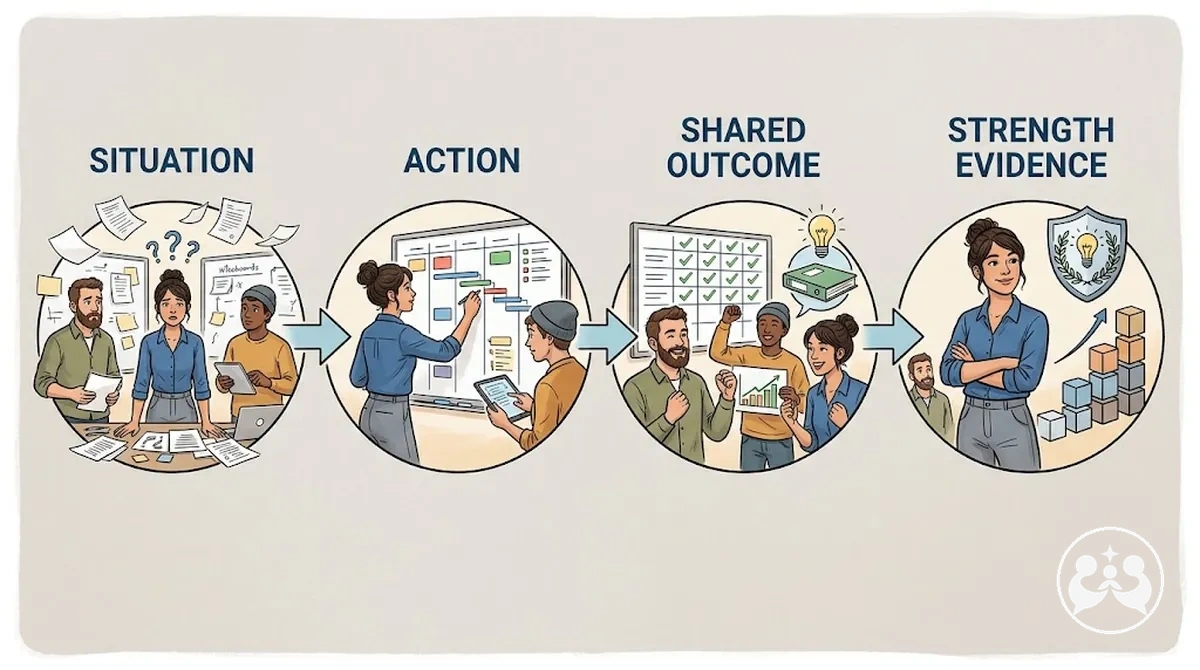
- Situation
- A group project involved several tasks and deadlines.
- Action
- I organised the work into a shared schedule and checked progress with the team as deadlines approached.
- Outcome
- The group completed the required tasks on time.
- What the example supports
- The behaviour provides evidence for organisation. Because the outcome was shared, describe it as a team result rather than claiming sole credit.
Connect the Strength Back to the Internship Role
Close the answer by connecting the demonstrated strength to a task or team need in the internship role.
This makes the relevance explicit by showing how the capability could support a practical contribution, provided that the connection reflects what the actual role requires.
For a fuller response framework, see how to structure a clear interview answer.
How to Choose a Credible Weakness for the Interview
Choose a genuine weakness that does not directly undermine a core requirement of the internship role and that you are actively working to improve.
The weakness should be truthful enough to support credibility while giving you a clear improvement action and evidence of progress.
Suitability depends on both truthfulness and role risk: evaluate the weakness against the actual internship requirements, then consider whether you can explain what you are doing about it.
- Genuine: Use a real limitation or development area that you can discuss honestly; authenticity supports credibility and self-awareness.
- Non-core to the role: Check whether the weakness directly conflicts with a core requirement of the internship role. A weakness may be risky when it would substantially affect a capability the role specifically requires.
- Actively improving: Choose a weakness for which you can describe a current improvement action and credible evidence of progress, showing that the limitation is being improved rather than merely acknowledged.
For example, difficulty speaking up in large groups may be suitable when large-group presentation is not a core requirement and the candidate is actively practising participation, but the same weakness may carry greater role risk when frequent presentations are central to the internship.
Judge each weakness by two conditions: whether it conflicts with an essential duty of the internship and whether you can show a concrete improvement action already in use.
Choose a Genuine Weakness, Not a Disguised Strength
A genuine weakness is a real limitation with an observable effect, while a disguised strength presents a positive trait as a flaw without identifying a meaningful limitation.
The comparison tests whether the answer names a real development area rather than simply making a positive quality sound negative.
Disguised strength
“I work too hard.”
When it identifies no real limitation or consequence, the answer is evasive rather than informative.
Genuine weakness
“I sometimes hesitate to speak up in group discussions, so I am practising contributing earlier.”
This identifies an observable effect and an improvement action already underway.
A common phrase is not automatically unsuitable; credibility depends on whether it truthfully describes a limitation, its effect, and how it is being improved.
Avoid Weaknesses That Undermine a Core Internship Requirement
A weakness may create significant role risk when it directly conflicts with a core requirement or essential duty of the internship role.
Its suitability therefore depends on which requirement the weakness affects and how important that requirement is to the work.
The same weakness can carry different risk across internships, so distinguish a core requirement from a secondary or trainable skill before deciding whether the weakness is suitable to discuss.
- Core requirement: A weakness is less suitable when it may undermine an essential duty that the internship specifically requires, particularly when that capability is central to performing the role.
- Secondary or trainable requirement: A weakness may present less role risk when it affects a secondary or trainable skill rather than an essential responsibility, depending on the actual tasks and context of the internship.
For example, difficulty speaking confidently to large groups may conflict with a core requirement in an internship centred on frequent presentations, while the same weakness may have limited relevance in a role where presenting is only an occasional, trainable task.
The role requirement determines the risk implication rather than the weakness label alone.
Choose a Weakness You Are Actively Improving
Choose a weakness for which improvement is already underway rather than something you only intend to address later.
A credible improvement action should be concrete enough to show that you have started changing how you respond to the limitation.
That action may involve repeated practice, seeking feedback, or changing a routine, with progress described only to the extent your actual experience supports it.
A remaining limitation can still exist while you are becoming more consistent through continued practice.
Intention only
“I plan to get better at speaking up.”
This describes a future intention but gives no evidence that improvement has started.
Active improvement
“I have been contributing earlier in group discussions and using feedback to improve, although I still sometimes hesitate.”
This shows action already underway while keeping the remaining limitation visible.
The distinction is demonstrated improvement rather than a promise of future change.
How to Build Your Weakness Answer
Build a weakness answer in a clear sequence: name the weakness, illustrate a concise situation and its effect, explain the corrective action you have taken, and state your current progress.
This progression keeps the response focused on what the limitation affects and what you are doing to improve it.
The sequence should demonstrate self-awareness and accountability rather than defend the weakness.
Keep the effect and degree of progress accurate to your experience, and describe learning through actions you have actually taken.
The ordered steps prevent the response from stopping at the weakness itself.
- Name the weakness: State the limitation directly and specifically. Check that the wording describes the actual weakness without minimising or overstating it.
- Illustrate the situation: Give a concise context in which the weakness became relevant. Include only enough detail to make the situation understandable.
- Explain the effect: Describe how the weakness affected your behaviour, work, or participation in that situation. Keep the consequence proportionate to what actually happened.
- Describe the corrective action: Explain the practice, feedback, changed routine, or other action you have used to address the weakness. Check that the action is something you have already started rather than only intend to do.
- State your progress: Describe what has changed so far while acknowledging any remaining limitation. Claim only the degree of progress that your experience can support.
Use this sequence as a model for organising the response, but express each part naturally in your own wording.
State the Weakness Honestly and Briefly
Name one genuine weakness directly and keep the brief statement clear and honest before explaining it further.
Prefer a professional limitation or skill-related development area that is relevant to the role without unnecessarily disclosing personal information or contradicting an essential internship requirement.
Explain a Specific Situation and How the Weakness Affected You
Use one specific situation to show how the weakness manifested in your behaviour or work and what practical effect followed.
Keep the context concise so the connection between the weakness, its manifestation, and the consequence remains clear.
The example should reveal the weakness's effect without becoming a long failure story.
- Situation
- During a group coursework project, I hesitated to raise a concern during an early team discussion while the task was being organised.
- Practical effect
- My perspective came later than it could have, which made my hesitation visible through its effect on participation.
- Boundary
- Keep the consequence proportionate to what actually happened, then move to the corrective action you took.
Show the Actions You Are Taking and the Progress You Have Made
Describe the concrete corrective action you are taking to manage the weakness, then show what has changed without implying that the limitation has disappeared.
- Corrective action
- Name a practice, feedback loop, changed routine or other action you have actually started and used more than as a future intention.
- Observed progress
- Describe only the change you have genuinely noticed, such as greater consistency or fewer recurring difficulties.
- Remaining limitation
- Acknowledge what still needs improvement so the degree of progress remains credible and proportionate to your experience.
The improvement evidence is strongest when the action, observed change and remaining limitation all refer to the same development area.
Strength and Weakness Examples for Internship Candidates
Use each strength example or weakness example as an idea generator rather than a script.
Before adaptation, an example must fit the internship context, reflect truthful experience, and remain appropriate for the role, with relevant evidence for a strength and credible improvement for a weakness.
A strength example is suitable when role relevance is clear and the candidate can support the claimed contribution with evidence from actual experience.
A weakness example is suitable when the limitation does not undermine a core role requirement and the candidate can demonstrate genuine improvement or progress.
Adaptation should therefore reflect the candidate's own experience and the requirements of the specific internship.
Strength Examples Relevant to Internship Work
Useful internship-relevant strengths are capabilities you can demonstrate with evidence and connect to a genuine need of the internship role.
Communication, teamwork, adaptability, organisation, problem solving, attention to detail, and initiative can each be relevant when your actual behaviour supports the strength and the role provides a meaningful contribution for it.
Evidence can come from truthful experience in coursework, projects, clubs, volunteering, part-time work, or prior practical experience.
The context does not need to be paid employment, but it should show observable behaviour that demonstrates the strength.
The examples below are patterns to adapt to your own experience and internship context, not scripts, and their order does not imply importance.
- Communication: Explaining part of a coursework project clearly to classmates can demonstrate communication that may support an internship role involving information sharing or team discussions.
- Teamwork: Coordinating responsibilities with other members of a club or group project can provide evidence of collaboration that may support work requiring shared tasks.
- Adaptability: Adjusting your approach after feedback during volunteering or practical experience can show adaptability and learning ability when an internship involves changing tasks or new information.
- Organisation: Prioritising coursework alongside part-time work and meeting your actual deadlines can demonstrate organisation that may support an internship involving several concurrent tasks.
- Problem solving: Identifying an obstacle in a project and testing a workable response can provide evidence of problem solving when the internship involves resolving task-level issues.
- Attention to detail: Checking a coursework submission or practical task against its requirements before completion can demonstrate attention to detail where accuracy is relevant to the internship role.
- Initiative: Taking responsibility for an appropriate task during volunteering or a club activity without needing repeated prompting can show initiative when the internship allows interns to contribute proactively.
Weakness Examples That Allow Credible Improvement
A usable interview weakness is a genuine limitation that can be improved and does not directly conflict with a core role requirement of the internship.
Examples such as public speaking, difficulty delegating, disorganisation, reluctance around asking for help, overthinking, or procrastination are suitable only when they reflect the candidate's truthful experience and the specific internship context.
The weakness label alone provides limited evidence of development; the improvement action and credible progress show what the candidate is doing about its possible work effect.
The examples below demonstrate that improvement logic rather than universally acceptable answers, with each option remaining conditional on the internship's role requirements.
- Public speaking: Discomfort with presentations may affect confidence when addressing larger groups; regular presentation practice can support progress, but this weakness requires caution if frequent public speaking is a core role requirement.
- Delegating: Difficulty delegating may lead a candidate to retain too much responsibility; deliberately sharing appropriate tasks during teamwork can build delegation skills, but suitability depends on whether independent delegation is already essential to the internship role.
- Disorganisation: Disorganisation may affect prioritisation or deadlines; using a planning system to organise tasks and review priorities can show progress when greater consistency is genuinely observed, but it may be unsuitable where strong organisation is an essential requirement from the outset.
- Asking for help: Reluctance around asking for help may delay communication when support is needed; practising earlier questions and seeking appropriate support can improve this behaviour, provided the internship does not require immediate independent judgement in the affected situations.
- Overthinking: Overthinking may slow decisions on routine tasks; setting clearer decision points and acting once sufficient information is available can support progress, but the example requires caution where timely decision-making is a core role requirement.
- Procrastination: Procrastination may delay starting tasks; breaking work into earlier milestones and beginning with a defined first action can improve consistency, but this weakness may conflict with an internship where independent deadline management is an essential duty.
Check That Your Answers Are Relevant, Specific, and Credible
Before practice, verify that each prepared answer is relevant to the internship role, specific, supported by evidence, credible, concise, and clear about improvement where a weakness is involved.
The final check should also confirm that the wording can support natural delivery rather than requiring memorisation.
Use the checklist to verify whether each answer is ready to practise, not to judge the candidate.
Each item tests one condition that determines whether the answer should be retained or revised.
- Role relevance: Does the answer connect the strength or weakness to an actual requirement, contribution, or condition of the internship role?
- Specificity: Is the answer specific enough to make the claimed strength or weakness and its practical effect clear?
- Evidence: Does the answer use a real example or observable behaviour that supports the claim?
- Credibility: Are the example, result, feedback, or progress described realistically without exaggerating the candidate's contribution?
- Concision: Does the answer communicate the necessary context, action, and implication without unnecessary detail or repetition?
- Improvement action: For a weakness, does the answer identify a corrective action that has actually been started and credible progress where applicable?
- Natural delivery: Can the main ideas be expressed naturally in the candidate's own words without depending on memorised wording?
If an answer does not meet one of these checks, revise the affected part rather than treating the checklist as a score.
Once the content itself is verified, the next step is learning how to practise without memorising a script.
Verified answers provide a clearer basis for natural practice, while the wider interview still requires preparation beyond strengths and weaknesses.
Reconnect these answers with the broader process used to prepare for an internship interview.